
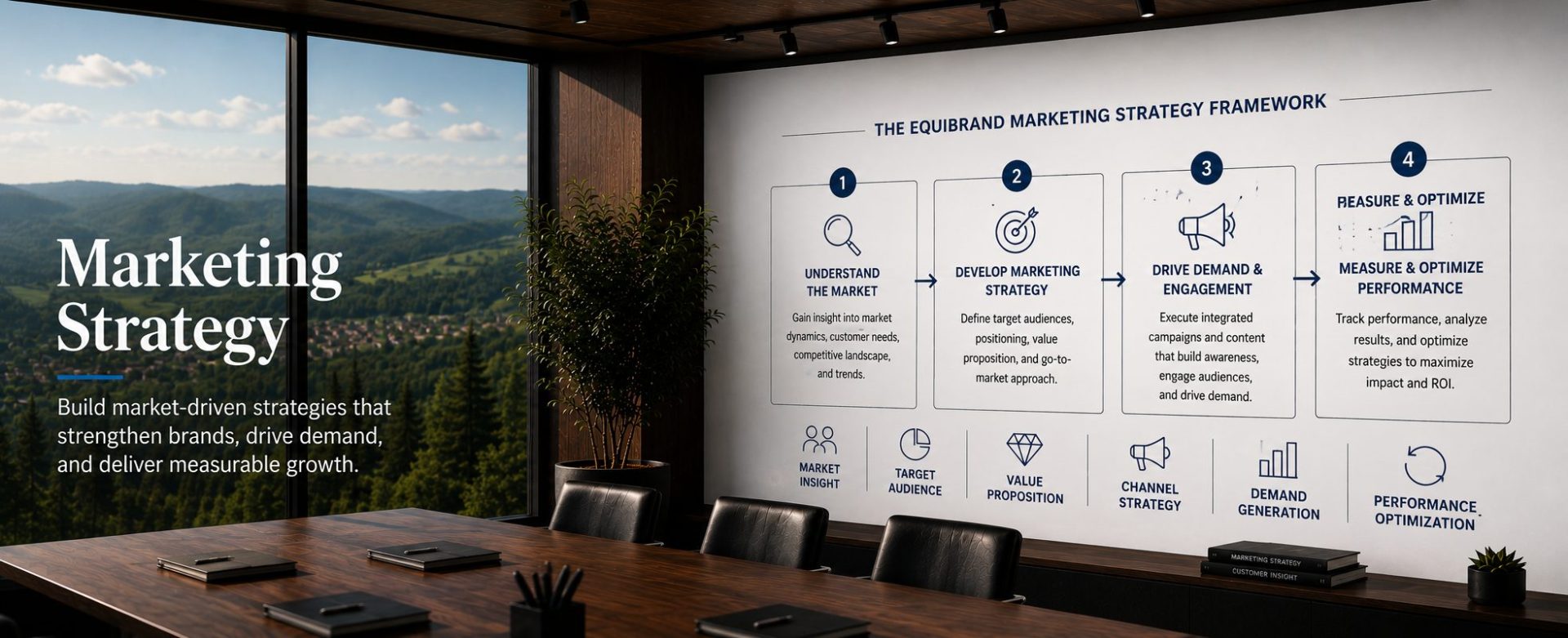
Marketing Strategy Consulting
Marketing strategy consulting helps organizations make four fundamental decisions:
- Where to play — which customers, markets, and opportunities deserve focus
- How to win — how to create distinctive value and compete effectively
- Where to grow — where the opportunities to innovate and expand exist
- Enabling execution — what organizational clarity and alignment makes strategy work
Everything else — customer insight, positioning, brand architecture, value proposition, innovation, and go-to-market strategy — supports those decisions.
EquiBrand helps senior leadership teams work through these questions systematically, combining customer research, competitive analysis, and cross-functional alignment to create marketing strategies that drive sustainable growth.
Our marketing strategy services span customer segmentation, positioning, portfolio and brand architecture, innovation, and go-to-market — delivered as a single connected engagement rather than a series of separate projects.
Marketing Strategy Is a System, Not a Series of Independent Projects
Most organizations treat marketing strategy as a collection of separate initiatives: a segmentation project here, a positioning engagement there, an innovation sprint, a rebrand, a go-to-market plan.
The problem is that these decisions are interdependent. Where you play determines what positioning is possible. Positioning determines which growth opportunities fit your brand. Brand architecture determines how growth investments are organized. Go-to-market determines whether any of it reaches the right customers with the right message.
When these decisions are made in isolation — by different teams, at different times, without a shared strategic framework — the result is a portfolio of disconnected work that rarely adds up to a coherent strategy.
EquiBrand's approach integrates these disciplines into a unified decision-making system built around four strategic questions. Because each decision informs the next, the strategies that result are more coherent, more actionable, and more durable over time.
The Four Strategic Questions
Where to Play
Identify the customers, markets, and growth opportunities that deserve focus
The challenge: Many organizations spread resources too broadly because they lack clear priorities. Marketing teams chase every opportunity. Sales pursues every lead. Innovation pursues every idea. The result is fragmented focus, diluted positioning, and slower growth, even though 70% of companies using segmentation see improved market positioning.
The strategic questions: Which customers actually create value — and what do they need, and how clearly have you defined your target market through demographics, psychographics, and buying behavior? Which markets are growing, and where is competitive intensity lower but customer need is high? Given where you want to compete, does your current portfolio serve those customers, or are there gaps and misalignments?
How EquiBrand helps:
- Customer Insights & Analytics — Understand what customers actually need and value
- Segmentation — Use customer segmentation to identify high-value customer groups and market opportunities, while refining customer personas so messaging resonates with target audiences
- Portfolio Strategy — Clarify which offerings serve your strategic priorities
How to Win
Define why customers choose you and how you compete
The challenge: Deciding where to play is necessary but not sufficient. Once you know which markets and customers deserve focus, you have to define how you will win in those spaces — what makes your brand distinctly valuable, and why customers should choose you over alternatives. Trust is part of that equation: 80% of consumers buy from brands they trust.
The strategic questions: What do you actually deliver that customers value — not what you think you deliver, but what customers believe you deliver, and what does deep audience research reveal about the distinctive messaging that will make that value clear? What distinctive space do you occupy in their minds? How should your brands and offerings be organized so customers understand them and you can deliver value effectively?
How EquiBrand helps:
- Brand Positioning — Define how you compete and differentiate
- Value Proposition — Clarify the value you deliver
- Brand Strategy — Structure brands for clarity, differentiation, growth, and a stronger brand identity
- Brand Architecture — Organize brands and portfolio for leverage
How Might We
Explore growth and innovation aligned with your positioning and customer needs
The challenge: Without strategic clarity, innovation becomes scattered. Companies launch products disconnected from positioning, pursue acquisitions that don't fit strategy, and extend brands beyond where they can credibly compete. Investment gets spread across opportunities that individually look interesting but collectively dilute focus.
The strategic questions: Do new opportunities serve your target customers? Do they fit your positioning? Do they advance your growth objectives? EquiBrand uses "How Might We" questions during innovation work to evaluate opportunities through three lenses: Do they reflect customer needs and strengthen customer engagement? Do they fit your brand and positioning? Do they advance your strategic priorities?
Mapping and optimizing customer journeys improves strategy quality and can boost conversions.
How EquiBrand helps:
- Strategic Integration — Ensure innovation is grounded in customer insight, positioning clarity, and strategic priorities
- Growth & Innovation Strategy — Identify growth opportunities aligned with your positioning and capability
What Would Have To Be True
Ensure organizational alignment and decision-making discipline
The challenge: Strategy doesn't create value by itself. It creates value when it's clearly communicated, when teams understand it, when it guides decision-making, and when it's integrated across the organization. Most strategy failures are not strategy failures — they are alignment failures.
The strategic questions: We ask, "What would have to be true for this strategy to succeed?" Can leadership explain the strategy in clear language? Do customer insight, brand decisions, and innovation efforts inform each other — or are they siloed? When strategic questions arise, can the organization answer them against a shared standard?
How EquiBrand helps:
- Strategic Integration — Create processes and alignment that ensure strategy guides execution
- Growth Assessment — Evaluate where strategy is clear and where gaps exist
Marketing Strategy Services
The four questions above define the work. Below is how it is delivered. Each of these is a marketing strategy service in its own right, and most engagements combine three or four — sequenced so that each decision informs the next.
Customer segmentation and insight
Primary research, segmentation modeling, and persona development that establish which customers actually create value and what they need. This is where most engagements begin, because every downstream decision depends on it.
Segmentation · Customer Insights & Analytics
Brand positioning, value proposition, and brand identity
Defining the distinctive space you occupy, articulating in customers' language why they should choose you, and ensuring the brand identity expresses that position consistently. Positioning is the hinge between market selection and everything that reaches the customer.
Brand Positioning · Value Proposition
Portfolio and brand architecture strategy
Structuring brands, sub-brands, and offerings so customers understand what you sell and the organization knows where to invest. Fragmented portfolios are one of the most common reasons growth stalls despite strong execution.
Brand Architecture · Portfolio Strategy
Growth and innovation strategy
Identifying and prioritizing where to expand — new products, adjacent segments, category extensions — against the filter of whether the opportunity fits your positioning and serves your target customers.
Growth & Innovation Strategy · New Product Strategy
Go-to-market strategy and commercial planning
Translating strategic choices into channel, messaging, and sales alignment so the strategy reaches the market as intended.
Go-to-Market Strategy · Strategic Integration
Marketing strategy audit and diagnostic
For organizations that want to understand where strategy is clear and where the gaps are before committing to a full engagement.
Growth Assessment · Marketing Strategy Audit
Why Marketing Strategy Matters
Most marketing problems are not execution problems. They are strategy problems.
When growth slows, when differentiation weakens, when marketing investments don't generate expected returns — the issue usually lies upstream: unclear choices about where to compete, how to differentiate, and which opportunities to pursue.
Execution cannot compensate for unclear positioning, undifferentiated value, or misaligned targeting. The most important marketing decisions are made before a campaign brief is written, before a product is launched, before a sales team is trained. Strategy determines whether those downstream investments have a foundation that can hold.
Where marketing investments break down
Marketing investments fail for structurally predictable reasons, and almost none of them are execution quality. Spend is directed at segments that were never validated. Messaging is built on a position competitors could claim equally well. Budget is split across a portfolio no one has rationalized. Campaigns are measured against goals that were never tied to a strategic choice. In each case the money is spent competently on a decision that was never properly made.
Strategic Marketing Consulting vs. Marketing Execution
The distinction matters because the two are often sold together and are rarely the same work.
Strategic marketing consulting focuses on the upstream decisions that determine where to compete, how to differentiate, and which opportunities to pursue. The output is a set of decisions and the evidence behind them: segmentation, positioning, portfolio structure, growth priorities. It is research-led, senior-led, and time-boxed.
Marketing execution is the downstream work of activating strategy in market — campaigns, content, media, digital programs, and sales enablement. The output is programs running. It is ongoing and capacity-driven, and best handled by agencies or in-house teams with the volume to do it well.
Most marketing problems that appear to be execution problems are actually strategy problems. Execution cannot compensate for unclear positioning, undifferentiated value, or misaligned targeting.
How marketing consulting differs from a marketing agency
A strategic marketing consultant is not a fractional marketing department and should not be engaged as one. The value is in the quality of a small number of decisions, not in throughput. Organizations that conflate the two typically end up paying strategy rates for execution work, or asking an execution partner to make choices it has no research basis to make. Marketing consulting that also sells media, creative, or technology implementation carries a structural incentive toward strategies that require a lot of downstream activity.
Aligning marketing and sales functions
Strategy only holds when marketing and sales functions are working from the same definition of the target customer and the same articulation of value. When they are not, marketing optimizes for volume and sales optimizes for close rate, and the two quietly select for different buyers. Cross-functional alignment work — shared segment definitions, a common value proposition, and agreed qualification criteria — is part of every EquiBrand engagement rather than a follow-on project.
For a fuller comparison, see brand consulting vs. marketing consulting.
When Organizations Engage EquiBrand for Marketing Strategy Consulting Services
Organizations typically work with EquiBrand when:
- Growth has stalled despite strong execution
- Customer segments are unclear or poorly prioritized
- Differentiation is weak or unconvincing in the market
- Brand portfolios have become fragmented or confusing
- Marketing, sales, and customer experience efforts feel disconnected
- The marketing department lacks clear strategic direction or measurable marketing goals
- Leadership teams lack alignment on growth direction
- Strategic decisions are made without sufficient customer insight
- The organization needs to answer the four strategic questions with clarity and discipline
These situations often reflect upstream strategy gaps rather than downstream execution failures. Unclear goals typically show up when objectives are not measurable or not supported by key performance indicators.
If several of these are familiar, a growth assessment is usually the right starting point — it identifies which gap is the binding constraint before a full engagement is scoped.
What to Look For in a Marketing Strategy Consulting Firm
Marketing consulting firms differ more than their websites suggest. Five things are worth checking before you engage anyone.
Integrated strategic thinking
Most consulting firms specialize in one discipline — brand strategy, innovation, customer research, or go-to-market planning. EquiBrand integrates these disciplines into a unified decision-making system built around four strategic questions, with specialized support that can also span digital transformation and market research. Because each decision informs the next, the strategies that result are more coherent, more actionable, and more durable over time.
Research-driven, not aspirational
Every engagement begins with structured discovery: customer interviews, stakeholder interviews, competitive analysis, segmentation work, and supporting data. Strategy built on internal assumptions consistently underperforms. We validate strategic direction with real buyer evidence — understanding what customers actually value, not what leadership assumes they value.
Senior engagement throughout
Every project is led directly by a senior consultant from discovery through final recommendations, bringing the judgment required for high-stakes strategic decisions. Unlike most consultants and many agencies, we do not pass core strategic work to junior teams. Clients work with the same person at every stage.
Proven across sectors
EquiBrand has developed marketing strategies for Fortune 500 companies, mid-market leaders, and growth-stage organizations across consumer products, energy, automotive, financial services, technology, professional services, healthcare, life sciences, and retail. This breadth helps tailor strategy to specific industries and keeps organizations current with changing market trends. The competitive dynamics differ by sector; the methodology stays consistent.
Independent perspective
EquiBrand is an independent marketing consulting firm, not an agency and not a management consulting practice with a technology arm. We are not tied to advertising, media buying, technology implementation, or agency retainers. Our recommendations reflect what is strategically right for your organization — not what supports a downstream service offering. This model also allows organizations to access senior strategic guidance without the cost, overhead, and commitment of a full-time marketing executive.
Measuring Marketing Effectiveness
Strategy that cannot be measured cannot be defended at the next budget cycle. Marketing effectiveness starts upstream: the choices about segment, position, and portfolio determine what is worth measuring in the first place. Organizations that measure activity — impressions, sessions, campaign volume — without a strategic frame end up optimizing toward metrics that move independently of growth.
Every EquiBrand engagement defines what success looks like before execution begins, tying each strategic decision to a measurable outcome and a set of key performance indicators leadership has agreed to.
Marketing budget allocation
Marketing budget decisions follow from strategy, not the reverse. Once segments are prioritized and positioning is set, allocation questions become answerable: which segments justify what share of spend, which channels reach them, what mix of brand-building and demand generation the position requires, and which portfolio investments should be reduced. Budget allocation must account for both financial and human resources across each channel — an under-resourced plan fails the same way an under-funded one does.
Representative Marketing Strategy Engagements and Client Results
Global Energy Company — Portfolio and Growth Strategy
Challenge: A leading global energy company needed clarity on which markets and customer segments to prioritize across a complex portfolio of business units, and on how to allocate resources across those units.
Engagement: EquiBrand conducted segmentation research, competitive analysis, and portfolio assessment, using a data-driven approach and analytical frameworks to interpret market trends and customer data.
Result: Prioritized investment targets, clarified target markets, and a portfolio aligned around long-term growth objectives — giving leadership a decision-ready strategic direction.
Automotive Manufacturer — Repositioning and Go-to-Market Strategy
Challenge: A leading automotive brand needed to redefine its strategic position and develop a go-to-market plan to support long-term growth.
Engagement: EquiBrand led customer research, competitive assessment, value proposition development, and revised positioning.
Result: Updated messaging frameworks and a clearer strategic basis for go-to-market decisions across the organization, with performance data used to refine execution after launch.
Professional Services Firm — Launch Marketing Strategy
Challenge: A newly formed professional services organization needed a complete marketing strategy to enter a competitive market from launch.
Engagement: EquiBrand developed target segment definition, competitive positioning, value proposition, and go-to-market approach, along with the brand identity required to establish a credible market presence.
Result: A clear strategic foundation, a credible market position from day one, and a repeatable marketing system supporting long-term business growth.
These engagements are designed to produce client results, not just recommendations. Ongoing performance measurement allows programs to keep improving after the strategy is delivered.
Our Approach: How Our Marketing Strategy Consultants Work
Our marketing strategy work integrates four disciplines that most organizations treat as separate functions: customer insight and segmentation, brand positioning and architecture, growth and innovation strategy, and go-to-market execution.
The four questions provide the structure. Customer insight provides the foundation. A marketing strategy consultant develops the plan through multiple stages — from insight to alignment to activation — and cross-functional integration ensures the strategy is activated consistently across the organization.
That activation spans the full marketing mix. Strategic choices inform Product, Price, Place, and Promotion, and shape the channel mix across SEO, content marketing, social media, and traditional media. Effective marketing efforts typically combine digital and traditional methods rather than treating them as alternatives.
Developing a genuine marketing strategy typically takes at least 30 days, and most engagements run eight to sixteen weeks. The work requires primary research, synthesis, and organizational alignment — not a framework and a set of slides. Budget allocation must account for financial and human resources across each channel, and setting SMART goals allows marketing performance to be tracked during execution.
Frequently Asked Questions
What is marketing strategy consulting?
Marketing strategy consulting is the work of helping organizations make clear strategic choices: which customers and markets to prioritize, how to differentiate and compete, where to grow and innovate, and how to align the organization around those decisions. A marketing strategy consultant brings structured research methods, strategic frameworks, and cross-functional alignment expertise to help leadership teams answer these questions with clarity and customer grounding.
What's included in marketing strategy services?
Marketing strategy services typically include customer segmentation and primary research, brand positioning and value proposition development, portfolio and brand architecture strategy, growth and innovation strategy, and go-to-market planning. Most engagements combine three or four of these rather than all of them; the mix depends on which decisions are actually unresolved. An initial diagnostic identifies which ones those are before scope is set.
How is strategic marketing consulting different from marketing execution?
Strategic marketing consulting focuses on the upstream decisions that determine where to compete, how to differentiate, and which opportunities to pursue. Marketing execution — campaigns, content, media, digital, and go-to-market programs — is the downstream work of activating strategy in market. Most marketing problems that appear to be execution problems are actually strategy problems. Execution cannot compensate for unclear positioning, undifferentiated value, or misaligned targeting.
What does a marketing strategy consultant do?
A marketing strategy consultant leads the process of developing or refining marketing strategy. This includes customer and market research, segmentation and targeting analysis, competitive assessment, value proposition and positioning development, portfolio strategy, and growth opportunity identification. It also typically includes cross-functional alignment work — ensuring that marketing, sales, customer experience, product teams, and business development functions are working from the same strategic foundation.
How do you choose a marketing strategy consulting firm?
Evaluate five things: whether the firm integrates strategy disciplines or sells them as separate projects; whether engagements include primary customer research or only synthesize internal opinion; whether senior consultants deliver the work or only sell it; whether the firm's experience spans sectors closely enough to bring useful pattern recognition; and whether the firm also sells execution, which creates an incentive toward strategies that generate downstream work. A useful question to ask any firm: describe a recommendation you made that the client initially disagreed with.
When should a company hire a marketing strategy consultant?
Organizations typically engage marketing strategy consultants when growth has slowed despite strong execution, when differentiation is unclear or unconvincing, when leadership lacks alignment on strategic priorities, when a new market or category entry requires a defined strategy, or when portfolio complexity is creating confusion in market. Organizations also bring in outside support when they need senior strategic guidance without the cost and commitment of a full-time hire.
What does a marketing strategy consultation involve?
An initial marketing strategy consultation is a working conversation, not a pitch. It covers where growth is currently constrained, what customer research already exists, how segments and positioning are defined today, and which strategic decisions are genuinely unresolved. It usually produces a clear view of whether the problem is upstream or downstream — and if it is downstream, we will say so.
How long does a marketing strategy engagement take?
Most marketing strategy engagements run eight to sixteen weeks, depending on scope and the depth of research required. A meaningful strategy typically requires at least 30 days — even before broader execution planning — because the work requires primary research, synthesis, and organizational alignment. Organizations with existing customer research can move faster.
What is the difference between marketing strategy and brand strategy?
Marketing strategy addresses the full set of upstream decisions: where to compete, how to differentiate, where to grow, and how to align the organization. Brand strategy is a component of marketing strategy — it focuses specifically on how brands are positioned, structured, and expressed in market. Marketing strategy without clear brand strategy lacks a coherent identity in market. Brand strategy without a broader marketing strategy can be well-positioned but directionless on where to compete and how to grow. More on brand strategy consulting.
How does marketing strategy connect to go-to-market execution?
Marketing strategy defines the choices — who to target, how to differentiate, which opportunities to pursue. Go-to-market execution translates those choices into customer-facing programs: how to reach the target segment, what to say, through which channels, and in what sequence. That includes advertising campaigns, paid media, and channel deployment, alongside messaging systems, sales enablement, and other marketing materials used in market. Strategy turns marketing investment into coordinated effort aimed at the right customers with the right message. The two are connected — and the connection must be explicit.
Start Your Growth Assessment
The most effective way to assess your marketing strategy is through a focused engagement that evaluates where strategy is clear and where gaps exist.
Typically completed in 4–6 weeks.
Related Capabilities
Brand Strategy Capabilities
- Brand Positioning — Define why customers choose you
- Brand Strategy — Structure brands for clarity and growth
- Brand Architecture — Organize brands and portfolio for leverage
- Value Proposition — Clarify the value you deliver
Growth & Innovation Capabilities
- Growth & Innovation Strategy — Identify growth opportunities aligned with your strategy
- Go-to-Market Strategy — Translate strategy into market impact
Ready to work on marketing strategy clarity? Contact EquiBrand to discuss your strategic priorities and align marketing investment with growth.
==============================================================================
OPTIONAL — FAQ STRUCTURED DATA (10 questions)
ONLY use if you are REPLACING the FAQ schema already on this page.
Two FAQPage blocks on one URL is worse than one. If Rank Math or Yoast
generates it from an FAQ block, leave this commented out.
To activate: delete this comment wrapper.





Follow EquiBrand