
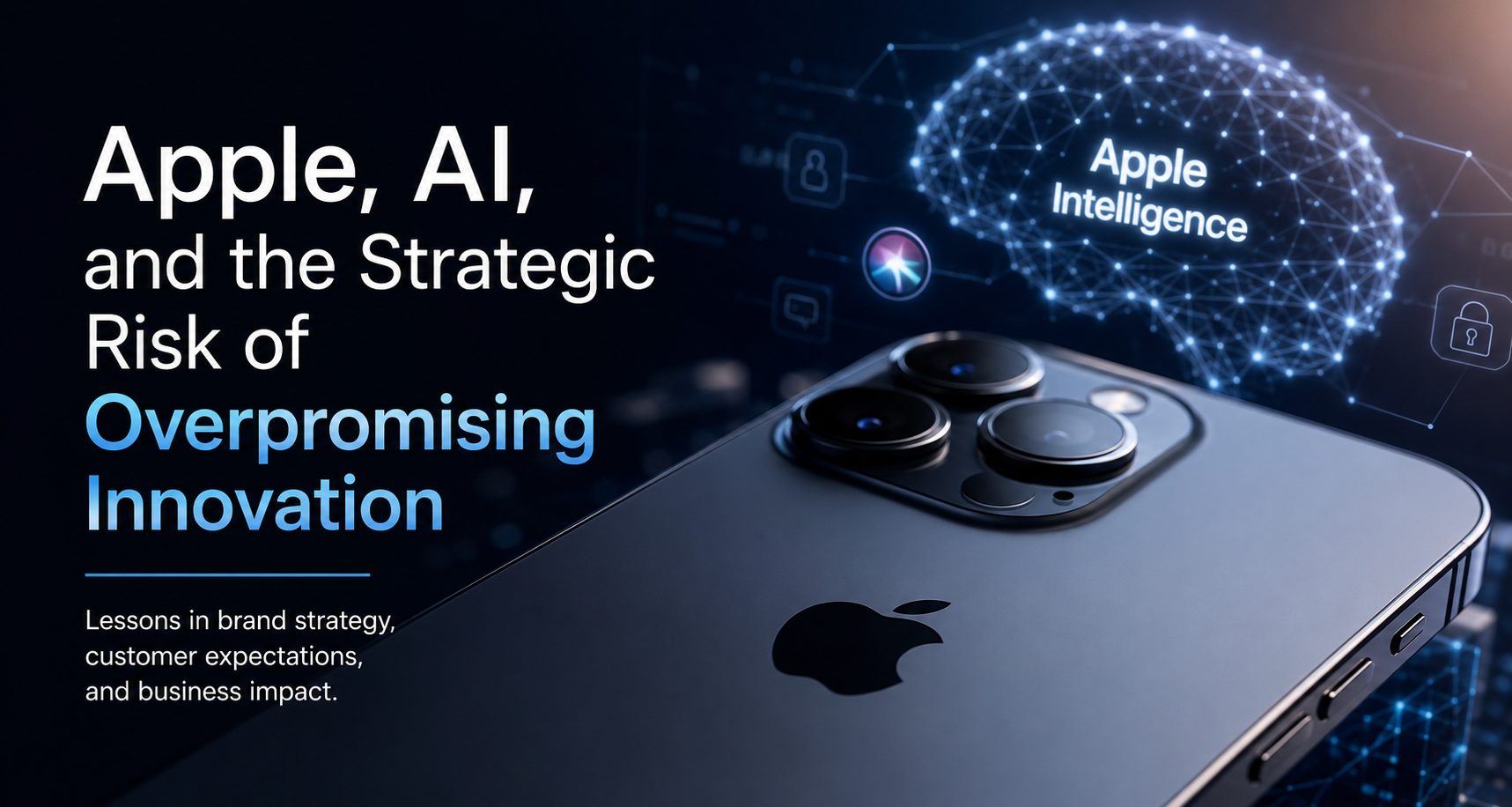
Apple, AI, and the Strategic Risk of Overpromising Innovation
Artificial intelligence is rapidly becoming one of the most important strategic positioning decisions facing modern organizations.
But as companies race to integrate AI into products, services, and customer experiences, a growing challenge is emerging: aligning innovation promises with customer reality.
Even one of the world’s strongest brands, Apple, is discovering that AI integration is not simply a technology decision. It is a brand strategy, customer expectation, and business integration challenge.
Apple’s rollout of “Apple Intelligence” provides an important case study in upstream marketing strategy, illustrating both the power and potential risk of integrating AI into a globally recognized brand ecosystem.
Conistency with Brand Positioning Requires More Than Innovations
Apple’s AI integration aligns naturally with the company’s longstanding positioning around simplifying technology for everyday users.
For decades, Apple has differentiated itself not by introducing every new technology first, but by making advanced technology intuitive, accessible, and seamlessly integrated into everyday life. The company’s integration of AI into Siri, the iPhone, and the broader Apple ecosystem reflects this same strategic approach.
However, AI positioning introduces a unique challenge: customer expectations often evolve faster than actual product capabilities.
When organizations promise transformative innovation before the customer experience fully delivers, the gap between positioning and reality can create reputational risk, even for highly trusted brands.
Apple’s strategic advantage is not simply AI capability itself. It is the company’s ability to integrate complex technology into intuitive customer experiences while preserving trust in the broader Apple ecosystem.
Brand Extension: Introducing “Apple Intelligence”
Apple’s introduction of the “Apple Intelligence” brand represents a deliberate and strategically significant brand extension decision.
Rather than presenting AI as a disconnected technology layer, Apple linked the capability directly to the Apple master brand. This approach reinforces Apple’s broader positioning around integrated innovation, simplicity, and premium user experience.
The naming itself is strategically important.
By using the Apple name directly within the AI offering, the company signals:
-
trust
-
integration
-
ecosystem consistency
-
ease of use
-
quality expectations
This is classic brand leverage.
At the same time, it raises the strategic stakes. When AI performance becomes directly tied to the master brand, any disconnect between expectations and delivery has the potential to impact broader brand perception.
For organizations navigating AI transformation, this highlights an increasingly important strategic reality:
AI is no longer just a product feature. It is becoming part of overall brand identity and positioning.
Brand Leverage: Extending Existing Platforms Rather Than Starting from Scratch
One of Apple’s smartest strategic decisions was leveraging existing assets rather than building entirely new standalone AI brands or interfaces.
By integrating AI into Siri and the iPhone ecosystem, Apple capitalized on:
-
existing user behaviors
-
established interfaces
-
brand familiarity
-
installed customer trust
-
ecosystem dependency
This approach reduces friction and accelerates adoption.
Rather than asking consumers to learn entirely new systems, Apple positioned AI as an enhancement to familiar experiences already embedded into users’ daily routines.
This reflects a broader upstream marketing principle:
strong brands often create growth not by abandoning existing equity, but by extending it strategically into new categories and capabilities.
Brand Architecture: Integrating Core, Sub-Brand, and Emerging Innovation
Apple’s AI rollout also demonstrates sophisticated brand architecture management.
The company effectively aligned:
-
the Apple master brand
-
the Siri sub-brand
-
the iPhone platform
-
the new Apple Intelligence layer
This creates a cohesive ecosystem in which each element reinforces the others.
Importantly, Apple avoided fragmenting the experience into disconnected AI offerings. Instead, the company integrated AI into the broader architecture of how customers already experience the brand.
That strategic coherence matters.
As organizations rush to add AI capabilities across products and services, many risk creating fragmented experiences, inconsistent messaging, or unclear value propositions.
Apple’s approach reinforces an important strategic lesson:
innovation is most powerful when it strengthens the broader brand system rather than operating outside of it.
The Strategic Risk of AI Positioning
As AI becomes integrated into more products and customer experiences, organizations face increasing pressure to communicate innovation leadership.
But AI positioning introduces a unique strategic challenge:
customers often interpret future capability claims as present-day functionality.
This creates risk when:
-
product readiness lags marketing communication
-
customer expectations accelerate faster than implementation
-
innovation messaging becomes disconnected from actual experience
-
organizations prioritize AI announcements over customer value clarity
Recent scrutiny surrounding AI-related claims across the technology sector highlights the growing importance of aligning:
-
positioning
-
customer expectations
-
product delivery
-
business integration
For organizations navigating AI transformation, upstream strategic clarity may become just as important as the technology itself.
AI Is Becoming an Upstream Marketing Challenge
Many organizations are currently treating AI as a downstream execution tool.
But AI increasingly impacts upstream strategic decisions including:
-
positioning
-
portfolio strategy
-
customer experience
-
value communication
-
organizational alignment
-
innovation prioritization
The organizations that succeed may not be those with the most AI capabilities, but those that integrate AI most credibly into their broader brand and business strategy.
As AI becomes more ubiquitous, competitive differentiation may shift away from simply “having AI” toward:
-
clearer positioning
-
stronger customer understanding
-
better integration
-
more believable value communication
-
more cohesive customer experiences
In other words, AI alone may not create competitive advantage.
Strategic clarity still matters.
AI Is Reshaping Strategic Marketing Decisions
EquiBrand helps organizations define:
-
portfolio strategy
-
customer experience alignment
before downstream execution begins.
→ Explore Marketing Strategy Consulting
→ Explore Brand & Portfolio Strategy Consulting
→ Explore Value Proposition Consulting
Strategic Business Integration Matters More Than Ever
Apple’s AI rollout ultimately demonstrates that artificial intelligence is no longer simply a technology initiative.
It is increasingly a:
-
brand strategy challenge
-
positioning challenge
-
customer expectation challenge
-
innovation challenge
-
business integration challenge
Organizations that approach AI purely from a technical perspective may struggle to create sustainable differentiation.
The broader strategic opportunity lies in integrating AI into:
-
a coherent customer experience
-
a believable value proposition
-
a clear brand narrative
-
a focused business strategy
As innovation cycles accelerate, companies must ensure that:
-
positioning remains credible
-
customer expectations remain aligned
-
technology investments support broader strategic goals
-
innovation translates into meaningful customer value
In many cases, the competitive advantage may not come from AI alone, but from how effectively organizations integrate AI into a clear and believable strategic narrative.
Upstream Strategy Diagnostic
Many organizations are investing heavily in AI execution before clarifying:
-
where AI creates customer value
-
how positioning should evolve
-
how customer expectations should be managed
-
how innovation supports broader business goals
EquiBrand’s Upstream Strategy Diagnostic helps leadership teams identify the strategic decisions that matter most before downstream execution begins.
→ Schedule an Upstream Strategy Diagnostic









Follow EquiBrand