
Brand Architecture Consulting
Structure Your Brand Portfolio for Clarity and Growth
Most organizations don’t set out to create a complex brand portfolio. Complexity accumulates — one product launch, one acquisition, one independently made naming decision at a time — until the portfolio that made sense internally becomes difficult for customers to navigate and expensive to manage.
By the time leadership recognizes the problem, the question is no longer theoretical. It’s urgent: Should we restructure the portfolio? Do we have the right brand architecture for where we’re heading? How do we maintain clarity as we grow?
Brand architecture consulting addresses the cause. It creates clarity across the portfolio, concentrates brand equity where it creates the most value, and establishes a scalable system for future growth decisions — including acquisitions, new product launches, and market expansions.
At EquiBrand, brand architecture is approached as an upstream strategic decision rather than a downstream branding exercise. We begin with customers, portfolio strategy, and growth objectives — not with naming systems or visual identity.
→ Discuss Your Brand Architecture Challenge
Why Brand Architecture Is a Strategic Growth Decision
Many organizations treat brand architecture as a branding problem. In practice it is a growth problem.
Architecture determines how customers navigate a portfolio — which means it directly influences purchase decisions, marketing efficiency, and the organization’s ability to introduce new offerings without creating confusion. It shapes how acquisitions are integrated, how innovation enters the market, and how brand equity is built and leveraged over time.
When architecture is clear, portfolios scale efficiently. Marketing investment works harder. Customers understand how offerings fit together. New brands and products can be introduced without undermining existing equity.
When it is not, the costs compound. Brands that overlap compete for the same customer rather than expanding the organization’s reach. Marketing investment fragments across too many brands to generate meaningful returns for any of them. New offerings create naming questions that take months to resolve. Acquisitions sit unintegrated for years because no clear framework exists for making integration decisions.
These are not branding problems. They are strategic problems — and they require a strategic solution rather than a creative one.
What Strong Brand Architecture Creates
A well-structured brand architecture delivers three outcomes that drive long-term portfolio performance.
Customer Clarity. Customers understand how brands, products, and offerings fit together — and can navigate the portfolio without confusion. Clarity reduces friction in the purchase process and improves the effectiveness of marketing investment across the portfolio.
Portfolio Focus. Brand equity and marketing investment are concentrated where they create the greatest strategic advantage — rather than fragmented across brands that have unclear roles or insufficient support to build meaningful equity.
Scalable Growth. The organization can introduce new offerings, integrate acquisitions, and expand into new markets without creating unnecessary complexity — because a clear structural framework exists to guide those decisions.
These outcomes are not achieved through naming or visual identity alone. They require a portfolio structure grounded in customer understanding, growth strategy, and a clear set of governing principles that guide future decisions consistently.
What We Help Organizations Solve
Brand architecture challenges vary in complexity, but the underlying questions are consistent.
Organizations typically engage EquiBrand for brand architecture consulting when they need to:
Define clear roles for brands across a complex portfolio. Which brands are master brands? Which are sub-brands? What distinct role does each play? Without clarity, teams create their own interpretations and customers become confused.
Resolve overlap and internal competition. Multiple brands serving the same customer segments waste marketing investment and create customer confusion. Strong architecture eliminates this overlap and clarifies which brand serves which segment.
Structure a portfolio for growth. Whether growing through acquisition, innovation, or market expansion, organizations need a clear framework for how new offerings fit into the existing structure. The wrong framework stalls growth; the right one accelerates it.
Develop scalable naming systems and architecture principles. Rather than senior leadership making naming decisions on a case-by-case basis, strong organizations establish principles and frameworks that guide future decisions consistently, without requiring senior involvement in every choice.
Align portfolio structure with customer decision-making. Organizations often structure portfolios around internal business units or organizational history. Strong architecture mirrors how customers actually make decisions, not how the organization is structured internally.
Simplify portfolios that have become too complex. When a portfolio has evolved without strategic direction, simplification is often required. This means consolidating brands, clarifying roles, and eliminating redundancy.
Integrate acquired brands without destroying equity. Acquisitions create portfolio complexity. Smart architecture decisions preserve the equity of both organizations while creating a coherent combined portfolio.
The common thread is that these are strategic decisions with long-term consequences — and they benefit from a process that begins with objective customer insight rather than internal opinion.
When Organizations Typically Revisit Brand Architecture
Organizations rarely invest in brand architecture for its own sake. Architecture becomes a priority when growth creates strategic choices that the existing structure cannot accommodate clearly.
The most common triggers include:
Acquisitions that create portfolio complexity. When you acquire a company with established brands, you face immediate architecture decisions: Do the brands merge? Do they remain independent? Do they become endorsed brands? Without a clear framework, these decisions drag on for months while two organizations operate independently.
Brands that overlap and compete internally. When multiple brands serve the same customer segment, they compete for the same marketing investment and confuse customers. This is often a signal that the architecture needs restructuring.
Customer confusion about how offerings relate. When customers struggle to understand which offering solves which problem, the portfolio structure is failing. This signals the need for clearer architecture.
New products or services that need a structural home. When launching innovation, where does it fit? Under an existing brand? As a new brand? The decision depends on having clear architecture.
Naming inconsistency across teams and markets. When some teams use masterbrand naming and others create independent names, it signals that governance is weak and architecture clarity has degraded.
Marketing investment fragmented across too many brands. When marketing budgets are spread across more brands than can be effectively supported, the portfolio is too complex. Architecture needs to simplify.
Growth strategy that no longer fits the existing structure. When the organization’s growth strategy diverges from the portfolio structure, architecture needs to change.
These are signals that the portfolio has evolved faster than the underlying architecture supporting it — and that the gap between organizational structure and customer experience has grown wide enough to affect growth.
The Four Core Brand Architecture Models
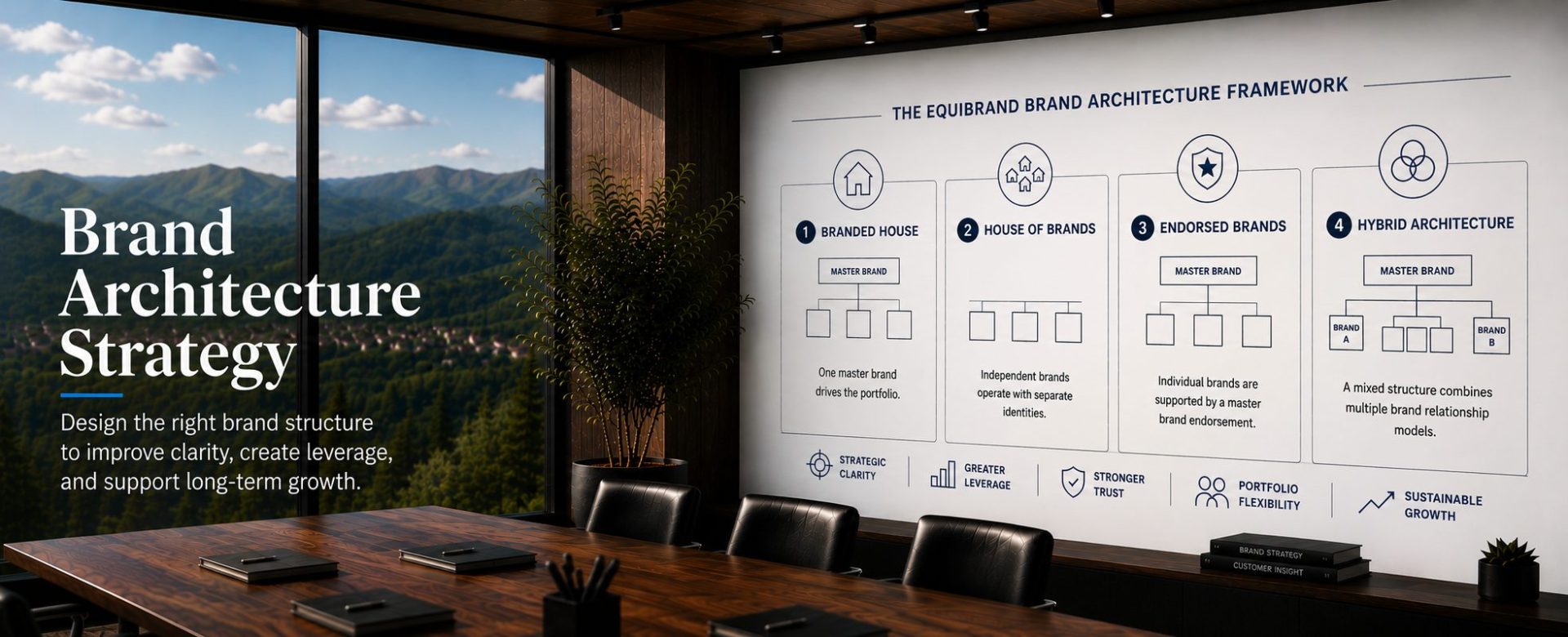
Most portfolios fall into one of four core architecture models. Understanding each helps clarify which approach fits your strategic context.
Branded House uses a single master brand across all offerings (Apple, Google, Nike). Maximum leverage but limited positioning flexibility.
House of Brands uses multiple independent brands with separate identities (Procter & Gamble, Unilever). Maximum flexibility but requires significant investment in multiple brands.
Endorsed Brands balances independence with leverage — sub-brands maintain distinct positioning while the parent brand provides credibility (Marriott, BMW).
Hybrid Models combine elements of multiple approaches, allowing different strategies for different portfolio segments.
For detailed exploration of each model, when it works, and real-world examples, see Brand Architecture Strategy & Models.
Brand Integration After a Merger or Acquisition
Acquisitions are among the most consequential — and most frequently mishandled — triggers for brand architecture decisions.
The pressure to make visible integration decisions quickly often leads organizations to make architecture choices before the strategic questions that should determine them have been answered. Which brand should lead? How should the combined portfolio be structured? How do value proposition and positioning decisions influence architecture choices?
These questions cannot be answered well without first understanding the equity of both brands objectively, defining the combined value proposition, and establishing the positioning strategy of the combined organization.
At EquiBrand, we view post-acquisition brand decisions as an interconnected strategic system. Value proposition, positioning, and brand architecture must be developed together rather than in sequence. The architecture should reflect where the combined organization is going — not simply where each organization has been.
Post-Acquisition Brand Integration Resources
For organizations navigating M&A brand decisions, EquiBrand has developed a specialized approach and comprehensive resources:
Brand Integration Consulting — Our structured process for aligning value proposition, positioning, and brand architecture following a merger or acquisition. This is where organizations begin when facing post-acquisition brand decisions.
Brand Integration Strategy — Why successful M&A brand integration requires more than brand architecture alone, and how to think about value proposition, positioning, and architecture as an interconnected system.
Six Brand Integration Strategies — The primary approaches organizations use when integrating brands post-acquisition, when each approach works, and how to choose among them.
M&A Brand Integration Guide — A comprehensive strategy-first walkthrough covering integration scenarios, brand architecture options, migration planning, and how marketing integration captures revenue synergies.
How to Choose a Brand Architecture Consulting Firm — If you’re evaluating consulting support for post-acquisition brand decisions, this guide covers what to look for and questions to ask.
Our Approach to Brand Architecture Consulting
At EquiBrand, brand architecture consulting begins upstream — with customers, portfolio strategy, and growth objectives — rather than with naming systems or visual identity decisions.
We begin with objective customer research. Internal assumptions about brand strength are consistently among the least reliable inputs in architecture decisions. We use quantitative research to measure brand awareness, preference, associations, and equity across the portfolio — establishing a factual foundation for decisions that are often influenced by organizational politics and internal attachment to existing brands.
We develop multiple architecture scenarios. Rather than presenting a single recommended structure, we develop alternative scenarios — typically covering branded house, house of brands, endorsed, and hybrid approaches — evaluated against structured strategic criteria. Each alternative is presented with a clear assessment of advantages, tradeoffs, and implications for future portfolio decisions.
We work at the senior level. Brand architecture decisions are too consequential to be delegated. We work directly with CEOs, GMs, and senior leadership teams throughout the engagement — because the people who will live with these decisions need to be in the room when they are made.
We deliver a system, not a diagram. Our engagements produce codified architecture principles, a brand hierarchy, a naming decision framework, and governance guidelines — tools designed to guide decisions for years after the engagement ends, without requiring external support for every naming or portfolio choice.
We connect architecture to the broader growth system. Brand architecture works alongside market segmentation, brand positioning, value proposition strategy, and go-to-market strategy as an interconnected set of upstream decisions. We ensure architecture decisions are grounded in and consistent with the broader strategic context — not developed in isolation from it.
Related Brand Architecture Resources
Explore specific aspects of brand architecture:
Brand Architecture Strategy & Models — Detailed exploration of the four core models, when each works, and how to choose the right approach for your business.
Brand Architecture Examples — Real-world applications of each model across industries, including Apple, Google, FedEx, Procter & Gamble, and others.
Customer-First Brand Architecture — Why portfolio structure must precede benefit messaging, and how leading B2B organizations build portfolios around customer navigation logic rather than internal organization.
Managing Brand Architecture — How to maintain clarity and prevent drift as your portfolio evolves. Covers governance, naming frameworks, and ongoing portfolio management.
Brand Portfolio Management — The enterprise-level discipline for determining which brands should exist, what roles they play, and how the portfolio should evolve as strategy changes over time.
Brand Naming Strategy — How naming systems support architecture clarity and scalability. Covers naming methodology and how naming decisions connect to broader strategy.
Brand Extension Strategy — How to extend brands into new categories without diluting equity. Critical when your growth strategy involves brand leverage.
Related Capability Hubs
Brand architecture is one component of a larger system of interconnected strategic decisions:
Marketing Strategy — Customer segmentation and portfolio analysis directly inform how brands should be organized and positioned within the architecture.
Value Proposition Strategy — Different value propositions across customer segments may require different brands within the architecture. The two decisions must be aligned.
Brand Strategy — Brand architecture is one component of comprehensive brand strategy, which also includes positioning, extension, and naming.
Go-to-Market Strategy — Architecture shapes how customers navigate and experience the portfolio across customer journeys, messaging, and experience.
Growth & Innovation Strategy — Portfolio architecture determines how new offerings enter the market, how acquisitions are integrated, and how innovation is organized across the business.
Learn More
For comprehensive understanding of brand architecture models, methodology, and strategic context:
Definitive Guide to Brand Architecture Strategy — Complete guide covering what brand architecture is, why it matters, the four models in depth, how to choose, common mistakes, and FAQ.
How to Choose a Brand Architecture Consulting Firm — If you’re evaluating consulting support, this guide covers what to look for, what to avoid, and questions to ask potential partners.
Start With a Diagnostic
Most organizations have portfolios that have evolved faster than their architecture has. The result is complexity that costs money, confuses customers, and slows growth.
The Upstream Strategy Diagnostic evaluates your current portfolio structure and identifies opportunities to simplify, clarify, and strengthen it — aligned with your growth strategy.
Start the Upstream Strategy Diagnostic or contact EquiBrand to discuss your portfolio challenges.
Typically completed in 4–6 weeks.





Follow EquiBrand