
Business Strategy Consulting
Upstream decisions that define where you compete, how you win, and what it takes to grow
EquiBrand is a business strategy consulting firm that helps leadership teams resolve the strategic questions that precede execution: where to compete, how to win, and what it takes to grow. We sit between traditional marketing agencies and large-scale management consulting firms — bringing the analytical rigor of a strategy firm and the practical marketing expertise to turn strategic clarity into recommendations that leadership teams can act on.
Our work focuses on the upstream decisions that determine long-term competitive advantage — choices about target markets, brand positioning, value proposition, and growth direction that shape everything downstream. We have worked across B2B, healthcare, consumer, and technology sectors for over 25 years, and every engagement is led by senior consultants, not delegated to junior teams.
How EquiBrand Approaches Business Strategy
EquiBrand’s approach to business strategy consulting is built on three integrated principles developed over 25 years of client work: Insight, Identity, and Innovation. Each addresses a different layer of upstream strategic decision-making, and the three work together — competitive advantage built on differentiation, cost leadership, or customer intimacy requires clarity on all three.
Insight is the foundation. It means developing a deep, rigorous understanding of end customers — their needs, behaviors, decision criteria, and unmet desires — and examining the full value chain to identify where competitive advantage can be created. The strategic question it answers: which customers, segments, and markets are worth pursuing, and why?
Identity builds on that understanding. Once you know where to play, you define how you will win. This encompasses the value propositions, brand positioning, and brand architecture that translate customer insight into a distinctive competitive position — giving organizational leaders the clear vision and business objectives needed to align the organization around a common direction.
Innovation extends identity into the future. It identifies strategic opportunities, builds the growth pipeline, and defines the process that allows the organization to drive growth across existing and adjacent markets over time.
A discipline that cuts across all three: asking What Would Have to Be True? This surfaces the assumptions embedded in any strategic choice — about customers, competition, and market dynamics — and tests them before commitment is made. It is one of the most useful tools in strategy consulting, and one that leadership teams rarely apply rigorously on their own.
Business Strategy Consulting Services
EquiBrand’s business strategy consulting practice is organized around seven integrated capabilities. Each is a strategic discipline in its own right. Together, they span the upstream decisions that determine how an organization competes and grows.
Marketing Strategy Consulting
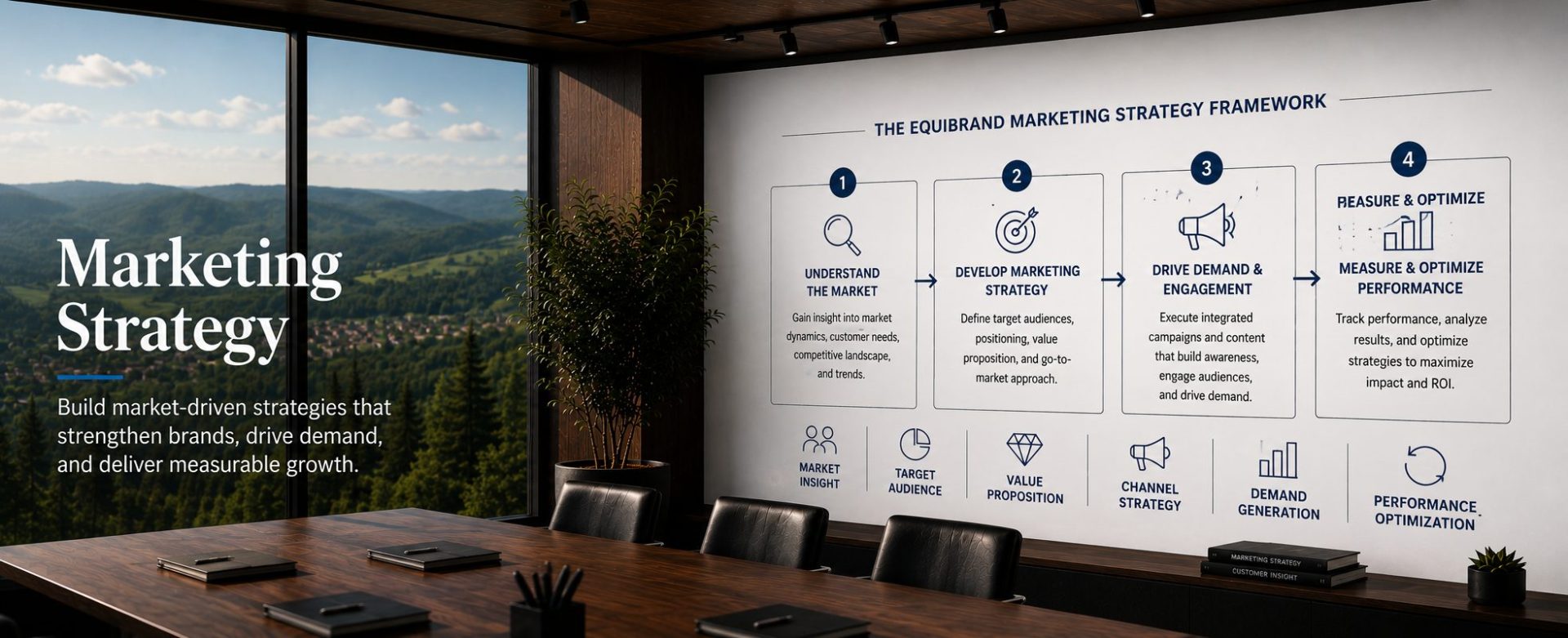
Marketing strategy consulting defines where an organization competes and how it allocates resources across markets, customers, and growth opportunities. EquiBrand helps leadership teams identify high-value segments, develop customer insights, evaluate competitive positioning, and prioritize the opportunities most likely to drive sustained growth.
Brand Strategy Consulting
Brand strategy consulting defines how an organization creates and communicates distinctive value — encompassing brand positioning, differentiation, and the brand structure required to support scalable growth. A strong brand is a strategic asset, built on choices about what to stand for and how to make that position credible in the market.
Value Proposition Strategy
Value proposition strategy clarifies why customers choose you over alternatives. EquiBrand defines the distinctive value an organization delivers, develops propositions across customer segments, and ensures messaging is consistent throughout the customer experience. When value propositions are unclear, even strong products struggle to win.
Brand Architecture Consulting
Brand architecture consulting structures the relationships between brands, sub-brands, products, and services so that the portfolio creates clarity rather than confusion. EquiBrand helps organizations resolve the portfolio decisions that affect customer perception, internal alignment, and long-term brand equity — particularly after acquisitions or during periods of significant growth.
Go-to-Market Strategy
Go-to-market strategy connects upstream strategic decisions to downstream execution — defining how the organization reaches target customers, structures the customer journey, and aligns internal teams around a coherent commercialization approach. Without this connection, strong upstream strategy stalls at implementation.
Growth Strategy & Innovation Consulting
Growth strategy and innovation consulting defines where future growth should come from before resources are committed to specific initiatives. EquiBrand identifies strategic opportunity areas, evaluates options to drive growth through market share gains or entry into new markets, and builds the growth pipeline that balances near-term performance with long-term positioning. Innovation anchored in insight and identity produces advantage. Innovation without it produces activity.
Strategic Planning Consulting
Strategic planning consulting translates upstream choices into an executable organizational roadmap. EquiBrand uses a structured 7-step methodology to help leadership teams define where they compete, which opportunities deserve focus, and how to concentrate resources on the initiatives most likely to create sustainable competitive advantage.
What to Expect From an Engagement
Business strategy consulting at EquiBrand follows four phases, though the specifics vary by organization and context.
Diagnostic. We begin by understanding the organization’s current strategic position — competitive environment, customer landscape, organizational structure, and the assumptions embedded in how the business currently operates. This is an ongoing process of uncovering what is working, what is not, and where the most important strategic decisions remain unresolved.
Framing. We define the strategic questions that deserve attention, map the options available, and evaluate the tradeoffs — including scenario planning to test how different choices hold up under varying market conditions. This is where the Upstream Marketing framework — Where to Play? How to Win? How Might We? What Would Have to Be True? — does its most important work. External consultants bring pattern recognition from various industries that internal teams cannot replicate.
Alignment. Clear strategy only creates value if it is understood and owned by the leadership team. EquiBrand includes the facilitation and communication work that creates alignment around organizational goals and a shared path forward — building the clear vision that guides execution across the organization.
Activation. EquiBrand stays engaged through the translation of strategic decisions into marketing strategy, brand positioning, value proposition development, and go-to-market execution — including the change management required to move the organization from strategy to action. The upstream and downstream work is connected, so the strategy reaches the market rather than staying on paper.
A well-executed engagement leaves the leadership team with something more useful than a report — clear choices they can articulate consistently and execute against with confidence.
Business Strategy vs. Strategic Planning
Business strategy and strategic planning are related but distinct, and confusing them leads to misaligned expectations about what an engagement produces.
Business strategy is concerned with choices: which markets to compete in, which customers to serve, what basis of competition to pursue. The output is strategic clarity — decisions that guide resource allocation and execution direction.
Strategic planning is concerned with process: how those choices get translated into objectives, priorities, initiatives, and timelines. A strategic plan operationalizes the strategy — it creates the organizational mechanism for executing the choices strategy has defined.
Organizations that begin with strategic planning before resolving their corporate strategy tend to produce well-organized plans in pursuit of unclear goals. EquiBrand’s approach starts upstream — clarifying the strategic choices — and then moves into strategic planning to make them operational. Strategy first, planning second. The sequence matters.
When Business Strategy Consulting Makes Sense
Business strategy consulting creates the most value when strategic clarity is genuinely absent — when the questions that should guide execution haven’t been answered, or when the answers the organization is working from are outdated or contested.
If growth has stalled despite strong execution, it often signals that upstream decisions about where to play and how to win have not been fully resolved. Tactical excellence cannot compensate for strategic ambiguity.
If the leadership team is debating priorities without a clear framework for resolution, strategy consulting provides the structured process and outside perspective needed to make those decisions and build alignment around them.
If your organization is approaching a significant transition — a new market entry, a product launch, a post-acquisition integration, a repositioning — the cost of getting the strategic direction wrong is high. This is the moment when upstream clarity has the greatest leverage on downstream outcomes.
If your brand, value proposition, and messaging have drifted — if different parts of the organization are telling different stories — business strategy consulting can rebuild the strategic foundation that makes everything downstream more coherent and more effective.
The engagements that produce the clearest results are the ones where leadership is willing to question their assumptions, work through real strategic debate, and commit to acting on what the process surfaces — even when it challenges the current direction.
Frequently Asked Questions
How is business strategy consulting different from management consulting?
Management consulting covers a broad range of organizational challenges — operations, finance, technology, change management, organizational design. Business strategy consulting is narrower and more upstream: it focuses specifically on the strategic decisions that determine where an organization competes and how it wins. EquiBrand’s practice sits at the intersection of business strategy and marketing strategy, working with leadership teams on the choices that determine competitive positioning, brand identity, and growth direction — rather than operational improvement or cost reduction alone.
What does a business strategy consulting engagement typically produce?
Deliverables vary by engagement, but most produce a clear articulation of target customer segments, a defined competitive positioning, a validated value proposition, and a prioritized set of strategic decisions with supporting rationale. Some engagements also produce a business unit strategy for a specific product line or market, a go-to-market plan, or a growth roadmap with defined strategic opportunities. The goal is always clarity that leadership teams can act on — not a document that describes the situation without resolving it.
How do strategy consultants help companies identify new growth opportunities?
Finding credible growth opportunities starts with understanding where the organization already wins and why — then examining whether those advantages translate to adjacent customer segments or new markets. EquiBrand uses a structured approach to map strategic opportunities against the organization’s actual sources of competitive advantage, rather than chasing market trends that don’t align with what the business does well. The goal is a prioritized growth pipeline grounded in insight, not optimism.
Which industries does EquiBrand serve?
EquiBrand has worked across various industries including B2B, healthcare, consumer products, technology, financial services, and professional services. The upstream strategic challenges that drive our engagements — unclear positioning, misaligned value propositions, uncertain growth direction — appear across all of these sectors. While industry context matters, the strategic decisions that create competitive advantage follow similar patterns regardless of the category.
Start With a Growth Assessment
EquiBrand’s Growth Assessment evaluates your current approach across target markets, brand structure, value proposition, positioning, and go-to-market execution — identifying the gaps and misalignments creating the greatest drag on growth. In 4–6 weeks, it produces a clear assessment, a prioritized set of recommendations, and a practical action roadmap.
Request a Growth Assessment or contact EquiBrand to discuss how business strategy consulting can support your next stage of growth.





Follow EquiBrand