
Brand Architecture Models and Examples
Structure brands and portfolios for clarity, synergy, and leverage.
As organizations grow, brand portfolios often become more complex. New products, acquisitions, sub-brands, and innovation initiatives can create confusion for customers and inefficiency for the business.
Brand architecture defines how brands relate to one another, how they are presented to customers, and how equity is leveraged across the organization.
The right brand architecture can simplify complexity, strengthen brand equity, and improve growth efficiency. Below are the most common brand architecture models and examples companies use to structure and manage growing portfolios of brands and offerings.
What Is Brand Architecture?
Brand architecture is the system used to organize brands, products, services, and offerings within a company.
It determines:
-
how brands relate to one another
-
how offerings are named and presented
-
how brand equity is leveraged
-
how customers understand the portfolio
Without a clear architecture, portfolios often become fragmented over time as companies launch new products, expand into new markets, or acquire additional businesses.
Brand Architecture Examples and Models
Most brand architecture strategies fall across a spectrum ranging from highly integrated branded house structures to highly independent house of brands portfolios.
Most organizations ultimately adopt a hybrid approach that combines elements of multiple models.
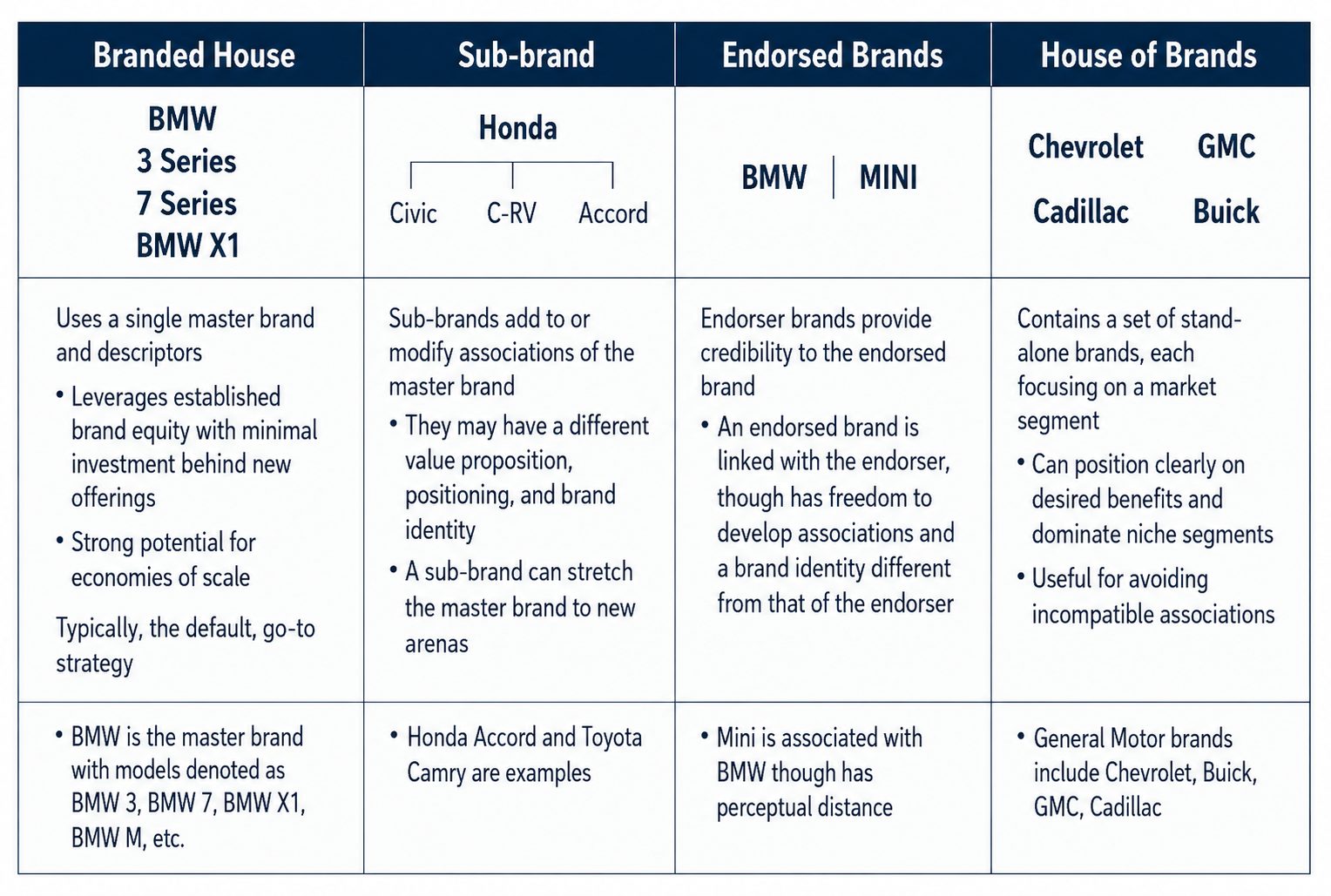
Example Brand Architecture Spectrum
Brand architecture models exist on a continuum ranging from highly integrated branded house strategies to fully independent house of brands portfolios. Most organizations ultimately adopt a hybrid approach tailored to their business strategy and customer needs.
1. Branded House Examples
A branded house architecture emphasizes a single master brand across products and offerings.
Common Branded House Examples
-
Apple
-
Google
-
FedEx
-
Virgin
Under this model, the parent brand carries most of the emotional equity, while product names or descriptors communicate functional differences.
Google demonstrates this strategy with:
-
Google Maps
-
Google Drive
-
Google Earth
-
Google Pay
In these cases, the Google master brand carries most of the equity while descriptors clarify functionality.
Advantages of a Branded House
-
maximizes leverage behind one master brand
-
creates stronger consistency across offerings
-
reduces complexity and duplication
-
improves marketing efficiency
-
simplifies cross-selling across products and services
Potential Challenges
-
reputational risk can affect the broader portfolio
-
brand stretch may dilute positioning
-
highly diverse offerings may require greater differentiation
2. Sub-Brand Architecture Examples
Sub-brands combine the strength of a master brand with additional differentiation for specific offerings or customer segments.
Common Sub-Brand Examples
-
Apple iPhone
-
Apple iPad Pro
-
Adobe Creative Cloud
-
Courtyard by Marriott
Sub-brands help organizations create targeted relevance while still leveraging the strength of the parent brand.
Advantages of Sub-Brand Architecture
-
balances leverage and flexibility
-
creates stronger relevance for different use cases
-
supports innovation and category expansion
-
allows differentiation without building standalone brands
Potential Challenges
Without clear governance, sub-brands can proliferate quickly and create confusion across the portfolio.
3. Endorsed Brand Examples
Endorsed brands operate somewhat independently while still drawing credibility from a parent brand.
Common Endorsed Brand Examples
-
Courtyard by Marriott
-
Polo by Ralph Lauren
-
MINI by BMW
In these architectures, the endorsement signals trust and connection while allowing the endorsed brand to maintain its own positioning.
Advantages of Endorsed Brands
-
transfers credibility from the parent brand
-
allows differentiated positioning
-
provides flexibility across customer segments
Potential Challenges
-
unclear relationships between brands can create confusion
-
endorsements may provide limited value if brand roles are not clearly defined
4. House of Brands Examples
A house of brands strategy uses largely independent brands designed to stand on their own in the marketplace.
Common House of Brands Examples
-
Procter & Gamble
-
Unilever
-
Yum! Brands
Each brand maintains its own positioning, identity, and customer relationship.
Advantages of a House of Brands
-
maximum flexibility across segments
-
isolates reputational risk between brands
-
supports highly differentiated positioning strategies
-
allows brands to target specific customer needs independently
Potential Challenges
-
higher investment requirements
-
increased operational complexity
-
fragmented marketing investment
-
more difficult portfolio management
What Effective Brand Architecture Should Achieve
At EquiBrand, we view successful brand architecture through three strategic objectives:
Clarity
Brand architecture should make it immediately clear how brands, products, and offerings fit together.
Strong architectures reduce customer confusion and simplify decision-making across the portfolio.
Apple provides a strong example. The Apple master brand sits above product brands such as iPhone, iPad, MacBook, and Apple Watch, while descriptors such as Pro, Air, and Mini clarify product differences.
Synergy
A well-structured architecture creates greater value together than independently.
The master brand strengthens product brands, while product brands reinforce the master brand.
Apple adds value to the iPhone, and the iPhone strengthens Apple. Amazon Prime reinforces Amazon, while Amazon strengthens confidence in Prime.
Leverage
Effective brand architecture allows organizations to extend equity across products, customer segments, channels, and future growth opportunities.
Strong architectures can:
-
support expansion into adjacent categories
-
improve marketing efficiency
-
accelerate adoption of new offerings
-
create stronger long-term scalability
Branded House vs House of Brands
One of the most important brand architecture decisions involves determining how closely brands should relate to one another.
Branded House Strategies Typically Prioritize:
-
leverage
-
consistency
-
efficiency
-
master brand strength
House of Brands Strategies Typically Prioritize:
-
flexibility
-
segmentation
-
differentiation
-
reputational separation
Most organizations ultimately operate somewhere between these two extremes.
Hybrid Brand Architecture
Most organizations do not operate as a pure branded house or pure house of brands.
Instead, companies often combine:
-
master brands
-
sub-brands
-
endorsed brands
-
standalone strategic brands
to balance clarity, flexibility, and economic leverage.
Amazon is a strong example of a hybrid architecture. The company emphasizes the Amazon master brand while also investing in strategic brands such as Prime, Kindle, and Echo. At the same time, Amazon employs lower-level private brands and branded features tied to specific roles within the portfolio.
Hybrid brand architecture strategies allow organizations to tailor portfolio structures to business strategy, customer needs, acquisitions, and market expansion.
A Trend Toward Branded House Strategies
Many organizations today are shifting toward stronger master brands and simpler brand architectures.
This reflects the growing cost and complexity of launching and managing multiple brands.
A branded house strategy can create significant economic leverage by “putting more wood behind one arrow,” concentrating investment behind fewer brands while reducing unnecessary brand proliferation.
While branded house approaches are often preferred, the optimal architecture ultimately depends on the company’s:
-
business strategy
-
customer segments
-
acquisition strategy
-
growth priorities
-
competitive environment
Establishing Clear Brand Roles
Not every element within a portfolio should function as a full strategic brand.
Strong brand architecture establishes clear roles across the organization, which may include:
-
strategic brands
-
sub-brands
-
endorsed brands
-
feature brands
-
product descriptors
-
value-tier offerings
Without clear governance, portfolios can become fragmented and difficult to manage over time.
Unmanaged brands risk becoming “empty vessels” with little meaningful differentiation in the marketplace.
Amazon illustrates this well. Prime, Kindle, and Echo operate as strategic brands tied to major growth opportunities, while offerings such as Amazon Basics and Amazon Essentials play more targeted portfolio roles.
Product Portfolio Strategy vs Brand Architecture
While closely related, product portfolio strategy and brand architecture address different strategic questions.
Product Portfolio Strategy
Product portfolio strategy is internally focused.
It addresses questions such as:
-
What offerings should we develop?
-
Which customer segments should we pursue?
-
Where should we invest for growth?
-
Which innovations align with business strategy?
Example:
Should we launch an electric vehicle?
Brand Architecture
Brand architecture is customer-facing.
It addresses questions such as:
-
How should offerings relate to one another?
-
Should a new offering use an existing brand or a new brand?
-
How should brands connect within the portfolio?
-
How should the portfolio be presented externally?
Example:
Should the electric vehicle use a new brand or extend an existing one?
Strong growth strategies require alignment between product portfolio strategy and brand architecture.
Signs Your Brand Architecture May Need to Evolve
Organizations often revisit brand architecture when:
-
acquisitions create overlap or duplication
-
customers struggle to understand the portfolio
-
naming conventions become inconsistent
-
innovation creates portfolio complexity
-
multiple brands target similar audiences
-
marketing investment becomes fragmented
-
organizational complexity surfaces externally
-
brands no longer play clear strategic roles
In many cases, what once made sense internally no longer makes sense externally through the eyes of the customer.
How Brand Architecture Consulting Engagements Work
Brand architecture consulting involves evaluating both customer perception and business strategy to determine the optimal portfolio structure.
At EquiBrand, engagements often include:
1. Customer and Business Strategy Inputs
Understanding customer segments, growth priorities, portfolio goals, and strategic direction.
2. Brand Architecture Audit
Inventorying all brands, sub-brands, descriptors, and touchpoints to assess the current architecture.
3. Research and Evaluation
Evaluating:
-
brand strength
-
customer understanding
-
competitive dynamics
-
investment requirements
-
strategic flexibility
4. Alternative Architecture Development
Exploring multiple “to-be” structures and evaluating tradeoffs between clarity, flexibility, and leverage.
5. Governance and Naming Principles
Establishing hierarchy systems, architecture principles, and naming frameworks to guide future decisions consistently.
Frequently Asked Questions
What are the main brand architecture models?
The primary brand architecture models include branded house, sub-brand architecture, endorsed brands, and house of brands.
What is a branded house strategy?
A branded house strategy emphasizes a single master brand across products and offerings, such as Apple or Google.
What is a house of brands?
A house of brands strategy uses largely independent brands that stand on their own in the marketplace, such as Procter & Gamble.
What is a hybrid brand architecture?
A hybrid brand architecture combines multiple architecture models within the same organization to balance leverage and flexibility.
What is the difference between product portfolio strategy and brand architecture?
Product portfolio strategy determines what offerings a company develops. Brand architecture determines how those offerings are structured and presented to customers.
When should companies rethink their brand architecture?
Organizations often revisit brand architecture after acquisitions, during rapid growth, when portfolios become confusing, or when innovation expands beyond the current structure.
What does a brand architecture consultant do?
A brand architecture consultant helps organizations structure brands, products, and offerings to improve clarity, strengthen leverage, and support long-term growth.
Evaluate Whether Your Brand Architecture Still Fits Your Growth Strategy
As portfolios expand, brand structures often become more difficult to manage. We help organizations clarify brand roles, strengthen portfolio alignment, and design scalable brand architectures that support long-term growth.
→ Explore Brand Architecture Consulting





Follow EquiBrand