

The 20 Best Marketing Books of All Time (Plus One New One) — Updated for 2026
Most marketing books teach tactics. Few shape how you think.
This list focuses on the books that have defined modern marketing strategy, from positioning and persuasion to business model design and growth.
If you’re serious about elevating your marketing, these are the books that matter.
Top Marketing Books (Quick List)
- Good to Great — Leadership and disciplined strategy
- Playing to Win — Where to play, how to win
- Start with Why — Purpose-driven brands
- Business Model Generation — Designing value
- Positioning — Owning a place in the mind
- Influence — Psychology of persuasion
- The 22 Immutable Laws of Marketing — Foundational rules
- The 7 Habits of Highly Effective People — Principle-based leadership
- Blue Ocean Strategy — Creating uncontested markets
- Marketing Management — Marketing fundamentals
- Ogilvy on Advertising — The craft of advertising that sells
- How to Win Friends and Influence People — The foundation of persuasion
- Purple Cow — Remarkable products market themselves
- Made to Stick — Why some ideas survive
- Crossing the Chasm — Winning the early majority
- Thinking, Fast and Slow — How customers actually decide
- Contagious — What makes ideas spread
- The Innovator’s Dilemma — Why good companies get disrupted
- Obviously Awesome — Positioning as a repeatable process
- Epic Content Marketing — Building an audience, not campaigns
- Upstream Marketing — Unlock growth through insight + identity + innovation
Here is EquiBrand Consulting’s list of the top 20 marketing books plus one new one:
1. Good to Great: Why Some Companies Make the Leap . . . And Others Don’t by Jim Collins
Jim Collins’ Good to Great is often hailed as one of the best business and marketing books ever written. In it, Collins explores what separates good companies from great ones, using case studies and data to back up his insights. A timeless classic, it provides valuable lessons on leadership, strategy, and corporate culture that can be applied to marketing.
Although published over 20 years ago, and some companies profiled have since faded, the underlying principles are as relevant today as ever. The book teaches that greatness is not just a matter of circumstance, but rather a disciplined approach to strategy and execution—a must-read for marketers who aim to propel their brand from good to great.
2. Playing to Win: How Strategy Really Works by A.G. Lafley and Roger Martin
Playing to Win breaks down strategy in its simplest form: a set of choices. Lafley and Martin show how brands can leverage these choices to identify markets, customers, and positioning that maximizes their chances of winning. It emphasizes asking the right questions—like “Where to play?” and “How to win?”—which serve as a fundamental strategy tool in marketing.
Rooted in the consumer products industry, this book’s principles extend beyond to business-to-business markets, making it a versatile tool for marketers seeking a strategic advantage.
3. Start with Why: How Great Leaders Inspire Everyone to Take Action by Simon Sinek
In Start with Why, Simon Sinek introduces the idea that successful brands and leaders first define their “why”—their purpose—before addressing the “what” and “how.” This simple yet profound idea can transform marketing efforts by focusing on the deeper motivations that drive customer loyalty.
For any marketer looking to build a brand with purpose and lasting impact, Sinek’s book provides a blueprint for turning customers into advocates by tapping into a more profound sense of connection and inspiration.
4. Business Model Generation: A Handbook for Visionaries, Game Changers, and Challengers by Alex Osterwalder and Yves Pigneur
This book goes beyond marketing to discuss innovative ways to design, test, and scale business models. Business Model Generation is highly visual and interactive, making it an essential tool for marketers who want to rethink their approach to delivering value. Osterwalder and Pigneur outline frameworks for creating and iterating on business models that are disruptive and customer-centric.
Understanding how your business model and marketing strategy align is critical to achieving long-term success, and this book helps you do just that.
5. Positioning: The Battle for Your Mind by Al Ries and Jack Trout
If you’re trying to carve out a unique space in your customer’s mind, Positioning is your playbook. This groundbreaking work by Al Ries and Jack Trout introduced the concept of “positioning” in marketing, which is all about owning a distinct place in the mind of the consumer. Whether you’re launching a new product or trying to redefine an existing one, positioning is critical to differentiate in today’s saturated market.
This book, often considered one of the best marketing books ever written, remains relevant decades after its initial publication. It emphasizes simplicity and clarity in communication—a lesson every marketer should heed.
6. Influence: The Psychology of Persuasion by Robert Cialdini
What drives people to say yes? Robert Cialdini’s Influence dives deep into the psychology of persuasion, outlining six key principles that marketers can use to ethically influence behavior. These principles—reciprocity, scarcity, authority, consistency, liking, and social proof—are foundational to creating effective marketing campaigns that resonate with customers on a psychological level.
If you’re involved in sales, content marketing, or any form of customer communication, this book will equip you with a toolkit of persuasive tactics that are both effective and ethical.
7. The 22 Immutable Laws of Marketing: Violate Them at Your Own Risk! by Al Ries and Jack Trout
Another masterclass from Ries and Trout, The 22 Immutable Laws of Marketing outlines 22 essential rules that marketers must follow to be successful. The book presents hard truths about what works and what doesn’t in marketing. While some examples may seem dated, the principles hold up in today’s digital landscape.
This concise yet impactful book serves as an excellent refresher on the core principles of marketing and is perfect for anyone looking to ensure they are adhering to the “laws” that stand the test of time.
8. The 7 Habits of Highly Effective People by Stephen Covey
Although The 7 Habits is often categorized as a self-help book, its principles directly apply to business and marketing. Covey’s advocacy for a principle-centered, value-driven approach is foundational for marketers who wish to develop strong relationships with customers. By focusing on trust, integrity, and proactive behavior, this book offers timeless wisdom on leadership and personal effectiveness that can shape your marketing strategy for the better.
If you’re looking for a book that blends personal development with actionable business advice, Covey’s work is indispensable.
9. Blue Ocean Strategy: How to Create Uncontested Market Space and Make Competition Irrelevant by W. Chan Kim and Renée Mauborgne
Why compete when you can create your own market? In Blue Ocean Strategy, Kim and Mauborgne argue for the creation of uncontested market space where competition becomes irrelevant. The book challenges the conventional wisdom of head-to-head competition and instead advocates for innovation and customer-focused strategy.
For marketers looking to break away from the crowded market and find new, profitable opportunities, Blue Ocean Strategy is an essential read.
10. Marketing Management by Philip Kotler and Kevin Keller
No list of top marketing books would be complete without including Philip Kotler’s Marketing Management. Often referred to as the “father of marketing,” Kotler’s influence on the field is immense. Marketing Management is widely considered the ultimate textbook on the subject and is a staple in MBA programs around the world.
It covers everything from consumer behavior to branding, pricing, and distribution—offering an all-encompassing look at marketing as a discipline. If you’re looking to deepen your knowledge of marketing’s foundational principles, this book is a must-have.
11. Ogilvy on Advertising by David Ogilvy
David Ogilvy founded one of the world’s most successful advertising agencies, and Ogilvy on Advertising distills what he learned into a practical guide. Ogilvy argues for research over instinct, clarity over cleverness, and holding creative work accountable for results. He covers headlines, layout, direct response, and how to run a campaign that sells rather than merely entertains.
The examples come from an earlier era, but the discipline behind them has not aged. For marketers who want a grounding in the craft of persuasion from someone who built a global agency on it, this remains the standard.
12. How to Win Friends and Influence People by Dale Carnegie
First published in 1936 and still among the best-selling books ever written, Carnegie’s work is fundamentally about understanding what other people want and learning how to talk with them about it. He covers taking genuine interest in others, remembering names, admitting fault readily, and framing an argument from the other person’s point of view—habits that translate directly into how brands earn attention and hold trust.
It is not sold as a marketing book, and it may be the most frequently cited title in the category. For anyone whose work depends on persuasion—positioning, messaging, sales conversations, or leading an organization through change—Carnegie’s principles remain the foundation everything else is built on.
13. Purple Cow: Transform Your Business by Being Remarkable by Seth Godin
Seth Godin’s central argument is simple: in a crowded market, being remarkable is the only reliable strategy. A “purple cow” is a product so distinctive that people talk about it without being asked. Godin makes the case that marketing cannot rescue an average product, and that the remarkable has to be built into the offering itself rather than added afterward.
Short, direct, and still relevant more than twenty years on. For marketers tempted to solve a product problem with a communications budget, this book is a useful correction.
14. Made to Stick: Why Some Ideas Survive and Others Die by Chip Heath and Dan Heath
Why do some ideas take hold while better ones disappear? The Heath brothers identify six qualities shared by ideas that stick—simple, unexpected, concrete, credible, emotional, and story-driven—and show how to build those qualities deliberately rather than hoping for them.
This is one of the most immediately practical books on the list. Any marketer who has watched a sound strategy fail to take hold inside their own organization will find the framework useful the same week they read it.
15. Crossing the Chasm by Geoffrey Moore
Geoffrey Moore’s insight is that the gap between early adopters and the early majority is a chasm rather than a gentle slope, and that the two groups buy for entirely different reasons. His answer is the beachhead strategy: dominate a narrow, well-defined segment completely before attempting to expand beyond it.
Written for technology markets but applicable well beyond them, Crossing the Chasm remains the clearest argument available for defining a target market tightly enough to actually win it.
16. Thinking, Fast and Slow by Daniel Kahneman
Nobel laureate Daniel Kahneman describes the two systems that govern human judgment: one fast, intuitive, and automatic; the other slow, deliberate, and effortful. The book explains the biases and mental shortcuts that shape decisions people believe they are making rationally.
This is not a marketing book, and it belongs on this list anyway. It explains why customers do not decide the way research assumes they do, and it sits underneath nearly every other book here that touches on persuasion.
17. Contagious: Why Things Catch On by Jonah Berger
Jonah Berger set out to answer why some products, ideas, and stories spread while others do not. His research produced six principles—social currency, triggers, emotion, public visibility, practical value, and stories—that explain what actually makes people share.
For marketers who treat word of mouth as luck, Contagious offers a structure that can be designed for. It pairs naturally with Made to Stick, which addresses whether an idea survives once it has traveled.
18. The Innovator’s Dilemma by Clayton Christensen
Clayton Christensen explains why well-managed, successful companies lose to inferior entrants. The practices that make a company good at serving its existing customers—listening to them closely, investing in proven markets, protecting margins—are the same practices that blind it to disruptive change.
Essential reading for anyone deciding where to place innovation bets. It provides a sober counterweight to the optimism of most growth literature, and it explains failures that otherwise look inexplicable.
19. Obviously Awesome: How to Nail Product Positioning by April Dunford
April Dunford supplies what Positioning leaves implicit: a repeatable process for arriving at a position. She walks through how to identify your true competitive alternatives, choose a market frame of reference, and recognize when your current positioning is quietly working against you.
Short, concrete, and immediately usable. For marketers who understand positioning in principle but struggle to actually run the exercise, this is the practical companion to Ries and Trout.
20. Epic Content Marketing, Second Edition by Joe Pulizzi
Joe Pulizzi, founder of the Content Marketing Institute, argues that content marketing is audience-building rather than campaign support, and that the organizations succeeding at it behave more like publishers than advertisers. The second edition, updated in 2023, revisits what has changed since the discipline’s early enthusiasm and what has held up.
For marketers building an owned audience rather than renting attention, Pulizzi provides the operating model and the discipline required to sustain it.
21. Upstream Marketing: Unlock Growth Using the Combined Principles of Insight, Identity, and Innovation by Tim Koelzer and Kristin Kurth
This new title draws on the lessons learned from the list of top marketing books and ties them together. The book introduces the concept of upstream marketing, defines it, and establishes a new framework to drive growth, drawing on core principles of insight, identity, and innovation.
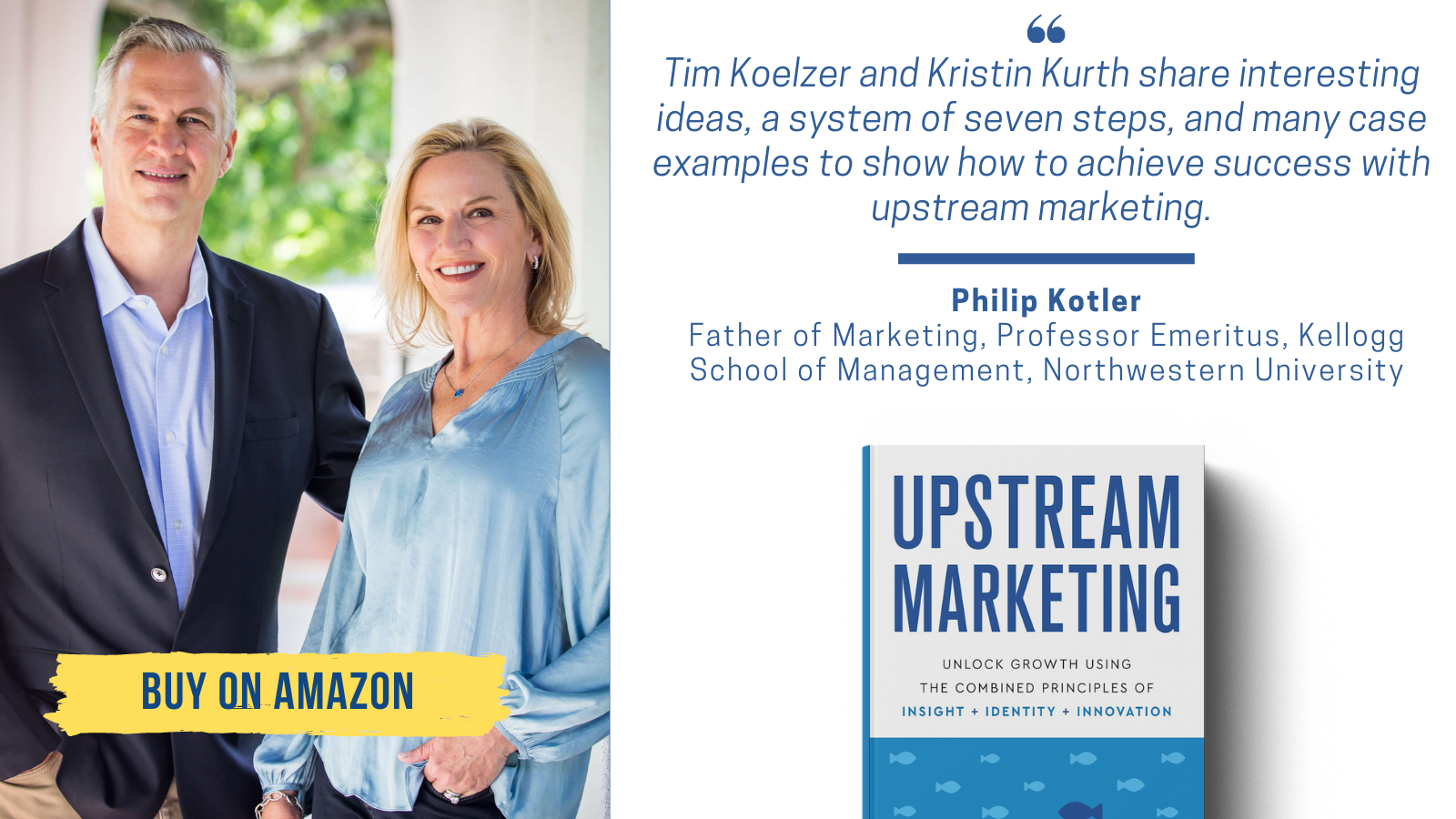
The book is written by EquiBrand co-founders Tim Koelzer and Kristin Kurth. If you’re interested in learning more about EquiBrand or Upstream Marketing, use this contact form.
Learn more, or read Chapter One free →
Why These Are the Best Marketing Books
The books on this list are consistently recognized as some of the best marketing books of all time because they go beyond tactics and focus on the core principles that drive growth.
Together, they cover the full spectrum of modern marketing, including:
- Marketing strategy and business strategy
- Brand positioning and differentiation
- Customer psychology and decision-making
- Innovation and market creation
- Advertising craft and content marketing
- Evidence-based brand growth
Many lists highlight popular titles. What distinguishes the top marketing books is their lasting impact. These are the books that continue to shape how marketers think about where to compete and how to win.
For those specifically looking for marketing strategy books, titles like Playing to Win, Blue Ocean Strategy, and Good to Great provide foundational frameworks that are directly applicable to real-world decision-making.
At the same time, books like Positioning, Influence, and Obviously Awesome remain essential for understanding how customers perceive value and make choices, making them some of the best books on marketing for both strategy and execution.
Whether you are building a brand, refining your positioning, or defining a go-to-market approach, these are the must-read marketing books that provide a durable foundation for long-term success.
Start With Chapter One
Every book on this list shaped how we think about growth. Upstream Marketing was written to connect them — a seven-step system for deciding where to compete and what to stand for, before the execution begins.
“Tim Koelzer and Kristin Kurth share interesting ideas, a system of seven steps, and many case examples to show how to achieve success with upstream marketing.”
— Philip Kotler, Professor Emeritus, Kellogg School of Management
Read Chapter One free, or get the book on Amazon →
From Reading Marketing to Applying It
Reading the best marketing books builds perspective. It sharpens how you think about customers, competition, and growth.
But the challenge most organizations face is not a lack of ideas. It is a lack of alignment.
Teams read the same books, use the same language, and reference the same frameworks. Yet they still struggle to answer a few fundamental questions:
- Where should we compete?
- Who is our highest-value customer?
- What do we want to be known for?
- How do we translate strategy into execution?
This is where marketing often breaks down. Not because the thinking is wrong, but because it is not fully defined, aligned, or applied.
The books on this list provide the foundation. The next step is turning that thinking into a clear, actionable strategy.
Start with a Growth Assessment
At EquiBrand Consulting, we work with organizations facing a common challenge: marketing activity is increasing, but growth is not.
The issue is rarely execution alone. It is usually upstream.
The Growth Assessment is designed to assess the core strategic decisions that drive marketing effectiveness:
- Where to play
- How to win
- What value to deliver
- How to differentiate
- How strategy connects to execution
In a focused 4 to 6 week engagement, we identify what is working, what is misaligned, and where the greatest opportunities for growth exist.
If these books resonate with you, the next step is applying their principles to your business.
Start with a Growth Assessment →
Your Content Goes Here








Follow EquiBrand