
For decades, marketing advantage lived downstream. Strategy
The teams that won were faster, sharper, and better resourced. They produced stronger creative, deployed more media, optimized more aggressively, and executed better across channels. Execution skill was scarce, and scarcity created advantage.
That era is over.
Artificial intelligence did not merely improve execution. It equalized it. Content creation, campaign production, testing, optimization, and personalization are now automated, scalable, and widely accessible. What once required time, talent, and coordination now happens almost instantly.
Execution has not disappeared. It has become a commodity. And when execution becomes a commodity, it can no longer be the source of differentiation. In fact, 60% of marketers now use AI tools daily in their workflows, reflecting how pervasive automation has become in routine marketing tasks. (Social Media Examiner)
The Great Leveling of Downstream Marketing
Most organizations are already living inside this shift, even if they have not fully acknowledged it.
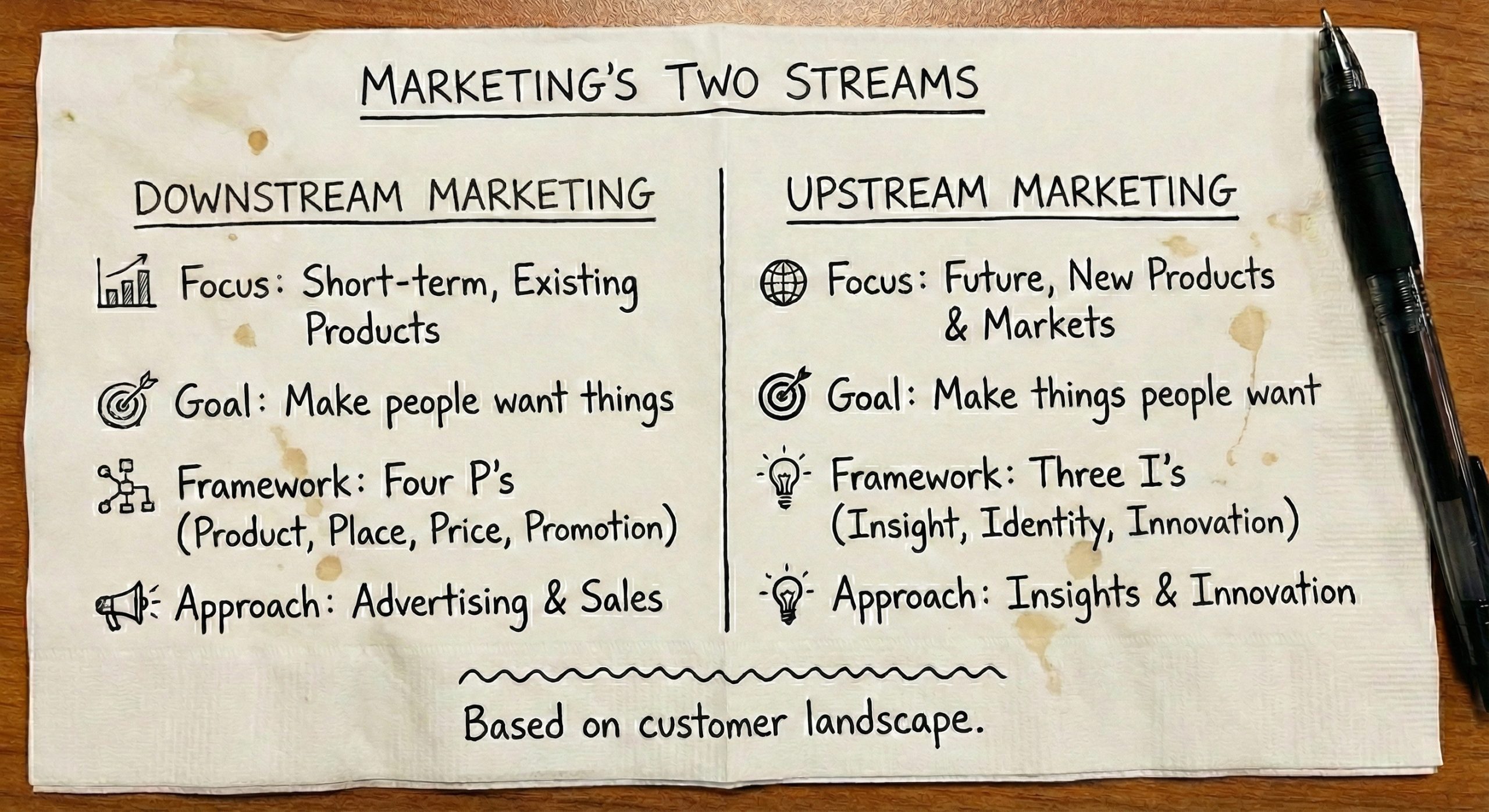
They have mastered the classic Four P’s (Product, Price, Place, Promotion). Their goal was simple: Make people want things. But today, AI systems now write copy, generate creative, test variations, and allocate spend in real time. Platforms increasingly decide what runs, when it runs, and who sees it.
Downstream marketing has become a high-speed machine.
This is not a failure of marketing. It is the natural outcome of pattern-based work becoming automated. Downstream execution was always rule-bound, repeatable, and optimizable. AI simply accelerated what was already true.
But the mistake many leaders make is assuming that faster execution automatically leads to better outcomes. In reality, speed without direction only magnifies whatever direction already exists. Automation does not create advantage. It amplifies it or exposes its absence.
The Shift from Left to Right
If you look at the two streams side-by-side, the difference is not just tactical; it is existential.
The left side is where the noise is – it is crowded, fast, and increasingly automated. It is the domain of “how.” The right side is where the clarity lives. It is the domain of “why.” The goal of modern leadership is to stop getting trapped in the commoditized battles on the left, and start owning the strategic advantage on the right.
The Trap: The Illusion of Motion
When execution equalizes, many teams respond by doing more.
More content. More campaigns. More testing. More dashboards. More motion.
This feels productive, but it is often defensive. Activity becomes a substitute for clarity. Output replaces understanding. Optimization replaces judgment.
We call this Surrender Marketing.
It is the act of outsourcing your thinking to systems designed only to optimize. The result is subtle but dangerous: Brands become busy but interchangeable. Messages improve incrementally while meaning erodes quietly. Performance metrics look acceptable, yet differentiation weakens.
This is how organizations surrender – not by abandoning marketing, but by letting the machine drive the car.
What Cannot Be Automated
AI excels at patterns. It finds correlations, surfaces trends, and improves efficiency at scale.
What it cannot do is decide what matters.
AI can report that customers are abandoning your pricing page. But it cannot tell you why – that perhaps your pricing model feels predatory to long-term users. AI sees the metric; it cannot see the friction, the anxiety, or the hope.
It cannot determine which tensions are meaningful versus which are noise. It cannot choose which problems deserve to be solved, or which promises a brand should commit to.
Those decisions are upstream decisions.
They require interpretation, context, and judgment. They require leaders to see customers as people navigating real lives, not as datasets producing signals.
When execution becomes a commodity, the scarce skill is no longer speed. It is understanding.
The Strategic Shift: Moving Upstream
The real shift underway is not technological. It is strategic.
As downstream work becomes automated, the center of gravity moves upstream. Advantage migrates to the disciplines that shape meaning before it is expressed at scale.
That starts with the Three I’s: Insight, Identity, and Innovation.
And the most critical of these is Insight.
Insight is not data. It is not dashboards, reports, or AI summaries. Insight is the discipline of understanding what customers are trying to accomplish in their lives.
Machines can surface signals. Humans must assign meaning.
Without insight, automation accelerates confusion. With insight, automation becomes powerful. This is the quiet truth of modern marketing: The better you understand the customer, the more effective every downstream system becomes.
The New Advantage Is Clarity
In an environment where everyone can execute well, the goal shifts. We are no longer just trying to make people want things; we are doing the hard work to make things people want.
Strategy stops being an abstract exercise and becomes a filter. It is the discipline of choosing where to focus, what to prioritize, and saying no to attractive distractions in order to say yes to meaningful progress.
This clarity does not come from more data. It comes from better questions, deeper listening, and disciplined interpretation.
Organizations that recognize this shift do not retreat from AI. They use it differently. They let machines accelerate execution, while leaders double down on understanding.
They move faster downstream because they are clearer upstream.
Stop Surrender Marketing
If execution has become faster, cheaper and easier to automate, then understanding the customer has become the most valuable work left for leaders.
Avoiding Surrender Marketing does not start with better tools or more optimization. It starts upstream, with the discipline of interpreting what customers are truly trying to accomplish in their lives, not just reacting to what the data surfaces.
If you want to reassert control over your strategic direction, take the next step upstream. Explore how high-performing teams build insight by focusing relentlessly on the end customer before execution begins.






Follow EquiBrand