
Step 3 of 6 | Strategic Direction
Strategic Direction and Opportunity Definition: Define where to play and what future to pursue
Part of the EquiBrand approach to building strategy:
Market Analysis → Customer Framework → Strategic Direction → Concept Development → Strategy Development → Guided Implementation
Strategic direction is where insight turns into choice.
After understanding the market and defining customer segments and needs, the next step is to determine:
Where should we focus, and what future are we trying to create?
At EquiBrand, our strategic direction consulting approach helps organizations define a clear point of view on where to play, which opportunities to pursue, and how to move forward with focus and confidence.
What is strategic direction?
Strategic direction is the process of translating market and customer insight into a clear set of priorities and opportunity areas.
It defines:
- Which customer segments to prioritize
- Which needs and demand spaces to focus on
- Which opportunities offer the greatest potential
- What the desired future state looks like
The output is not a detailed plan, but a clear strategic point of view that guides everything that follows.
Why this step matters
Many organizations move directly from insight into planning.
The result is often:
- incremental thinking
- lack of differentiation
- scattered initiatives
- unclear priorities
Strategic direction ensures that strategy is built around intentional choices, not reactive decisions.
It helps organizations:
- Focus on the most important opportunities
- Align leadership around a shared direction
- Define a clear future state
- Establish a foundation for positioning and innovation
Defining where to play
This step is the culmination of “where to play” decisions.
It integrates:
- Market dynamics
- Customer segments and needs
- Competitive context
Into a focused set of:
- Strategic opportunity areas
- Priority segments and targets
- Clear areas of emphasis and trade-offs
Rather than trying to do everything, organizations define where to concentrate effort.
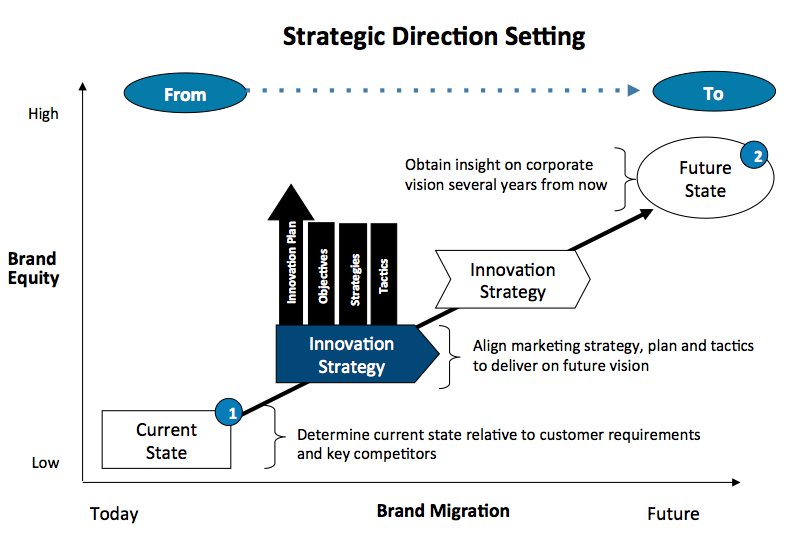
Begin with the end in sight
A core principle of EquiBrand’s approach, drawn from upstream marketing, is to:
Begin with the end in sight
This means:
- Defining the desired future state
- Working backward to understand what must be true to achieve it
- Making direction tangible early in the process
By establishing a clear view of the future, organizations can:
- Evaluate strategic options more effectively
- Align stakeholders more quickly
- Avoid drifting into incremental decisions
From opportunity areas to strategic focus
A key output of this step is defining strategic opportunity areas (SOAs).
Each opportunity area typically includes:
- Target segment definition
- Customer insight
- Need or situation
- Jobs to be done and benefits sought
- Estimated opportunity size or impact
These opportunity areas provide the foundation for concept development and strategy.
Grounded in upstream marketing
This step reflects the transition from:
👉 Understanding demand
to
👉 Choosing where to compete
It is inherently strategic, not creative.
Rather than brainstorming broadly, the focus is on:
- Identifying the most promising opportunity areas
- Applying judgment and prioritization
- Making trade-offs
This ensures that subsequent work is focused and meaningful.
How EquiBrand defines strategic direction
Our approach is designed to balance rigor with speed and alignment.
1. Synthesize market and customer insight
Identify key patterns, tensions, and opportunities
2. Develop alternative strategic paths
Define multiple ways the business could compete and grow
3. Define strategic opportunity areas
Structure opportunities into clear, actionable focus areas
4. Prioritize and make trade-offs
Evaluate based on attractiveness, fit, and feasibility
5. Align leadership around direction
Establish a shared point of view on where to focus
Key deliverables
- Strategic direction or vision statement
- Defined strategic opportunity areas
- Prioritized target segments and needs
- Initial hypotheses for positioning and growth
- Alignment around key strategic choices
These outputs set the stage for concept development and strategy refinement.
How this connects to marketing strategy
Strategic direction is the bridge between insight and execution.
It transforms:
- Market understanding
- Customer insight
Into:
- A focused set of strategic choices
This directly informs:
- Positioning and value proposition development
- Innovation and concept development
- Go-to-market strategy
What comes next
With strategic direction defined, the next step is to bring that direction to life through tangible, testable ideas.
→ Continue to Concept Development (Step 4 of 6)
Start with the right foundation
The most effective strategies are not just analyzed, they are chosen.
Strategic direction ensures that your organization is aligned around where to play and what future to pursue.
Start with an Upstream Diagnostic →
A focused marketing strategy assessment to identify priority opportunity areas, target segments, and strategic direction.





Follow EquiBrand