
As organizations expand across products, services, categories, and markets, complexity in brand systems often increases faster than clarity. New offerings, sub-brands, and acquisitions add layers to existing portfolios, leaving leadership teams with more brands than strategic guidance. Brand Portfolio Management addresses this challenge. It is a brand-strategy discipline focused on defining the role, purpose, and relationship of each brand within a broader system. While closely related to customer segmentation and brand architecture, Brand Portfolio Management provides the enterprise-level clarity required to manage brands intentionally over time. Many organizations engage with a brand consulting firm to support this work, particularly when portfolio complexity begins to slow alignment or dilute brand focus.
Brand Portfolio Management vs. Brand Architecture
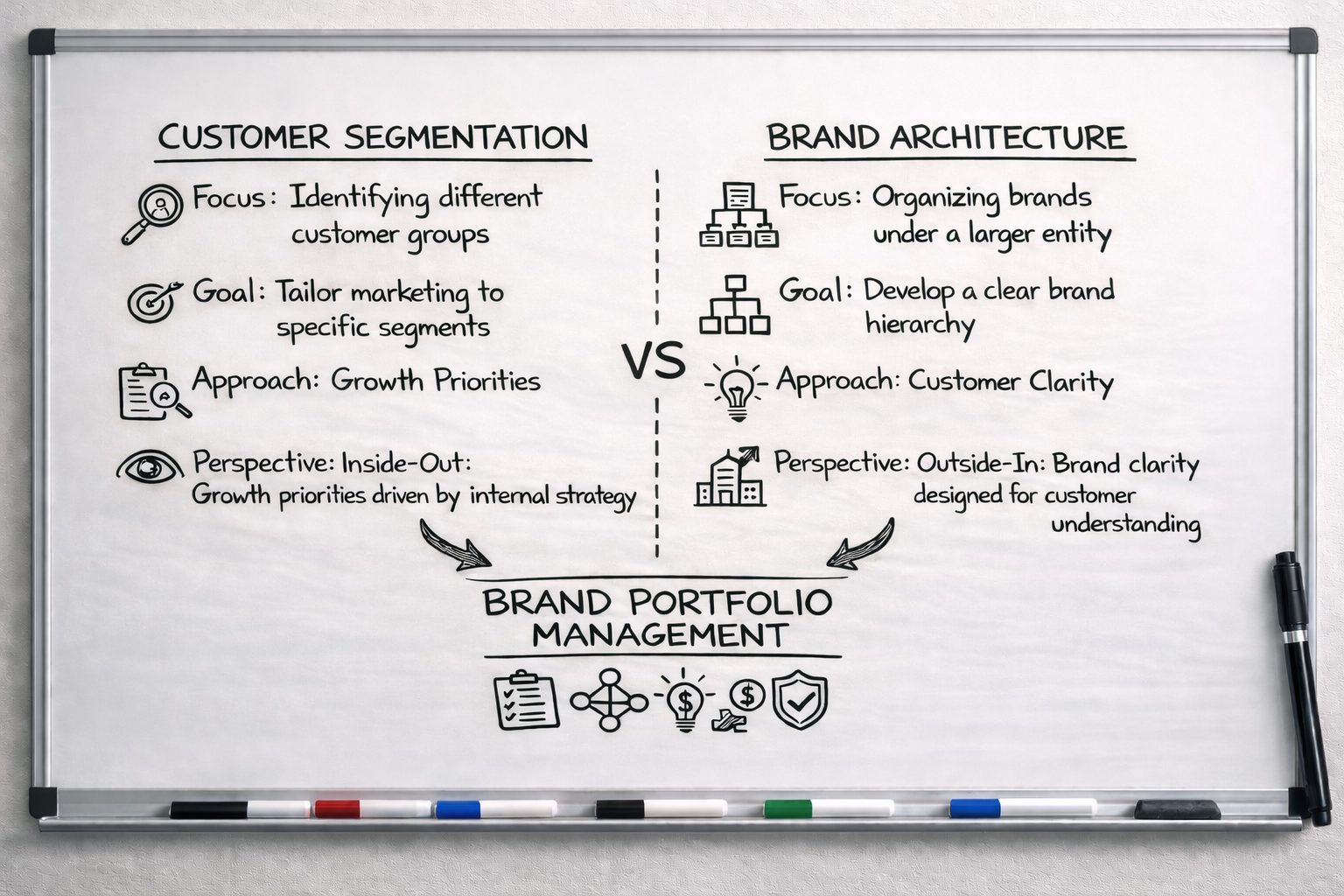
Brand Architecture and Brand Portfolio Management are often used interchangeably, but they serve different purposes. Brand Architecture defines how brands are structured and presented to customers. It is an outside-in discipline focused on clarity, navigation, and brand relationships. Brand Portfolio Management operates at a higher strategic level. It helps organizations determine which brands should exist, what role each brand plays, and how the portfolio should evolve as strategy changes. In practice, organizations most often revisit brand architecture at moments of portfolio change, such as acquisitions, major launches, or significant repositioning efforts. Architecture is therefore a critical output of portfolio strategy, but not a substitute for it.
From Customer Segmentation to Portfolio Decisions
Customer segmentation identifies where an organization should compete. It is typically inside-out and growth-led, clarifying priority audiences, unmet needs, and opportunity spaces. Brand Portfolio Management translates these insights into brand-level decisions. It ensures that segmentation of choices and brand structures reinforces one another, rather than creating overlap or confusion. This integrative role is a core focus of brand consulting services supporting organizations through growth, portfolio expansion, or consolidation.
How the Disciplines Work Together
At a high level, the relationship can be summarized simply:
Customer Segmentation + Brand Architecture = Brand Portfolio Management
- Customer segmentation clarifies where to compete
- Brand architecture clarifies how brands show up
- Brand Portfolio Management determines which brands should exist and how they work together
By integrating these perspectives, organizations reduce fragmentation and improve long-term brand coherence.
Why Brand Portfolio Management Matters at Scale
For Fortune 500 companies and funded growth organizations, unmanaged brand portfolios often become a constraint rather than an enabler. Common challenges include overlapping brand promises, inconsistent positioning, and inefficient use of marketing resources. Left unresolved, these issues dilute brand equity and slow decision-making.
1. A disciplined Brand Portfolio Management approach helps organizations:
- Define clear roles for each brand
- Focus brand and marketing effort more intentionally
- Introduce new brands or extensions without fragmenting the system
These outcomes are often the result of working with a brand consulting firm that brings objectivity and portfolio-level perspective.
2. Assessing Portfolio Health
An effective portfolio strategy includes periodic assessment of portfolio health, typically focused on brand clarity rather than financial modeling.
A portfolio review may examine:
- Brand awareness and customer perception
- Relative growth roles across brands
- Overlap or redundancy in offerings
- Alignment with long-term brand strategy
These insights inform decisions about consolidation, repositioning, or brand extensions while keeping the system focused and coherent.
The Role of Naming and Positioning
Brand Naming Services and brand positioning are most effective when guided by portfolio strategy. Naming or repositioning brands in isolation often creates short-term clarity at the expense of long-term coherence. When informed by Brand Portfolio Management, naming and positioning decisions reinforce the overall system rather than add complexity, a principle consistently emphasized in strong brand consulting practices.
Turning Brand Complexity into Strategic Advantage
Brand Portfolio Management is not about adding structure for its own sake. It is about enabling clarity, focus, and adaptability as organizations grow. For companies managing multiple brands or preparing for their next phase of growth, Brand Portfolio Management provides a strategic foundation for better brand decisions over time. This is why many organizations engage in a brand consulting firm to bring disciplined thinking and structured frameworks to portfolio strategy.
Continue the Work: Tools That Support Portfolio Clarity
Brand Portfolio Management decisions are only as strong as the inputs behind them, especially customer understanding, demand signals, and strategic focus. If you want to go deeper on the upstream work that strengthens segmentation and portfolio choices, these resources are a helpful next step.
- Define Your Purpose: To Whom? For What?
Use the customer demand framework to identify priority opportunities and focus where it matters most. Download the free guide here.
- Chapter 3 of our book, Upstream Marketing
Learn a practical approach to building deeper end-customer understanding, and uncovering insights competitors miss. Access your free chapter here.
Access these resources to begin applying upstream marketing principles that support clearer, more durable brand decisions.









Follow EquiBrand