
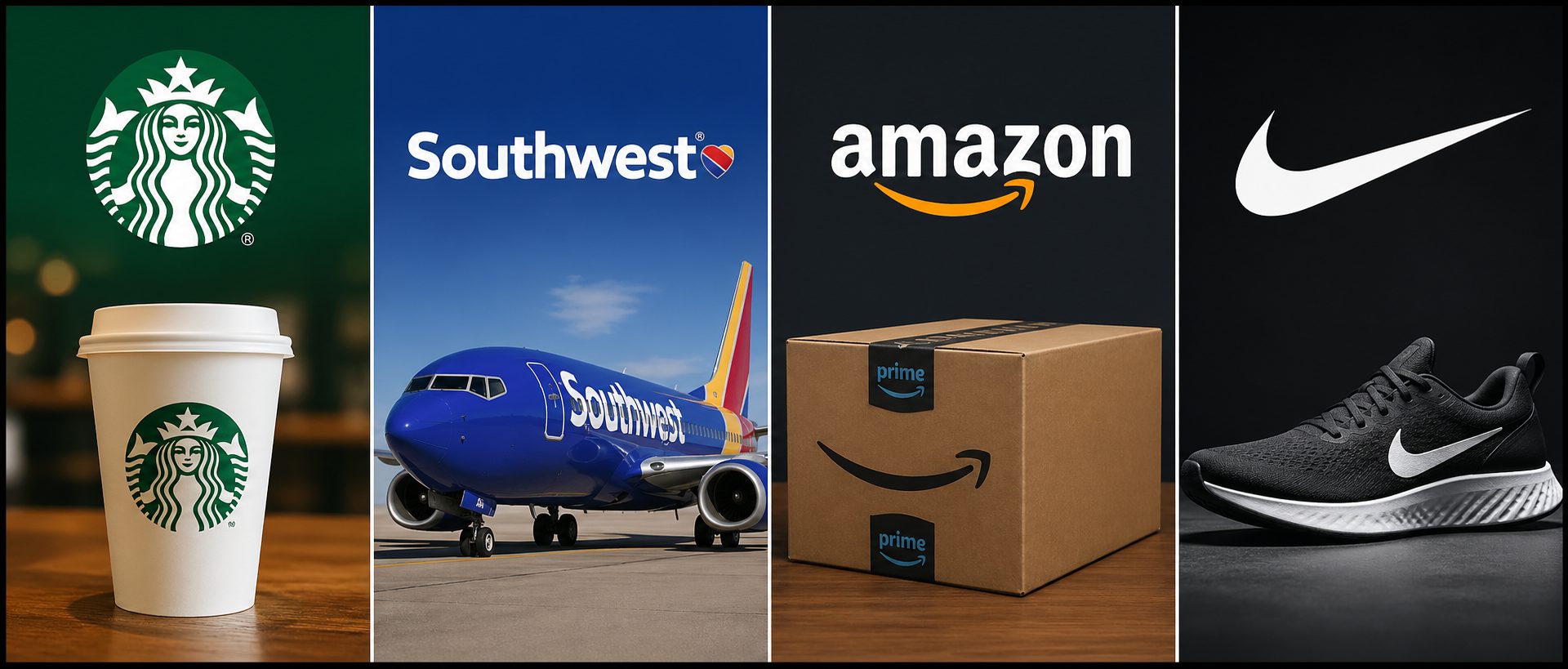
Value Proposition Examples
How Leading Brands Define and Deliver Value
Value propositions are often reduced to a single statement. In practice, they are far more than messaging.
A strong value proposition connects customer needs with the benefits a company chooses to deliver and the operational system required to deliver them consistently.
Below are real-world value proposition examples that illustrate how leading brands structure, align, and execute their strategies. Each demonstrates a different approach — and what each approach teaches about building competitive advantage.
What Makes These Examples Valuable
These aren’t aspirational case studies. They’re working examples of how successful organizations actually think about value — how they identify customer needs, choose which benefits to own, structure their operations to deliver consistently, and communicate in ways that resonate.
The patterns you’ll notice across these examples:
Multidimensional value. No leading brand competes on a single benefit. They layer complementary planks that reinforce each other.
Operational alignment. Their value propositions aren’t just marketing claims. They’re built into how the organization actually operates.
Clear trade-offs. Each brand is explicit about what they do and what they don’t do, who they serve and who they don’t.
Defensibility. Their value propositions are difficult for competitors to replicate because they require systemic alignment.
Value Proposition Examples: Individual Case Studies
Starbucks: Experiential Differentiation Built on Multiple Value Planks
Starbucks doesn’t sell coffee. It sells a premium experience built across product quality, customer interaction, environment, and emotional connection.
The plank structure:
- Premium product quality (beans, roasting, preparation)
- Personalized customer experience (barista knowledge, custom orders, relationship)
- Third place environment (spaces between home and work where customers belong)
- Convenience and accessibility (location strategy, mobile ordering, delivery)
- Emotional and social identity (status, community, ritual)
What this teaches: Competing in a commoditized category doesn’t require undercutting on price. It requires building multiple value planks that create a multidimensional experience competitors can’t easily replicate. Starbucks doesn’t just improve coffee — it improved how customers experience and think about coffee.
Southwest Airlines: Simplicity and Operational Excellence as Competitive Advantage
Southwest Airlines competes not by offering more amenities but by simplifying the flying experience and executing consistently at low cost.
The plank structure:
- Transparent, simple pricing (no hidden fees, no change fees, no baggage fees)
- Operational efficiency and reliability (fast turnarounds, on-time performance, direct routes)
- Employee friendliness and personality (culture as a value differentiator)
- Customer-friendly policies (boarding, baggage, standby)
What this teaches: A strong value proposition is built on coherence, not breadth. Southwest intentionally excludes premium services (seat assignments, meals, business lounges) that would complicate their model. Every plank reinforces the others. Their value proposition works because their entire operation is aligned around delivering it.
Amazon: Ecosystem, Convenience, and Scale as Reinforcing Value Planks
Amazon’s value proposition has evolved from “lowest prices” to a multidimensional ecosystem that makes shopping fundamentally more convenient.
The plank structure:
- Selection (broadest catalog available)
- Convenience (one-click ordering, fast delivery, easy returns)
- Ecosystem integration (Prime membership, streaming, cloud services)
- Price competitiveness (scale advantage, data-driven pricing)
- Customer reviews and transparency (trust and information)
What this teaches: The strongest value propositions compound over time. Early advantage in one plank (selection) enables investment in others (convenience, speed). As planks accumulate and reinforce each other, they become progressively harder for competitors to match. Amazon’s value proposition isn’t about any single plank — it’s about the system.
What These Examples Have in Common
While each company takes a different approach, strong value propositions share several characteristics:
They Are Multidimensional
Not a single statement, but a system of reinforcing benefits. One plank reaches customers for whom that benefit is most important. Additional planks reach incrementally more customers until diminishing returns set in.
They Align Internally and Externally
Strategy, operations, and customer experience work together. The value proposition isn’t just what marketing says — it’s what customers experience when they interact with the company.
They Require Trade-offs
Companies choose what to prioritize and what to exclude. Southwest doesn’t offer business class. Starbucks doesn’t compete on price. Amazon doesn’t emphasize luxury experience. Clear choices about what you won’t do make what you will do stronger.
They Evolve Over Time
New value planks can be added as the business grows. But evolution is intentional, research-validated, and structurally coherent — not reactive or scattered.
They Are Difficult for Competitors to Replicate
Not because any single plank is proprietary, but because matching all the planks simultaneously requires systemic organizational change. Competitors can match features. They struggle to match systems.
Value Proposition Framework: How It Works
These examples all follow the same underlying three-part framework:
Customer Needs — What the target customer is trying to accomplish, avoid, improve, or achieve.
Examples from these companies:
- Starbucks: customers want a welcoming space and a sense of ritual
- Southwest: customers want affordable travel without complications
- Amazon: customers want choice and convenience combined
Differentiated Benefits (Value Planks) — The specific outcomes customers receive that create preference and choice.
Examples:
- Starbucks: “a third place where you belong”
- Southwest: “transparent pricing with no surprises”
- Amazon: “everything you need, delivered fast”
Value Elements — The capabilities, assets, products, services, and experiences that enable those benefits.
Examples:
- Starbucks: store design, barista training, supply chain control
- Southwest: aircraft standardization, employee culture, route strategy
- Amazon: warehouse network, technology platform, data analytics
When these three elements align, the value proposition becomes powerful and defensible.
To understand the full framework behind these examples, see our Value Proposition Development Guide →
The benefit-plank framework used in this analysis — the ante, driver, and reassurance roles — comes from Upstream Marketing, endorsed by Philip Kotler. Read Chapter One free, or get the book on Amazon →
How to Evaluate and Apply These Examples to Your Organization
These case studies are not templates. Your organization will have a different market, different customers, different capabilities, and different opportunities. But you can learn from their structural approach:
1. Map Your Customer Needs Clearly
Don’t assume you know what drives customer choice. Validate through research. What are customers actually trying to accomplish? What are they trying to avoid?
2. Identify Your Potential Value Planks
Brainstorm the benefits you could deliver. Then research which ones matter most to customers and where your organization has genuine competitive advantage.
3. Evaluate Your Combination for Reach
Not all plank combinations are equally effective. TURF analysis shows which combinations reach the most customers in your target market.
4. Test for Organizational Alignment
Can your organization actually deliver each plank credibly? Where are the gaps? Which gaps are worth closing? Which planks should be removed?
5. Sequence Your Architecture
Which plank should lead? Which follows? The order matters — both for how customers perceive your value and for how you allocate organizational resources.
Frequently Asked Questions
Should we try to replicate the structure of one of these companies?
No. These companies are structurally aligned to their markets, customers, and capabilities. What you should replicate is the discipline — clear customer needs, multidimensional benefits, operational alignment, and intentional trade-offs. Your specific planks will be different.
How do we know if we have enough planks?
Research tells you. TURF analysis shows the point where adding another plank produces minimal additional customer reach. For most organizations, that’s between four and six planks. Too few and you limit your appeal. Too many and you dilute focus and strain operations.
What if we’re in a category these examples don’t address?
The framework applies universally. Identify your customer needs, define your potential benefits, validate through research, align your organization. The specific planks will differ by industry, but the process is the same.
Can we add new planks to our value proposition over time?
Yes, but intentionally. Major additions should go through research and validation before implementation. Adding planks reactively to match competitors typically weakens rather than strengthens your proposition.
How do these examples inform positioning strategy?
Your value proposition is the foundation. Your positioning is how you frame your value relative to competitors. These examples show how clear value propositions enable clear positioning.
Related Value Proposition Resources
- Value Proposition Strategy Hub
- The Definitive Guide to Value Proposition Strategy
- Value Proposition Frameworks
- Value Proposition Research
- Sales and Marketing Alignment Through Value Proposition Strategy
- Value Proposition & Brand Positioning
- Value Propositions in Business Markets
- Beyond the Value Proposition Canvas
- How to Choose a Value Proposition Consulting Firm
Define Your Own Value Proposition
Most organizations struggle not with ideas, but with alignment.
The Upstream Strategy Diagnostic evaluates your current value proposition against these examples, identifies where you have clarity and where you have gaps, and defines a focused roadmap for building a stronger, more defensible proposition.
We evaluate:
- What do customers actually value and what creates preference?
- Which of your benefits are truly differentiated versus table stakes?
- How well does your current value proposition reflect customer insight?
- How clearly is your value proposition connected to positioning?
- What value proposition changes would have the greatest impact on growth?
Request an Upstream Strategy Diagnostic
Typically completed in 4–6 weeks.
Tim Koelzer is the founder of EquiBrand Consulting and author of Upstream Marketing. He helps organizations clarify strategy before executing.





Follow EquiBrand