
Value Proposition Consulting
Define Why Customers Choose You Over Every Alternative
Many organizations struggle to clearly articulate why customers should choose them. Their products may be strong. Their capabilities may be differentiated. Yet customers still struggle to understand the value being offered — and so does the organization itself.
When value proposition is unclear or misaligned with what customers actually value, growth becomes more difficult. Sales conversations become less effective. Positioning becomes generic. Pricing power diminishes. Marketing investments generate weaker returns. New offerings fail to gain traction.
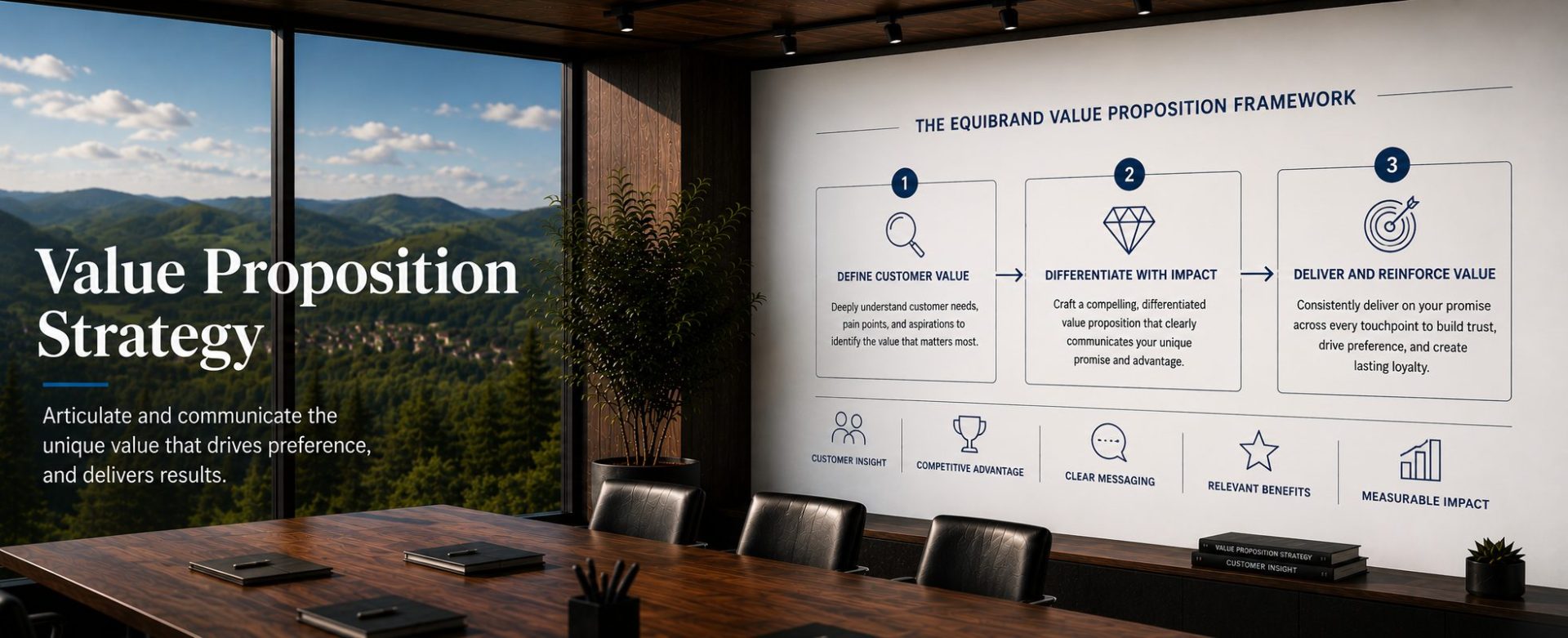
EquiBrand helps organizations develop value propositions that clarify why customers choose them, strengthen differentiation, and guide strategic decisions across the organization. A strong value proposition becomes the foundation for positioning, innovation, and sustainable growth.
What We Help You Accomplish
When you work with EquiBrand on value proposition strategy, we help you:
Clarify what customers actually value. Understand which customer needs matter most and which benefits would create genuine preference. Move from assumption-driven strategy to insight-driven strategy.
Define a structured benefit framework. Rather than a single-sentence value statement, develop a structured set of benefit planks — typically four to six — that together describe the full scope of value your brand delivers.
Differentiate meaningfully. Identify benefits that competitors can’t easily replicate. Distinguish between table-stake benefits (ante), purchase-driving benefits (driver), and emotionally credible benefits (reassurance).
Align the organization around value. When leadership shares the same definition of why customers choose you, strategy becomes more coherent and execution more aligned.
Connect value to business outcomes. Ensure value proposition informs positioning, guides innovation priorities, supports pricing decisions, and improves sales effectiveness.
Build value that’s operationally deliverable. Value propositions that aren’t grounded in organizational capability create credibility gaps. We ensure benefits are supported by actual capability.
Why Value Proposition Initiatives Often Fail
Many organizations invest in value proposition work but fail to create strategic impact. Common reasons include:
Confusing value proposition with messaging. Organizations develop a headline or tagline thinking that’s their value proposition. Messaging communicates value. It doesn’t create it. A strong value proposition is a system — the alignment of customer needs, differentiated benefits, and organizational capability. Messaging expresses that system. Without the system, messaging falls flat.
Creating statements instead of frameworks. A single-sentence value proposition oversimplifies customer decision-making. Real purchase decisions involve multiple benefits working together. Customers evaluate you on multiple dimensions. A framework that captures that multidimensional value is more powerful than a single claim.
Disconnecting from customer insight. Value propositions developed without deep understanding of what customers actually value often miss the mark and fail to resonate. Internal assumptions about what matters rarely match what customers actually prioritize.
Building benefits that aren’t operationally supported. Making benefit claims without the operational capability to deliver them creates credibility problems. When customers test the proposition against their experience and find gaps, trust erodes faster than almost anything else.
Treating value proposition as marketing’s job. Value proposition is strategic — it requires alignment across product, operations, sales, and marketing. When only one function owns it, organizational misalignment typically follows.
Not distinguishing between benefit types. Treating all benefits as equal misses the strategic role different benefits play. Ante benefits (table stakes) are required but don’t differentiate. Driver benefits create preference. Reassurance benefits close conversions. Understanding these roles shapes investment priorities and messaging strategy.
Failing to integrate with positioning. Value proposition and positioning are distinct but connected. Value proposition answers “Why should customers choose you?” Positioning answers “Why instead of alternatives?” Failure to clarify their relationship creates confusion.
How EquiBrand Approaches Value Proposition
We develop value propositions that are analytically rigorous, strategically coherent, and operationally deliverable.
Starting with customer insight. We begin with deep understanding of customer needs, motivations, how customers evaluate alternatives, and what creates genuine preference. This foundation is essential. Everything that follows is built on this insight.
Structuring benefit planks strategically. Rather than a broad statement, we develop structured benefit planks that reflect customer needs and competitive differentiation. Typically four to six planks, organized to work together as a system rather than a list.
Classifying benefits by role. We distinguish between ante benefits (table stakes), driver benefits (purchase drivers), and reassurance benefits (emotional/credibility). Each plays a different strategic role. Understanding these roles shapes everything downstream — investment priorities, messaging sequencing, sales conversation strategy.
Validating with research. We combine qualitative insight with quantitative validation to ensure benefits resonate and the overall proposition maximizes reach and preference. This moves decisions from intuition to data.
Aligning with organizational capability. We ensure benefits are supported by actual product, service, operational, and experiential capability. Benefits without capability create credibility gaps that erode trust.
Connecting to positioning and strategy. We ensure value proposition clearly links to brand positioning, innovation priorities, go-to-market strategy, and portfolio coherence. Value proposition isn’t isolated — it’s the foundation that all strategic decisions build on.
Driving organizational alignment. We facilitate discussions that align leadership around value and its strategic implications. When the executive team shares the same definition of why customers choose you, everything that follows — product decisions, messaging, resource allocation — becomes more coherent.
Service Outcomes
When you work with EquiBrand on value proposition, you gain:
Clarity on why customers choose you — grounded in customer insight, not organizational assumption
A structured benefit framework — typically 4-6 planks that together create differentiation
Understanding of customer decision-making — which benefits drive preference, which create credibility, which are table stakes
Competitive clarity — what you deliver that competitors can’t easily replicate
Operational alignment — benefits supported by actual capability
Strategic coherence — value proposition that informs positioning, innovation, and go-to-market decisions
Confidence in your story — leadership aligned around why customers choose you and what that means strategically
When Organizations Engage EquiBrand for Value Proposition
Organizations typically work with us when:
- Customer understanding of value is vague or unclear
- Value proposition feels generic or interchangeable with competitors
- Messaging doesn’t resonate because value isn’t clear
- Sales teams struggle to articulate why customers should choose you
- New offerings fail to gain traction despite strong capability
- Positioning isn’t landing because value proposition is misaligned
- Leadership disagrees about what makes you distinctive
- Pricing power is eroding and value needs to be reinforced
- Growth has stalled and value proposition clarity is needed to unlock it
Related Value Proposition Resources
- The Definitive Guide to Value Proposition Strategy
- Value Proposition Frameworks
- Value Proposition Research
- Value Proposition Examples
- Sales and Marketing Alignment Through Value Proposition Strategy
- Value Proposition & Brand Positioning
- Value Propositions in Business Markets
- Beyond the Value Proposition Canvas
- How to Choose a Value Proposition Consulting Firm
How This Connects to Your Strategic System
Value proposition doesn’t exist in isolation. It connects directly to customer insight, brand strategy, and go-to-market execution.
Customer Insight Foundation
Value proposition is built on deep customer insight — understanding customer needs, what drives preference, how customers evaluate alternatives, and where unmet demand exists. Without this foundation, value proposition remains assumption-based.
→ Explore Customer Insights & Analytics
Brand Positioning Connection
Value proposition defines why customers choose you. Positioning defines how you’re understood relative to alternatives. Together, they create a complete strategic foundation.
→ Explore Brand Positioning → Explore Value Proposition & Positioning
Brand Strategy Alignment
How brands and offerings are structured should reflect customer value. Brand architecture decisions should align with the value propositions each brand delivers.
→ Explore Brand Strategy → Explore Brand Architecture
Portfolio Coherence
Each offering in your portfolio should deliver clear value aligned with Strategic Opportunity Areas. Value proposition clarity is essential to portfolio coherence.
Innovation & Growth
Unmet customer needs revealed through value proposition work inform innovation priorities. Value proposition clarity guides which growth opportunities deserve investment.
→ Explore Growth & Innovation Strategy
Go-to-Market Execution
Value proposition guides messaging, positioning, customer experience design, and sales strategy. Go-to-market execution should bring value proposition to life consistently.
→ Explore Go-to-Market Strategy
Start With Strategic Clarity
If your value proposition is unclear, misaligned with customer reality, or disconnected from strategy, the Upstream Strategy Diagnostic can help.
We evaluate:
- What do customers actually value and what creates preference?
- Which benefits are truly differentiated versus table stakes?
- How well does current value proposition reflect customer insight?
- How clearly is value proposition connected to positioning?
- What value proposition changes would have the greatest impact on growth?
Request an Upstream Strategy Diagnostic
Typically completed in 4–6 weeks.
Tim Koelzer is the founder of EquiBrand Consulting and author of Upstream Marketing. He helps organizations clarify strategy before executing.





Follow EquiBrand