
Brand Positioning Consulting: Define How Customers Understand Your Brand
If your position in the market isn’t clear, your brand will be misunderstood.
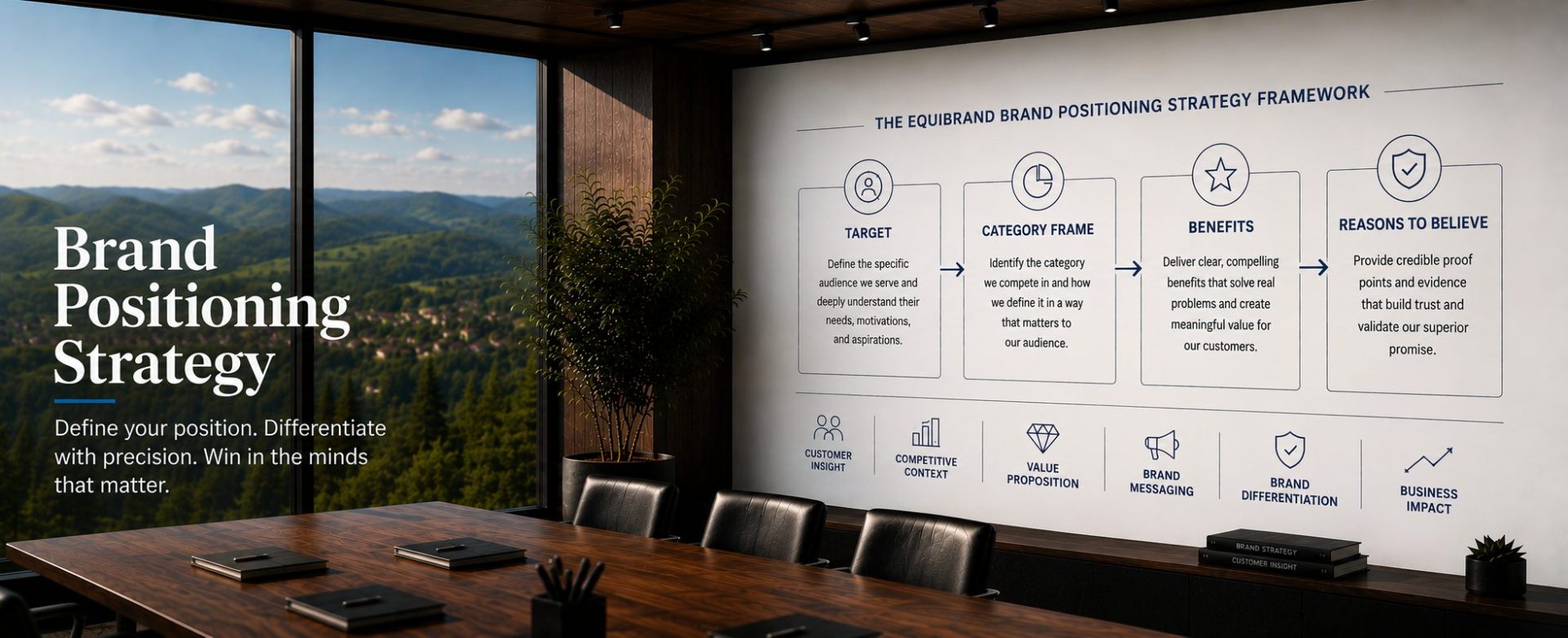
We help organizations define a clear, differentiated market position through focused brand positioning strategy and consulting, so they can compete effectively, communicate with precision, and align their teams around a shared direction.
When Organizations Focus on Brand Positioning
Organizations typically engage positioning consulting when critical clarity gaps emerge:
Their brand feels unclear or inconsistent in the market. Customers struggle to articulate what makes the brand different. Marketing messages feel interchangeable with competitors.
Differentiation is difficult to establish. Competitors offer similar features or benefits, making it hard to claim meaningful distinction. Price becomes the primary lever because positioning is weak.
Growth is constrained by lack of clarity. The market understands what you do but not why they should choose you. Sales conversations drift toward price instead of value.
Teams are misaligned on how the brand should be understood. Sales describes the offering one way, marketing another, product a third. This fragmentation makes consistent execution impossible.
Multiple offerings create confusion. As organizations expand their product or service lines, it becomes unclear how offerings relate to one another or what each is positioned to deliver.
These challenges are upstream problems. They cannot be solved through better messaging alone. They require clarity on how your brand is positioned in the minds of customers and how that position is defended against competition.
Why Positioning Efforts Fail
Most positioning initiatives fall short not because the process is flawed, but because critical elements are missing or misaligned:
Positioning built on assumptions rather than customer insight. Many organizations develop positioning based on internal beliefs about what matters to customers, not evidence of what customers actually value. This positioning sounds compelling internally but fails to resonate in market because it misses what customers genuinely care about.
Positioning developed in isolation from value proposition. A clear position must be grounded in benefits you can actually deliver. When positioning is created without deep understanding of your value proposition, you end up with a position you can’t sustain. Customers eventually discover the gap between your position and your reality.
Positioning that isn’t integrated with brand architecture. Organizations with multiple products, services, or brands often develop positioning for the master brand without clarifying how sub-brands or offerings fit within that position. This creates confusion. Customers don’t understand how offerings relate to one another or which solution is right for their situation.
Positioning without true organizational alignment. Positioning only works when marketing, sales, product, and leadership operate from the same strategic understanding. When alignment is missing, execution becomes inconsistent. Sales ignores the position. Marketing undermines it. Product decisions contradict it. Over time, the position erodes.
Positioning treated as a one-time exercise. Markets evolve. Competitors shift. Customer expectations change. Positioning that worked five years ago may no longer be defensible. Organizations that treat positioning as a one-time deliverable often find it drifts without intent, becoming weaker over time.
At EquiBrand, we approach positioning as an integrated strategic system — grounded in customer insight, aligned with what you can deliver, integrated with your brand architecture, and maintained through ongoing organizational discipline. This ensures positioning is both defensible and durable.
What We Help You Do
We work with leadership teams across four interconnected areas to develop positioning that sticks:
Ground positioning in customer insight. We conduct research to understand how customers actually evaluate alternatives, what decision criteria matter most, and what needs are unmet. This foundation ensures positioning reflects market reality, not internal assumptions.
Define your competitive frame. We clarify where you compete and against whom. This means identifying the true competitive context — not who you think competitors are, but who customers perceive as alternatives. Positioning must address this reality.
Establish clear differentiation. We identify points of meaningful difference and parity. This requires discipline: what makes you distinctly valuable? What are you willing to concede to competitors? Strong positioning involves strategic choices about what you will own and what you will not.
Align across your organization. We ensure positioning is understood and adopted across marketing, sales, product, and leadership. Without alignment, positioning is just a document. With it, positioning becomes the decision-making system that guides strategy and execution.
Why Organizations Work with EquiBrand on Brand Positioning
Organizations across B2B and consumer markets engage EquiBrand when they need a brand positioning consulting firm that brings both methodological rigor and senior-level judgment to positioning decisions.
Integrated approach. Positioning does not exist in isolation. It connects directly to value proposition, brand architecture, messaging, and go-to-market execution. We treat these as an interdependent system — not separate projects. Positioning built in isolation produces strategies that sound strong internally but are difficult to activate consistently in market.
Research-driven, not aspirational. Every brand positioning engagement begins with structured discovery: customer interviews, stakeholder interviews, competitive analysis, and segmentation work to understand what actually drives purchase decisions. Positioning built on internal assumptions consistently underperforms. We validate strategy with real buyer evidence before finalizing recommendations — the discipline that prevents the most common failure in positioning work.
Senior engagement throughout. Every engagement is led directly by a senior consultant from discovery through final recommendations — not handed off to junior staff after the initial brief. Clients work with the same person at every stage, which produces stronger strategic decisions and cleaner execution.
Proven across sectors. EquiBrand has developed brand positioning strategies for Fortune 500 companies, mid-market leaders, and growth-stage organizations across consumer products, energy, automotive, financial services, technology, and professional services. The competitive dynamics differ by sector; the methodology stays consistent.
Representative Brand Positioning Engagements
Automotive brand — Repositioning and value proposition. A leading automotive manufacturer engaged EquiBrand to reposition an established brand and extend its value proposition to support long-term growth. The engagement included customer research, competitive assessment, revised positioning, and updated messaging frameworks aligned to the new strategic direction.
Professional services firm — Launch positioning. A newly formed professional services organization needed a clear strategic position to differentiate in a competitive market. EquiBrand developed positioning grounded in qualitative research with target clients, competitive mapping, and leadership alignment — giving the firm a credible and distinctive market position from launch.
Pharmaceutical product — Launch positioning. A biotech client needed a defensible launch position for a new product form entering a crowded therapeutic category. EquiBrand developed the positioning strategy including target patient segment definition, competitive frame of reference, key benefit articulation, and the messaging foundation for healthcare provider communications.
Core Areas of Brand Positioning
We help organizations develop positioning through these interconnected areas. Each represents a distinct dimension of the positioning work:
Develop your competitive frame of reference, define points of difference and parity, and structure a defensible market position grounded in customer insight and competitive dynamics. Positioning strategy is the foundation — it clarifies what position you will own and why customers should believe it.
See how leading brands use positioning to win in their markets. Real-world examples reveal the strategic frameworks behind positioning that works — from how Tesla positions around vision, to how Patagonia positions around values, to how Amazon positions around operational capability. These examples show that strong positioning flows from strategic choices, not creative messaging.
Translate your positioning into clear, consistent communication across all customer touchpoints. Messaging is how positioning shows up in market — in sales conversations, marketing campaigns, product experience, and customer interactions. Strong messaging systems ensure positioning is consistently expressed, not diluted through inconsistent communication.
How We Develop Positioning
Positioning is built on three interconnected foundations. Without all three, strategy remains incomplete and execution becomes fragmented.
Customer Insight Foundation. We begin with deep understanding of how customers actually make decisions, what they value most, and how they evaluate alternatives. We don’t assume we know what matters. We conduct research — segmentation studies, customer interviews, competitive analysis — to uncover the evidence. Without this foundation, positioning relies on internal assumptions that rarely survive contact with market reality.
Competitive Context. We position you within a clear competitive frame — not in isolation, but in relation to what customers see as true alternatives. Your position must be distinctive relative to real competition. It must also be relevant to how customers think about the category. Positioning that is unique but irrelevant to customer decision-making fails. Positioning that is relevant but not distinctive gets lost in noise.
Organizational Alignment. Positioning only works when leadership teams, marketing, sales, and product all operate from the same strategic understanding. This requires moving beyond workshops and documents. Alignment means embedding positioning into how decisions are made. Sales uses positioning to guide which opportunities to pursue. Product uses it to guide development priorities. Marketing uses it to guide all communication. When alignment is real, positioning becomes the system that guides strategy execution.
What Clear Positioning Delivers
When positioning is clear and aligned:
Market Impact. Customers understand what makes you different. Marketing becomes more efficient because messaging is no longer scattered across competing narratives. Your brand begins to own space in customers’ minds.
Competitive Advantage. Your position becomes defensible. Competitors can’t easily copy it because it’s grounded in your specific capabilities and customer insight, not just messaging or creative execution. Price pressure decreases as customers recognize genuine differentiation.
Internal Alignment. Leadership, marketing, sales, and product teams make decisions from the same strategic foundation. Organizational energy stops being wasted on internal debates about positioning and gets directed toward executing it consistently.
Go-to-Market Efficiency. Positioning clarifies where to invest. You stop pursuing every opportunity and focus on customers and market contexts where your position is strongest. This focus improves conversion and reduces wasted effort on poor-fit opportunities.
Long-Term Growth. Strong positioning supports premium pricing, customer loyalty, and brand equity extension. It becomes the foundation for sustainable growth, not just quarterly campaigns or seasonal promotions.
Related Capabilities
Brand positioning is one critical component of a larger strategic system. These related capabilities often work together to create alignment:
- Value Proposition & Positioning — How value proposition and positioning work together to define why customers choose you
- Brand Strategy — How to structure brands for clarity and growth (brand positioning is one component)
- Marketing Strategy — How to define where to compete and how to win (positioning reflects this strategic choice)
- Go-to-Market & Customer Experience — How to translate positioning into consistent market impact across the customer journey
- Brand Architecture — How to organize brand portfolios so positioning is clear across multiple offerings
- Growth & Innovation — How to identify growth opportunities and ensure positioning supports them
Clarify Your Position
The most effective way to define or refine your positioning is through a focused assessment.
We evaluate your current positioning, competitive context, and organizational alignment. We identify gaps, opportunities, and the most critical priorities for positioning work. We provide clear, actionable recommendations for strengthening your position.
Typically completed in 4–6 weeks.





Follow EquiBrand