

Starbucks Value Proposition Example: Breakdown and What You Can Learn
Starbucks is a great example of how “commoditized” products can compete on value by combining multiple, reinforcing brand benefit planks.
At its core, Starbucks does not just sell coffee. It builds a differentiated experience across product quality, customer interaction, and environment, creating what it famously calls a “third place.”
In this Starbucks value proposition example, we break down the key elements that drive its success and what businesses can learn from it.
Starbucks Value Proposition (Simple Summary)
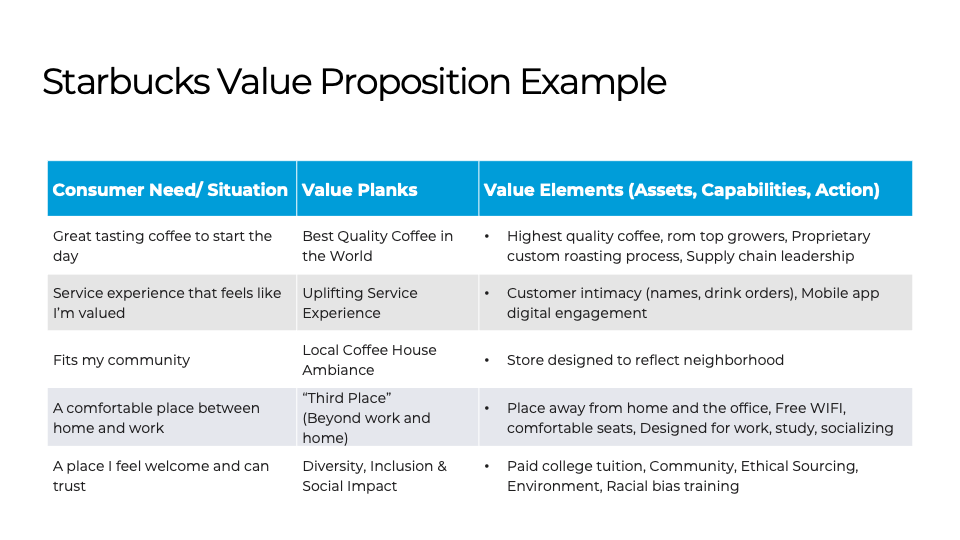
At a high level, Starbucks’ value proposition is built across five key dimensions:
-
Product quality: Premium, consistent coffee supported by supply chain control
-
Customer experience: Personalized, human interaction at scale
-
Convenience: Seamless digital ordering, payment, and rewards
-
Atmosphere: A localized, comfortable “third place” environment
-
Brand values: Social impact, inclusiveness, and employee investment
Together, these elements allow Starbucks to command premium pricing while maintaining strong customer loyalty.
To understand the full framework behind this example, see our Value Proposition Development Guide →
The benefit-plank framework used in this analysis — the ante, driver, and reassurance roles — comes from Upstream Marketing, endorsed by Philip Kotler. Read Chapter One free, or get the book on Amazon →
Starbucks Value Proposition Breakdown
1. Product Quality and Control
The first value plank ties to the core product, coffee, and sets a clear ambition: to offer the best-tasting coffee in the world.
Starbucks supports this by:
-
Working directly with growers
-
Controlling its roasting process
-
Managing retail distribution
Given how central product quality is to its positioning, Starbucks invests heavily in maintaining consistency and perceived superiority.
2. Customer Intimacy and Personalization
Customer experience is the second major plank.
Starbucks aims to deliver an uplifting, personalized experience across both physical and digital interactions.
-
In-store: Baristas use customer names, remember orders, and create intentional interactions
-
Digital: The app enables ordering ahead, payments, and rewards tracking
Delivering this level of personalization across thousands of locations is complex, but it reinforces emotional connection and repeat behavior.
3. Store Experience and Atmosphere
The third plank centers on the in-store environment.
Rather than standardizing every location, Starbucks designs stores to reflect local culture and neighborhood characteristics.
This approach:
-
Enhances authenticity
-
Strengthens customer connection
-
Reinforces brand differentiation
4. The “Third Place” Strategy
For many customers, Starbucks serves as a “third place” outside of home and work.
Howard Schultz described this as a core responsibility:
“Providing the world with a warm and welcoming third place may just be our most important role and responsibility, today and always.”
Beyond brand storytelling, this is also a business strategy. By creating a space where customers linger, Starbucks increases engagement and drives incremental revenue throughout the day.
5. Social Impact and Brand Values
The final plank focuses on social impact, diversity, and employee investment.
These values are not separate from the experience. They are embedded throughout the business.
As Schultz noted:
“We built the Starbucks brand first with our people, not with consumers.”
This reinforces trust, strengthens culture, and supports long-term brand equity.
What Businesses Can Learn from Starbucks’ Value Proposition
Strong value propositions are not accidental. They are built through deliberate choices and alignment across the organization.
Key takeaways include:
-
Competing beyond the core product
-
Creating emotional and experiential differentiation
-
Aligning digital and physical experiences
-
Reinforcing value through multiple, consistent touchpoints
Organizations that succeed in this area make clear decisions about how they create and deliver value, not just what they sell.
→ Learn more about our value proposition consulting approach
Explore Other Value Proposition Examples
For a broader overview of how strong value propositions are structured, differentiated, and aligned to growth strategy, explore our comprehensive guide to value proposition examples.
You may also find these helpful:
-
Nike value proposition
Looking at multiple companies helps clarify how different strategies create different outcomes.
From Example to Strategic Choice
While Starbucks provides a powerful illustration, most organizations face more complex tradeoffs when defining their own value proposition.
Leadership teams must evaluate:
-
Alternative positioning directions
-
Competing sources of differentiation
-
Long-term growth implications
These tradeoffs are explored further in The Tale of Two Brands, which examines how different value proposition choices lead to different outcomes.
From Value Proposition to Positioning
A strong value proposition is the foundation of effective positioning.
Apply These Principles to Your Own Value Proposition
The Starbucks value proposition demonstrates how customer needs, brand benefits, and value elements can work together to create strong customer preference. While every industry is different, the underlying principles remain the same.
The resources below provide additional frameworks, guidance, and best practices for developing a stronger value proposition within your own organization.
Customer Value Proposition Framework
Learn the proven framework for identifying customer needs, aligning benefits, and building stronger customer preference.
Brand Positioning Consulting
A value proposition defines why customers should choose you. Positioning determines how you should be perceived relative to competitors.
Customer Insight & Analytics Consulting
Strong value propositions begin with a deep understanding of customer needs, decision criteria, and unmet opportunities.
How to Choose a Value Proposition Consulting Firm
Understand the questions to ask, capabilities to evaluate, and warning signs to consider when selecting a consulting partner.
Need Help Applying This Framework?
Many organizations understand the importance of customer value but struggle to define it clearly.
Our Value Proposition Consulting Services help leadership teams identify customer needs, define differentiated brand benefits, align value elements, and create stronger customer preference.
Or begin with an Upstream Diagnostic to assess your current value proposition, identify opportunities, and define a path forward.
The principles behind Starbucks’ value proposition — a structured plank set, clear ante-driver-reassurance roles, and organizational investment aligned to delivery — are the same principles EquiBrand applies in its value proposition consulting work. The difference between companies that compete on value and those that compete on price is rarely product quality. It is almost always strategic clarity about which benefit planks to stand for, which to lead with, and whether the organization is genuinely built to deliver them.








Follow EquiBrand