

What Is Surrender Marketing?
When Marketing Capability Outpaces Strategic Clarity
Surrender Marketing occurs when organizations gradually transfer strategic marketing judgment to platforms, algorithms, dashboards, and tactical execution — while underinvesting in the decisions that create long-term differentiation and sustainable growth.
It doesn’t happen through a single bad decision. It happens through hundreds of good ones. Understanding how requires understanding how the marketing profession got here — because the path matters as much as the destination.
How Did We Get Here?
Each stage of marketing’s evolution created genuine value. Collectively, they shifted organizational attention in the same direction — toward execution, away from strategy. Every improvement in execution capability made strategic questions slightly easier to defer. Over time, deferral became habit. Habit became structure.
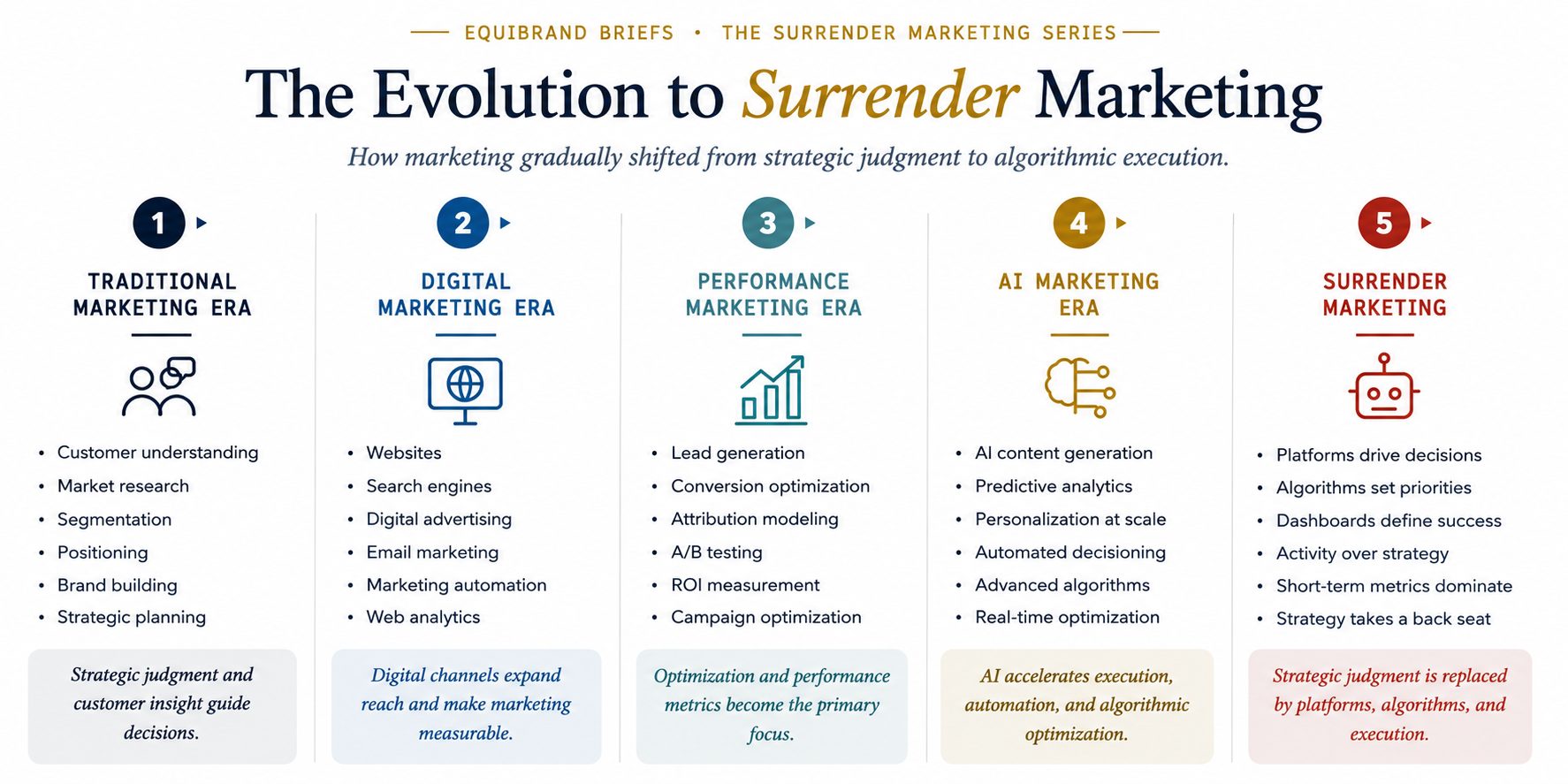
Stage 1: Traditional Marketing
Before digital technologies transformed the profession, marketing was broadly understood as a strategic discipline. Leaders were expected to understand customers deeply — their needs, motivations, and unmet desires — and to identify opportunities, shape innovation priorities, and guide how the organization should differentiate. Tools were limited, data was scarce, and measurement was slow.
But strategic judgment occupied the central role. Marketing’s primary job wasn’t communicating value — it was helping organizations create it, by understanding customers better than competitors did and translating that into positioning, innovation, and growth decisions. Customer insight drove strategy. Strategy guided execution.
Stage 2: The Digital Marketing Era
Websites, search, digital advertising, email, automation, and analytics transformed what was possible. For the first time, organizations could observe customer behavior at scale, campaigns became measurable, and reach expanded dramatically. This was genuine progress — and it introduced a subtle, consequential shift.
As measurement expanded, organizations naturally focused more attention on what could be measured easily. Execution became more visible; strategic thinking, relatively less so. The questions that produce metrics — how many clicks, how much traffic, what conversion rate — began crowding out the ones that don’t: which customers matter most, what do they actually need, how should we compete differently? Small at first, almost imperceptible — but the direction was set.
Stage 3: The Performance Marketing Era
As digital capabilities matured, performance optimization became the dominant language of marketing. Lead generation, conversion rates, attribution, acquisition costs, A/B testing, ROI — all of it grew more sophisticated and more central to how marketing was funded. CMOs learned to speak the language of finance, and marketing earned its seat at the table by demonstrating quantifiable impact.
But the optimization imperative carried a largely unnoticed cost. The function focused on improving performance within existing systems — better campaigns, better funnels, better attribution — rather than questioning whether those systems were pointed in the right direction. The questions that resist measurement received progressively less attention, not because leaders stopped caring, but because the budget processes and performance reviews governing marketing weren’t designed to answer them.
Stage 4: The AI Marketing Era
Artificial intelligence accelerated every trend before it — and compressed the timeline. AI content generation, predictive analytics, personalization at scale, and real-time optimization made execution faster and cheaper than anyone anticipated. Work that once took a team of ten several weeks can now be done by three people in an afternoon. The constraint on execution largely disappeared.
Which left the strategic questions more exposed than ever — because the systems doing the executing now moved faster than the judgment meant to guide them. Organizations that hadn’t resolved their positioning, segmentation, or growth priorities found those gaps amplified rather than hidden: more content communicating an unclear value proposition, more campaigns optimizing toward an underdeveloped strategy. AI accelerated execution. It did not automatically strengthen strategy.
Stage 5: Surrender Marketing
The end state is not a technology problem. It is a judgment problem. Platforms drive decisions. Algorithms set priorities. Dashboards define success. Activity takes precedence over strategy — not because anyone decided it should, but because the systems that dominate the marketing function were never designed to do strategic thinking. They were designed to execute, optimize, and scale.
The result is a marketing function that can be highly active, highly optimized, and deeply sophisticated — while growing increasingly disconnected from the decisions that create long-term competitive advantage. It rarely looks like failure: campaigns still perform, teams stay busy, dashboards report healthy activity. The damage appears elsewhere — differentiation weakens, pricing power erodes, growth takes more effort, and competitors become harder to distinguish from. By the time leadership connects these symptoms to their root cause, they’ve usually been accumulating for years.
What Does It Look Like Inside Your Organization?
Surrender Marketing is easier to recognize in retrospect than in real time. From the inside, the organization feels busy and productive; the warning signs show only in the pattern across decisions, not any single one. Ask these in your next leadership meeting:
- Do our marketing conversations start with customer needs or channel performance?
- Can we articulate what our most important customers need at a motivational level — not just what they do, but why?
- Do we have a clear, differentiated value proposition that guides decisions across teams and channels?
- Do we know where our next growth will come from beyond the core business?
- When did we last invest meaningfully in upstream strategic work rather than downstream execution?
Significant disagreement among leaders on any of these is itself a signal — it means the organization lacks a shared strategic foundation, one of the clearest indicators that surrender is already underway.
What’s the Alternative?
Escaping Surrender Marketing doesn’t require abandoning the tools that caused the drift — digital, performance marketing, analytics, automation, and AI are all valuable. The issue was never the tools. The issue is what happens when tools begin making the strategic decisions.
The alternative is Upstream Marketing — the discipline of restoring four strategic decisions before execution begins: Insight (why customers do what they do), Identity (a differentiated value proposition), Innovation (proactive growth aimed by insight), and Integration (the four working as one connected system). Optimization can’t permanently compensate for weak strategy; strong strategy, amplified by modern execution, creates durable advantage.
Read how the four principles work →
Is Your Organization Vulnerable?
Most organizations don’t recognize Surrender Marketing until it’s already affecting growth, pricing power, or competitive position. The Surrender Marketing Diagnostic is a free, 20-question self-assessment organized around the four upstream principles. It takes ten minutes — work through it with your leadership team and compare scores. Disagreement between members is itself useful data.
Take the Surrender Marketing Diagnostic →
Part of the Surrender Marketing Series by EquiBrand Consulting.





Follow EquiBrand