

Southwest Airlines Value Proposition Example: Breakdown and What You Can Learn
Southwest Airlines is a classic example of how a company can compete by simplifying a commoditized category and executing a focused strategy consistently.
At its core, Southwest does not try to match competitors across every dimension of air travel. Instead, it makes deliberate tradeoffs, choosing to prioritize cost, simplicity, and consistency over additional amenities.
In this Southwest Airlines value proposition example, we break down the key elements that drive its success and what businesses can learn from it.
Southwest Airlines Value Proposition (Simple Summary)
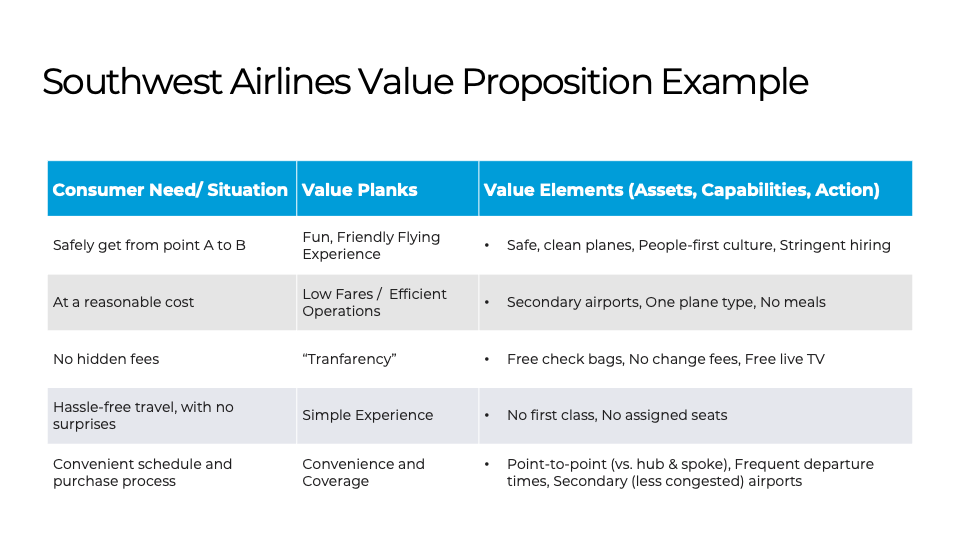
At a high level, Southwest’s value proposition is built across five key dimensions:
-
Safe, reliable travel: Delivered through a people-first, customer-centric culture
-
Low fares: Enabled by efficient operations and cost discipline
-
Transparency: No hidden fees, with a simplified pricing structure
-
Simple experience: A streamlined, hassle-free travel model
-
Convenience and coverage: Frequent flights supported by a point-to-point network
Together, these elements allow Southwest to deliver a consistent, trusted experience while maintaining strong customer loyalty.
To understand the full framework behind this example, see our Value Proposition Development Guide →
The benefit-plank framework used in this analysis — the ante, driver, and reassurance roles — comes from Upstream Marketing, endorsed by Philip Kotler. Read Chapter One free, or get the book on Amazon →
Southwest Airlines Value Proposition Breakdown
1. Safely get from point A to B
For many people, air travel is fundamentally about getting from point A to B safely. These are table stakes needs, but also where Southwest excels through its “Fun, Friendly Flying Experience” plank.
Southwest’s industry-leading customer satisfaction and loyalty scores, delivered through its people-first culture, serve as meaningful differentiators even within a category where safety is expected.
2. At a reasonable cost
Southwest’s next benefit plank, low fares / efficient operations, aligns directly with its internal operating model and cost discipline.
One example: Southwest uses only one plane type, the Boeing 737. Compare this with United, Delta, and American, which may operate ten or more types of aircraft.
Having one plane type results in lower maintenance and operational costs, which are passed on to customers through lower fares.
3. No hidden fees
The Transfarency plank delivers on the customer’s need for no surprises.
Competitors charge to check baggage. On Southwest, you can check two bags for free. Competitors charge change fees. Southwest does not.
Southwest also offers free live TV, and many in-flight offerings are included at no additional cost.
This Transfarency plank represents a branded initiative for Southwest and is central to its positioning.
4. Hassle-free travel, with no surprises
The simple experience plank provides a more streamlined, hassle-free journey.
With no first-class section, Southwest simplifies food and beverage service. No assigned seats allow planes to fill more quickly, reducing time at the gate.
Grabbing differentiation and efficiency where it can, Southwest resists the path of competitors who instead layer on complexity and additional charges.
5. Convenient schedule and purchase process
The final value plank, convenience and coverage, is delivered through the company’s point-to-point route structure rather than the traditional hub-and-spoke model.
Since secondary airports are less congested, Southwest minimizes ground time and improves performance. This enables more direct nonstop routes and more frequent, conveniently timed flights.
What Businesses Can Learn from Southwest’s Value Proposition
Strong value propositions are not accidental. They are built through deliberate choices and alignment across the organization.
Key takeaways include:
-
Making clear tradeoffs about what to offer and what not to offer
-
Aligning operations directly with the value proposition
-
Simplifying the customer experience wherever possible
-
Reinforcing value through consistent execution across touchpoints
Organizations that succeed make disciplined strategic choices, not just incremental improvements.
→ Learn more about our value proposition consulting approach
Explore Other Value Proposition Examples
For a broader overview of how strong value propositions are structured, differentiated, and aligned to growth strategy, explore our comprehensive guide to value proposition examples.
You may also find these helpful:
-
Nike value proposition (coming soon)
Looking at multiple companies helps clarify how different strategies create different outcomes.
From Example to Strategic Choice
While Southwest provides a clear illustration, most organizations face more complex tradeoffs when defining their own value proposition.
Leadership teams must evaluate:
-
Alternative positioning directions
-
Competing sources of differentiation
-
Long-term growth implications
These tradeoffs are explored further in The Tale of Two Brands, which examines how different value proposition choices lead to different outcomes.
From Value Proposition to Positioning
A strong value proposition is the foundation of effective positioning.
Apply These Principles to Your Own Value Proposition
The Southwest Airlines value proposition demonstrates how customer needs, brand benefits, and value elements can work together to create strong customer preference. While every industry is different, the underlying principles remain the same.
The resources below provide additional frameworks, guidance, and best practices for developing a stronger value proposition within your own organization.
Customer Value Proposition Framework
Learn the proven framework for identifying customer needs, aligning benefits, and building stronger customer preference.
Brand Positioning Consulting
A value proposition defines why customers should choose you. Positioning determines how you should be perceived relative to competitors.
Customer Insight & Analytics Consulting
Strong value propositions begin with a deep understanding of customer needs, decision criteria, and unmet opportunities.
How to Choose a Value Proposition Consulting Firm
Understand the questions to ask, capabilities to evaluate, and warning signs to consider when selecting a consulting partner.
Need Help Applying This Framework?
Many organizations understand the importance of customer value but struggle to define it clearly.
Our Value Proposition Consulting Services help leadership teams identify customer needs, define differentiated brand benefits, align value elements, and create stronger customer preference.
Or begin with an Upstream Diagnostic to assess your current value proposition, identify opportunities, and define a path forward.
The principles behind Southwest Airlines value proposition — a structured plank set, clear ante-driver-reassurance roles, and organizational investment aligned to delivery — are the same principles EquiBrand applies in its value proposition consulting work. The difference between companies that compete on value and those that compete on price is rarely product quality. It is almost always strategic clarity about which benefit planks to stand for, which to lead with, and whether the organization is genuinely built to deliver them.








Follow EquiBrand