Value Proposition Development: A Practical Guide to Defining Customer Value

A structured framework for defining customer value, aligning your organization, and driving growth.

Looking to apply this in your organization?

Explore Value Proposition Consulting →

This guide outlines a structured approach to value proposition development, connecting customer insight, differentiated benefits, and operational delivery by focusing on the key components and key elements that make a value proposition effective.

A value proposition is more than a statement. It is a multidimensional framework that translates customer needs into a clear and actionable definition of value, serving as a North Star to guide the company’s product development, marketing, and customer support efforts. The company must align its business activities and internal processes to consistently deliver on the value proposition, ensuring that every aspect of the organization supports the promise made to customers.

In this guide, we’ll walk you through the essential elements of value proposition development, using our proprietary Value Proposition Framework approach. Whether you’re refining an existing value proposition or creating a new one, our comprehensive approach ensures your business delivers value that resonates with customers, provides a competitive advantage, and drives sustainable success. The recommended structure of a value proposition includes a strong headline, a sub-headline, and supporting bullet points that highlight key features and benefits.


What is a Value Proposition?

A value proposition defines the key benefits your product or service offers to target customers. Structurally, a value proposition consists of four to six benefit-based planks, each representing a specific customer benefit such as convenience, peace of mind, or enhanced performance. These planks, when combined, form a full value stack—the complete value proposition for your offering.

Just as an organization can have multiple brands, it can also have multiple value propositions at various levels—corporate, business unit, and product or service levels. At EquiBrand Consulting, we work with companies to design and align these value propositions across all levels, ensuring they deliver a relevant and distinctive offering to customers while driving organizational alignment.

Value Proposition Framework: A Three-Part Design Approach

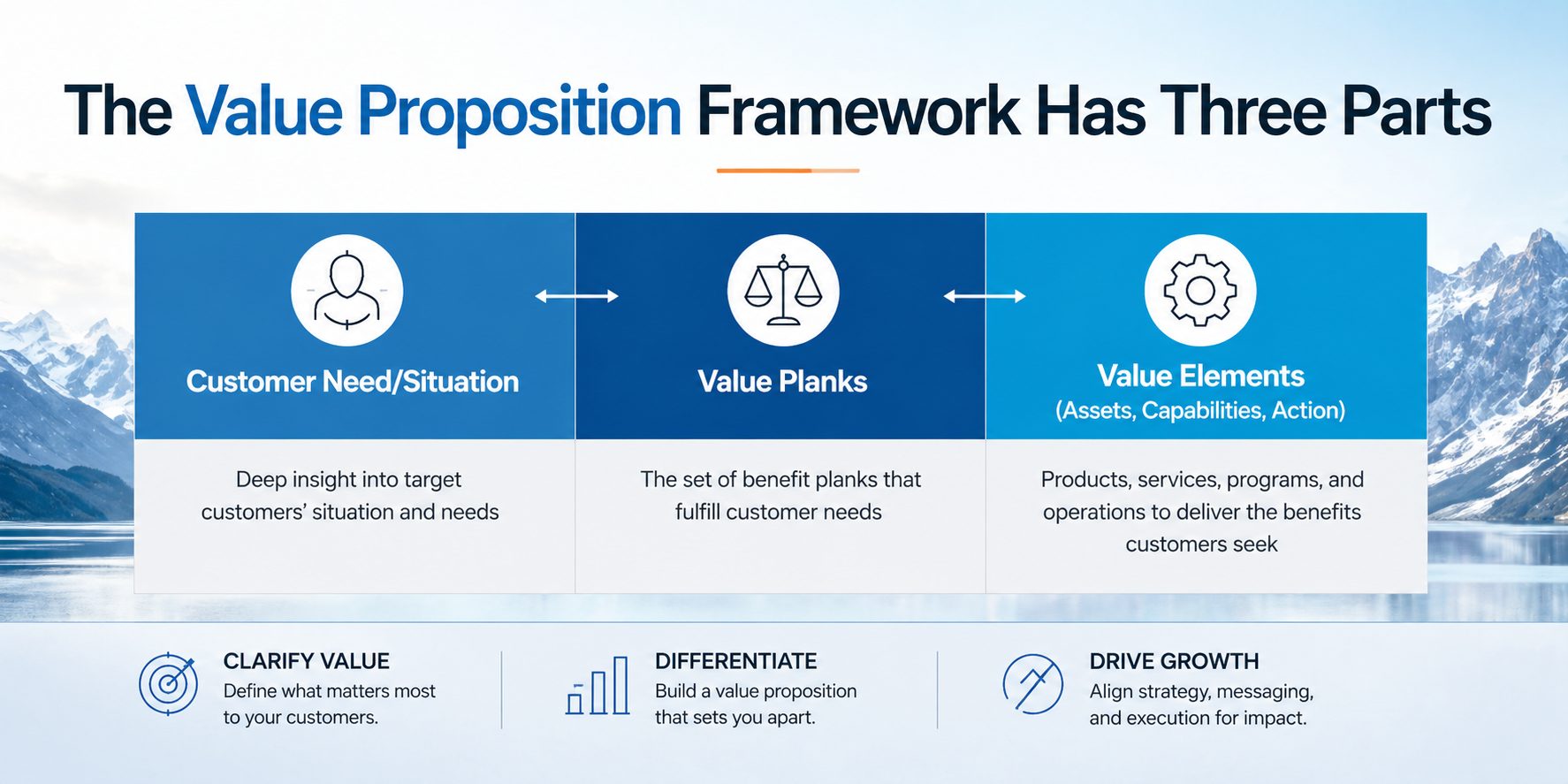
A well-structured value proposition framework translates customer insights into business terms, allowing you to make better decisions and develop actionable plans. Tools like the proposition canvas and value map help visualize and align your value with customer needs by mapping your products and services to specific customer jobs, pains, and gains. Our Value Proposition Framework includes three critical components:

  1. Customer Situation: Define the target market, segment, or persona. This involves creating a detailed customer profile using the Value Proposition Canvas, which includes understanding customer jobs—the tasks, problems, and emotional or social drivers your customers face—as well as their pains and gains.
  2. Value Planks: Identify the key elements of your offer—the specific products and services you provide to address customer needs. Clearly articulate how your offerings relieve pains and create gains for your target customer profile.
  3. Reasons to Believe: Provide evidence and proof points that support your value proposition and differentiate your offer from competitors.

Value Proposition Framework in Three Parts

The Value Proposition Canvas can be used to align your product features with customer jobs, pain relievers, and gain creators, helping you design, test, and validate your value propositions by ensuring your products and services directly address the needs of your customer profile.

1. Customer Situation

This part focuses on gaining deep insights into the target customer’s current and future needs. One effective approach is using the ‘jobs to be done’ framework, which helps uncover the functional, emotional, and social tasks customers are trying to accomplish. Understanding what your customers want, what challenges they face, what customers expect from products or services, and how they behave provides the foundation for designing a relevant value proposition. We obtain this insight through a combination of research methods, including in-depth interviews, ethnographic studies, and data analytics. Creating a customer profile is not a one-time task; it requires ongoing iteration and testing of assumptions to better tailor products or services to meet evolving customer needs.

Customer Pains and Gains

Understanding customer pains and gains is at the heart of developing a strong value proposition. Customer pains are the obstacles, frustrations, or negative experiences that customers encounter when trying to complete important tasks or achieve their goals. These pains can range from inefficiencies and high costs to emotional stress or unmet expectations. On the other hand, customer gains represent the positive outcomes, benefits, or improvements that customers desire—such as increased productivity, cost savings, peace of mind, or enhanced status.

A compelling value proposition is built on a deep understanding of these pains and gains. By identifying what truly matters to your target audience, you can design a product or service that not only alleviates their most pressing pains but also delivers meaningful gains. This approach ensures your proposition communicates unique value and resonates with customers on both rational and emotional levels.

A well-crafted value proposition should clearly articulate how your offering addresses specific customer pains and delivers tangible gains. For example, a software solution might relieve the pain of manual data entry (pain) while providing real-time analytics for better decision-making (gain). By mapping pains and gains, businesses can create a value proposition that stands out in the market, connects with customers, and drives preference for their product or service.


2. Value Planks

These are the key benefits your business offers to meet customer needs, starting with identifying the main benefit that sets your product or service apart. As part of value proposition development, it’s important to clarify your product category—defining exactly what type of product or service you offer and how it stands out in its market segment. Value planks can range from functional benefits (e.g., convenience, performance) to emotional or self-expressive benefits (e.g., brand prestige, personal fulfillment). Effective value propositions also include pain relievers—specific ways your offering alleviates customer pains such as negative emotions, costs, risks, or frustrations. When considering customer gains, examples include better performance, increased efficiency, or enhanced satisfaction. The combination of these planks forms your full value proposition, making it relevant and distinctive in the marketplace.

3. Operational Value Elements

These are the internal capabilities, competencies, and assets required to deliver the promised value. This includes aligning your business activities with the value proposition to ensure consistent delivery and market differentiation. Examples include technical expertise, superior customer service, or advanced manufacturing capabilities. The company plays a critical role in ensuring operational feasibility and driving strategic growth by leveraging these strengths. Aligning your operational strengths with your value planks ensures that your business can reliably deliver on its value proposition.

This structured approach ensures that your business creates and captures value effectively, aligning customer needs with the operational elements required to meet them.

Value Proposition Design Approach: Aligning Value Across Your Organization

Our proprietary Value Proposition Design Approach takes value proposition development a step further by aligning it across all levels of your organization and integrating it with your overall business strategy to achieve a sustainable competitive advantage. Much like developing a new product, creating a value proposition involves defining and delivering a broader set of benefits that help attract new business and support your efforts to sell more effectively. The process includes:

  • Creating a multidimensional definition of brand value by combining various value planks that together create a compelling offering.
  • Driving strategic direction by identifying and owning the benefits that matter most to customers and on which your category decisions are made.
  • Focusing resource allocation to ensure your efforts and investments are directed toward delivering the benefits that have the highest impact on your target customers.
  • Aligning strategies across the organization, ensuring each department—marketing, sales, product development, and customer service—is focused on delivering value in a cohesive and coordinated manner.

A strong value proposition is distinct from a unique selling proposition (USP); while a USP highlights what makes your service unique in the marketplace, a customer value proposition (CVP) focuses on the specific value and benefits provided to the customer. To effectively differentiate your offerings, it is essential to understand your target customers’ pain points and demonstrate how your solutions specifically address these issues, creating a compelling reason for customers to choose you over competitors.

This approach ensures your value proposition is not only relevant to customers but also fully integrated across your business, from strategy to execution.

Communicating the Value Proposition

Effectively communicating your value proposition is essential for attracting potential customers and differentiating your product or service in a crowded market. A compelling value proposition should be presented as a concise, clear statement that highlights the unique value and key benefits your offering delivers to the target audience. Avoiding jargon and focusing on what matters most to customers ensures your message is easily understood and memorable.

Sales teams play a critical role in this process. Equipping them with a well-crafted value proposition enables them to confidently communicate the proposition’s unique value and benefits during sales conversations, presentations, and customer interactions. Consistency is key—your value proposition should be reflected across all marketing channels, from your website and digital campaigns to sales collateral and customer service scripts.

By ensuring your value proposition is communicated clearly and consistently, you help potential customers quickly grasp why your product or service is the right choice for them. This not only increases engagement and drives sales but also supports the achievement of product-market fit by aligning your message with what customers truly value.


Benefits of a Strong Value Proposition

A well-crafted value proposition is of critical importance, as it offers numerous benefits to both customers and your organization:

It clarifies the main point of differentiation by addressing customer pain points and delivering clear value, making it easier for customers to understand why they should choose your offering over competitors.

A clearly defined customer value proposition (CVP) is essential—86% of business buyers are more likely to buy from a company that understands their goals, underscoring the importance of aligning your value proposition with customer needs.

It also supports cost savings, enhances the customer experience, and drives sales success by focusing on what matters most to your target audience.

1. Multidimensional Brand Value

  • A strong value proposition encompasses multiple value planks, each addressing different aspects of customer needs. The more comprehensive and multidimensional the proposition, the higher the perceived value by customers.

2. Customer Engagement and Loyalty

  • By going beyond the core product or service, businesses can deepen their relationship with customers. For example, Amazon and Nike extend their value proposition through features like Amazon Prime or Nike Membership, enhancing customer engagement and loyalty through additional offerings and touchpoints.

3. Strategic Alignment

  • A value proposition serves as a strategic guidepost for your organization, helping prioritize initiatives and focus innovation efforts on what matters most to your customers. It also provides a framework to evaluate new opportunities, ensuring that any innovations or extensions align with your brand’s core value planks.

4. Focused Innovation

  • A clear value proposition helps guide innovation efforts, ensuring that new initiatives align with customer expectations and your brand’s identity. It provides a filter for which opportunities to pursue and which to avoid, ensuring that resources are used efficiently.

Examples of Strong Value Propositions

Some of the most successful companies, like Amazon, Southwest Airlines, and Starbucks, have developed multidimensional value propositions that go beyond a single statement. These companies integrate multiple value planks—functional, emotional, and self-expressive—to create a compelling and cohesive customer experience. Notably, successful organizations often cast a wide net when testing and refining their value propositions, gathering broad insights to ensure their messaging resonates with diverse customer segments.

At EquiBrand, we help businesses design value propositions that mirror this approach, ensuring that each plank delivers a distinct benefit while reinforcing the overall brand value.

Testing and Pivoting

Testing and pivoting are critical steps in refining your value proposition to ensure it truly resonates with your target audience. Start by conducting thorough market research and gathering direct feedback from real customers to validate your assumptions about their most important tasks, pain points, and desired benefits. Use surveys, interviews, and data analytics to uncover what customers care about most and how well your current value proposition addresses those needs.

Experiment with different versions of your value proposition, testing which messages and benefits generate the strongest response in the market. Analyze the data to identify which elements drive engagement, satisfaction, and conversion. If your initial value proposition does not deliver the expected results, be prepared to pivot—adjust your messaging, focus, or even your product or service offering to better align with customer needs.

Continuous testing and willingness to adapt are essential for creating a well-crafted value proposition that delivers real value to customers. By iterating based on data and customer insights, your business can improve customer satisfaction, foster loyalty, and achieve lasting success in the market.


Value Proposition Design: Balancing Cost and Value

A strong value proposition balances what customers get for what they pay. This balance can be achieved in two ways:

  1. Adding benefits to increase value without necessarily lowering the cost.
  2. Lowering costs while maintaining or enhancing the benefits provided.

At EquiBrand, we typically focus on improving the value customers receive by enhancing the benefits delivered, unless your business is positioned as the absolute lowest-cost provider. Programs like subscription services, loyalty programs, or product enhancements can increase perceived value and allow for premium pricing.


Avoiding Common Mistakes

Creating a strong value proposition requires careful attention to common pitfalls that can undermine its effectiveness. One frequent mistake is failing to distinguish between customer needs and wants, which can result in a value proposition that overlooks the most important tasks and pain points customers face. Another is attempting to appeal to all customer segments at once, leading to a diluted proposition that lacks relevance for any specific group.

It’s also important to avoid developing your value proposition solely from your company’s perspective. Instead, focus on understanding customers’ real experiences and requirements—empathize with their challenges and aspirations. Overlooking social and emotional jobs, or trying to address every possible pain and gain, can cause your value proposition to lose focus and fail to deliver unique value.

By being mindful of these common mistakes, businesses can create a focused, well-crafted value proposition that clearly communicates the unique value and benefits of their product or service. This targeted approach ensures your proposition resonates with the right customer segments, drives engagement, and supports business growth.

Why Choose EquiBrand for Value Proposition Development?

At EquiBrand Consulting, we bring decades of experience and a proprietary approach to value proposition development that combines customer insight, brand identity, and innovation. Drawing on our Upstream Marketing frameworks, we help businesses develop value propositions that are:

  • Relevant to customer needs and aligned with market opportunities.
  • Distinctive in offering a unique combination of benefits that set you apart from competitors.
  • Credible, ensuring your brand delivers on its promises both operationally and financially.

With our Value Proposition Framework and Value Stack Design Approach, we ensure that your business develops a comprehensive, customer-centric value proposition that drives both growth and differentiation.


Start Developing Your Value Proposition Today

Ready to design a value proposition that aligns with your customers’ needs and drives organizational growth? Contact EquiBrand Consulting to learn how we can help you create and deliver a compelling value proposition that resonates in the marketplace and sets your business up for success.


About EquiBrand Consulting

At EquiBrand Consulting, we specialize in strategic marketing, brand development, and value proposition consulting. Our proprietary frameworks, including insights from the book Upstream Marketing, have helped businesses across industries define their value, innovate successfully, and create lasting customer relationships.


If You’re Making High-Stakes Marketing Decisions, Start with a Diagnostic

A structured diagnostic identifies the decisions that will have the greatest impact on growth, brand, and go-to-market performance.

  • Clarifies where strategy is misaligned
  • Identifies the highest-impact opportunities
  • Defines a focused roadmap for action

Typically completed in 4-6 weeks