
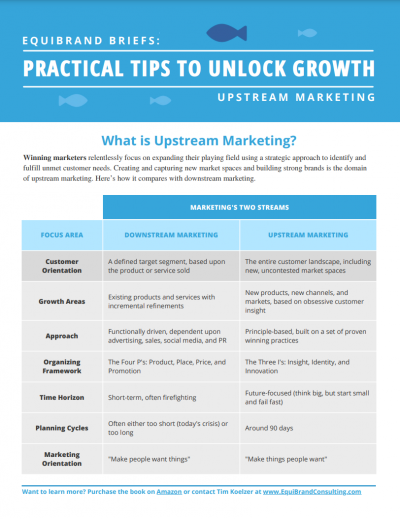
Upstream vs. Downstream Marketing
Understand the Strategic Difference Between Defining Growth Strategy and Executing Marketing
Most marketing performance problems are not execution problems. They are strategy problems.
Organizations often invest heavily in advertising, digital marketing, SEO, lead generation, CRM systems, sales enablement, and campaign execution before fully clarifying the strategic decisions that drive long-term growth.
As markets become increasingly crowded, commoditized, and influenced by AI-driven execution, the distinction between upstream and downstream marketing has become more important than ever.
Upstream marketing focuses on defining strategic direction before marketing execution begins. Downstream marketing focuses on activating and executing against those strategic decisions through campaigns, channels, sales programs, and customer engagement initiatives.
Both are essential. However, downstream marketing is typically far more effective when upstream decisions are clearly defined first.
At EquiBrand Consulting, we help organizations strengthen growth strategy through the combined principles of customer insight, positioning, innovation, and go-to-market alignment.
What Is Upstream Marketing?
Upstream marketing focuses on the strategic decisions that shape long-term business performance before tactical marketing execution begins.
Rather than concentrating primarily on campaigns, promotions, or short-term lead generation, upstream marketing addresses the foundational questions that determine how organizations compete, grow, and create differentiated customer value.
This includes decisions related to:
- Customer segmentation and prioritization
- Market opportunity identification
- Customer insight development
- Brand positioning and value proposition strategy
- Innovation direction and concept development
- Go-to-market alignment
- Brand architecture and portfolio strategy
- Long-term growth planning
Upstream marketing begins by understanding customers deeply, identifying unmet needs, clarifying where to compete, and aligning organizational strategy around delivering differentiated value.
Related Resources:
→ Upstream Marketing Definitive Guide
→ Upstream Marketing Frameworks & Executive Guides
What Is Downstream Marketing?
Downstream marketing focuses on executing against established strategic direction through customer acquisition, communication, demand generation, and sales activation programs.
While upstream marketing defines the strategy, downstream marketing operationalizes and scales it across channels and customer touchpoints.
Typical downstream marketing activities include:
- Advertising campaigns
- Digital marketing and SEO
- Content marketing
- Social media marketing
- Media planning and activation
- CRM and email marketing
- Lead generation programs
- Sales enablement
- Promotional campaigns
- Conversion optimization
- Customer retention initiatives
Downstream marketing plays a critical role in generating awareness, engagement, and sales performance. However, even highly effective execution can struggle when positioning, differentiation, segmentation, or innovation strategy are unclear.
Upstream vs. Downstream Marketing
The distinction between upstream and downstream marketing is one of the most important concepts in strategic marketing.
Upstream marketing:
- Defines strategic direction
- Focuses on customer insight and unmet needs
- Clarifies where to play and how to win
- Shapes positioning and differentiation
- Guides innovation and portfolio decisions
- Supports long-term growth strategy
- Includes segmentation, positioning, and value proposition development
Downstream marketing:
- Executes tactical programs
- Focuses on customer acquisition and engagement
- Activates channels and campaigns
- Communicates product and brand benefits
- Optimizes campaign and channel performance
- Supports short-term revenue generation
- Includes advertising, SEO, CRM, and demand generation
Both are essential. However, organizations often struggle when downstream execution occurs before upstream strategic clarity is established.
Why the Difference Between Upstream and Downstream Marketing Matters
The distinction between upstream and downstream marketing has become increasingly important as execution becomes more automated and accessible.
AI tools, marketing automation platforms, and digital media systems are making downstream marketing execution faster, cheaper, and more scalable.
As a result, competitive advantage increasingly shifts upstream toward:
- stronger customer insight,
- clearer positioning,
- differentiated value propositions,
- smarter segmentation,
- stronger innovation strategy, and
- better strategic alignment.
Organizations that rely exclusively on downstream optimization often encounter problems such as:
- weak differentiation,
- rising customer acquisition costs,
- inconsistent brand positioning,
- fragmented innovation efforts,
- poor strategic focus, and
- commoditized market perception.
This is why many organizations are reinvesting in upstream strategy development before scaling downstream execution.
Examples of Upstream vs. Downstream Marketing
Apple
Apple’s upstream marketing decisions include:
- defining premium positioning,
- simplifying customer experience,
- designing integrated ecosystems,
- and identifying unmet user frustrations.
Its downstream marketing then activates those decisions through:
- product launches,
- advertising campaigns,
- retail experiences,
- and media execution.
Southwest Airlines
Southwest’s upstream strategy focused on:
- low-cost simplicity,
- operational efficiency,
- and customer-friendly positioning.
Downstream execution reinforced this through:
- advertising,
- promotions,
- customer communication,
- and brand consistency.
Starbucks
Starbucks’ upstream marketing emphasized:
- customer experience,
- emotional connection,
- premium positioning,
- and lifestyle integration.
Downstream marketing translated those decisions into:
- loyalty programs,
- store activation,
- seasonal campaigns,
- mobile app engagement,
- and digital communication.
Common Business Problems Caused by Weak Upstream Strategy
Organizations often experience performance challenges when:
- customer segments are poorly prioritized,
- positioning lacks differentiation,
- innovation efforts are disconnected from customer needs,
- brand portfolios become fragmented or confusing,
- go-to-market execution becomes reactive,
- or downstream tactics are not aligned around a coherent strategy.
In many cases, these challenges originate upstream before execution problems become visible downstream.
Strategic Questions That Drive Upstream Marketing
Strong upstream marketing often begins by answering four foundational strategic questions.
1. Where to Play?
Which customer segments, markets, channels, and opportunity spaces should the organization prioritize?
2. How to Win?
What value proposition, positioning, experience, or capability will create meaningful differentiation?
3. How Might We?
What unmet needs or innovation opportunities could unlock new growth?
4. What Would Have to Be True?
What organizational, operational, financial, or market conditions are required for success?
These questions help leadership teams clarify strategic direction before major investments are made downstream.
Applying Upstream Marketing in Practice
Organizations facing growth challenges, repositioning efforts, portfolio complexity, innovation pressure, or changing customer expectations often begin by stepping back to reassess strategic direction upstream.
This may include:
- clarifying customer priorities,
- refining positioning,
- identifying new growth opportunities,
- strengthening brand architecture,
- aligning innovation efforts,
- or improving go-to-market focus.
Related Resources:
→ Upstream Marketing Frameworks & Executive Guides
→ Upstream Strategy Diagnostic
Frequently Asked Questions
What is the difference between upstream and downstream marketing?
Upstream marketing focuses on defining strategic direction, customer insight, positioning, innovation, and growth opportunities before execution begins. Downstream marketing focuses on executing campaigns, promotions, media, SEO, CRM, and sales activation programs.
Is upstream marketing more important than downstream marketing?
Both are essential. However, downstream execution is generally more effective when upstream strategic decisions are clearly defined first.
What are examples of upstream marketing activities?
Examples include customer segmentation, market opportunity identification, value proposition development, brand positioning, innovation strategy, and portfolio planning.
What are examples of downstream marketing activities?
Examples include advertising, digital marketing, SEO, social media marketing, CRM programs, content marketing, promotions, and lead generation campaigns.
Why is upstream marketing important?
Upstream marketing helps organizations improve differentiation, align innovation with customer needs, strengthen strategic clarity, reduce wasted marketing spend, and support long-term growth.






Follow EquiBrand