
Go-to-Market Strategy Consulting
Strategy Is Only Powerful When Customers Experience It
Your strategy is clear internally. But is it showing up in market?
Most organizations have invested significantly in strategy: they’ve segmented their market, articulated their value proposition, established their positioning, and defined their brand. Yet when customers encounter the brand, something disconnects. Messaging varies. Experience feels inconsistent. Across channels, across teams, across interactions, strategy becomes invisible.
Go-to-market consulting addresses that gap. It connects internal strategic decisions — positioning, value proposition, segmentation, and portfolio choices — to the actual customer experience, so strategy is expressed clearly in market and delivered consistently through execution.
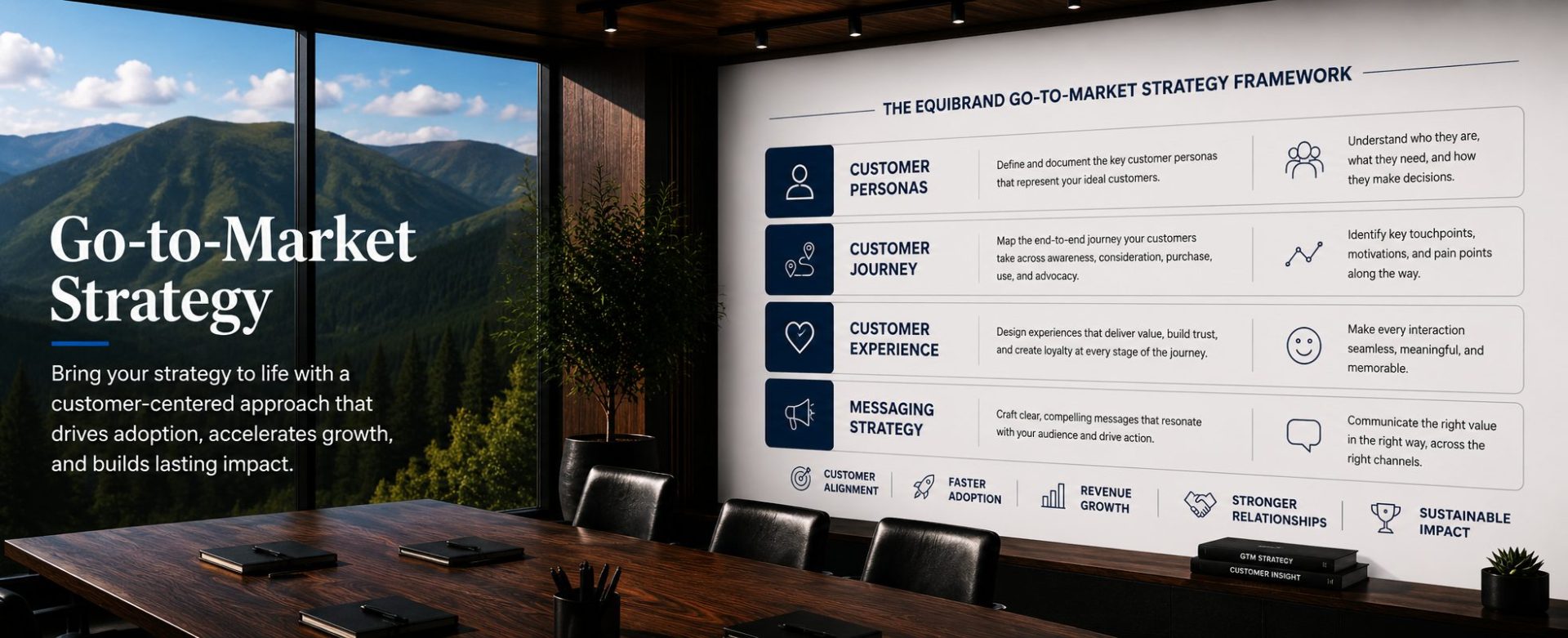
This work spans the practical decisions that shape go-to-market effectiveness: customer understanding and personas, value proposition and positioning, messaging strategy, customer journey and experience design, and the operating gaps between strategy and execution. The goal is not more planning for its own sake, but diagnosing why go-to-market performance breaks down and fixing the points where strategy stops showing up for customers.
Understanding market dynamics, customer expectations, and the business objectives that drive decisions is what separates an effective GTM strategy from one that looks good on paper but fragments in execution.
Most organizations don’t fail because of poor strategy. They fail because strategy doesn’t show up in market.
Go-to-Market Strategy: Turning Strategic Choices Into Customer Experience
At EquiBrand, go-to-market strategy is rooted in Upstream Marketing principles. It’s where strategic decisions are activated in market — where insight, identity, and innovation meet execution.
Before translating strategy into customer experience, organizations must answer four foundational framing questions:
Where to play? Which customers matter most, and what do they really need? This isn’t about broad market segments — it’s about identifying the specific target customers and their unmet needs that should shape your go-to-market approach.
How to win? What value will you deliver that competitors don’t? This connects to your positioning and value proposition — not what you claim to offer, but what customers will actually experience that makes you different.
How might we? What’s the most effective way to reach and serve those customers? This is where strategic thinking about marketing channels, distribution channels, channel mix, and experience design comes in — including how digital transformation has reshaped where and how customers engage.
What would have to be true? What must customers believe, experience, and do for your strategy to succeed? This links strategic intent to execution requirements and defines the GTM plans that guide your teams.
These four framing questions shape the four components of go-to-market strategy, translating abstract strategy into concrete customer experience.
The Four Components of Go-to-Market
Go-to-market strategy requires clarity across four interconnected elements. When they work together, execution compounds. When any one is missing or misaligned, execution fragments.
Target Market & Customer Understanding
Who are you targeting and what actually drives their decisions?
Most organizations have segmented the market — they know which customer groups exist and which segments deserve focus. But execution teams don’t have actionable customer understanding. Marketing teams create messaging based on assumptions. Sales teams prepare for conversations with customers they don’t understand. Experience design reflects internal thinking, not customer reality.
Effective go-to-market strategy requires deep understanding of your customer base: their pain points, motivations, decision criteria, and the specific language that resonates. Customer segmentation tells you which potential customers to pursue. Customer personas translate that segmentation into the specific customer insights execution teams can actually use — understanding not just who your customers are, but how they think, what they fear, and what they need to hear to move forward.
→ Learn more: Customer Personas
Value Proposition Definition
Why should customers choose you?
Your value proposition defines the benefits you deliver. Your positioning defines how those benefits are understood relative to alternatives. But the gap between what you’ve decided internally and what customers hear is where most organizations lose alignment.
Go-to-market strategy ensures that what you’ve decided about value is actually communicated — through messaging grounded in positioning, through channels customers trust, at the moments when it matters most. This includes being clear about pricing and value-based differentiation so customers understand not just what you offer, but why it’s worth choosing over alternatives.
→ Learn more: Messaging Strategy
Experience & Journey Design
How does strategy show up across the complete customer decision process?
Most organizations optimize only the purchase moment. They miss the moments before, where positioning must build credibility. They miss the moments after, where long-term success and customer engagement are actually built or lost.
Go-to-market strategy maps the complete customer journey — pre-purchase, purchase, post-purchase — across multiple touchpoints and designs the experience at each stage to reinforce positioning and deliver value. This includes mapping distribution channels and the full channel mix: direct sales, digital channels, partner networks, and marketing channels where your message must show up. For organizations pursuing market entry into new segments or managing a product launch, this mapping is especially critical — it’s where early wins are built or lost.
→ Learn more: Customer Journey
→ Learn more: Customer Experience
Messaging Strategy
How is positioning consistently expressed across all interactions?
Messaging translates positioning into customer language for each target audience. Effective messaging clearly articulates the brand story and benefits so they resonate with prospective customers. It ensures that marketing, sales, customer service, and partners all express the same strategic intent, even when specific words differ.
Effective messaging is grounded in customer understanding, aligned to journey stages, and reinforced by actual experience. It also provides the guardrails that allow sales teams to improve sales processes and customer conversations without diverging from the strategic story.
→ Learn more: Messaging Strategy
Why Go-to-Market Performance Fails
Most go-to-market problems look like execution problems. They’re usually strategy problems.
Positioning exists but hasn’t been translated into messaging. Leadership knows what the brand stands for. Marketing teams haven’t been given a framework that translates positioning into customer language. Sales teams create their own messaging because the positioning doesn’t show up in conversations. The result is fragmentation.
Segmentation exists but personas haven’t been developed. The organization knows which segments to target. Execution teams lack shared customer understanding. Each creates content and conversations based on their own assumptions.
Strategy exists but the customer journey hasn’t been mapped. Value proposition is clear internally. But no one has defined how that value should be communicated at each stage of the customer’s actual decision process.
Sales processes aren’t aligned to strategy. Sales productivity suffers when teams lack messaging frameworks grounded in customer understanding. Sales efficiency drops when reps are improvising positioning instead of executing a shared go-to-market system. The result is inconsistent pipeline coverage and conversion rates that underperform relative to marketing efforts.
Multiple teams execute without a shared framework. Marketing, sales, agencies, and partners each develop their own version of the brand story. Without a shared go-to-market system, these versions diverge. Customers encounter inconsistent signals. The experience feels fragmented even when each piece is well-executed.
The underlying issue is the same: the connection between strategy and execution is missing.
When Go-to-Market Strategy Matters Most
Organizations focus on go-to-market strategy when they recognize these patterns:
Marketing execution feels fragmented or inconsistent. You’re doing more campaigns, more channels, more marketing activity, but results aren’t following proportionally. You suspect the problem isn’t execution volume but strategic alignment.
Messaging varies across teams and channels. Your website says one thing. Sales says another. Customer service says something different. There’s no shared framework.
Strategy is defined but not visible in market. Internally, positioning and value proposition are clear. But when you look at what customers actually encounter — website, ads, sales conversations, customer service — the strategy isn’t there.
Marketing and sales are misaligned. Sales teams say marketing doesn’t give them messaging that works in real conversations. Marketing says sales doesn’t use the positioning. The gap reveals that strategy hasn’t been translated into actionable form.
You’re entering a new market or launching a new product. Market entry into a new segment or geography — or a product launch into an existing one — is where misalignment is most costly. Establishing your go-to-market approach before scaling execution prevents fragmentation from the start and builds early wins that sustain growth.
Customer experience feels disconnected from brand strategy. You’re clear internally about what you stand for. But customers don’t experience it.
Increased activity isn’t producing proportional growth. You’re doing more marketing, more campaigns, more outreach. But conversion rates aren’t improving, churn rates aren’t dropping, expansion rates aren’t accelerating.
These are signals that the bridge between what you’ve decided strategically and what customers experience has broken.
How the Four Components Work Together
Customer Understanding informs the other key components of go-to-market strategy.
Understanding who you’re targeting — their needs, frustrations, language, decision criteria — shapes every downstream decision. It tells you where positioning needs to show up on the journey. It tells you what experience will resonate. It tells you what language will land.
Experience & Journey Design reveals where strategy needs to be present.
Mapping how customers move through awareness, consideration, purchase, and post-purchase shows you where positioning must show up to build credibility, where experience must reduce friction, where value proposition must be delivered, and where sales activities need alignment.
Messaging Strategy brings it all together.
Grounded in customer understanding, aligned to journey stages, delivered through experiences that reinforce it — messaging is where all the pieces converge into a single coherent signal.
When all four are aligned:
- Customers quickly understand what you stand for
- Strategy is visible across every interaction
- Experience feels coherent
- Execution compounds instead of fragments
- Sales efficiency and pipeline coverage improve as teams operate from a shared system
- The result is driving revenue growth that supports sustainable, profitable growth over the long term
Our Go-to-Market Consulting Approach
At EquiBrand, we work with leadership teams to build the strategic foundation that makes go-to-market execution effective. Our work has a proven track record of helping commercial organizations across industries close the gap between strategy and customer experience.
Our work includes:
- Customer persona development — Grounded in research, not imagination. Understanding your target customer deeply enough that execution teams have actionable insight.
- Customer journey mapping — Understanding how customers actually move through their decision process and where strategy needs to show up.
- Customer experience strategy — Designing how strategy shows up at each touchpoint across pre-purchase, purchase, and post-purchase.
- Messaging strategy and framework development — Translating positioning into clear, consistent communication that lands with target customers.
- Sales messaging and enablement — Ensuring sales conversations reflect strategy instead of diverging from it, improving sales productivity and sales acceleration from the start.
- GTM plans and go-to-market alignment workshops — Getting the organization on the same page about customer understanding, journey, experience, and messaging — with leading indicators to track alignment over time.
- Execution governance — Ensuring strategy stays visible as execution scales and new channels are added, delivering measurable results against business objectives.
We work across brand strategy, marketing strategy, value proposition, and growth strategy to ensure execution reflects what you’ve decided, grounded in the Upstream Marketing framework.
Related Go-to-Market Capabilities
→ Customer Experience Strategy
Related Capability Hubs
Learn More
For a comprehensive treatment of go-to-market concepts, frameworks, and best practices, see The Definitive Guide to Go-to-Market Strategy.
When evaluating go-to-market consulting partners, see How to Choose a Go-to-Market Consulting Firm.
Start With Clarity
If go-to-market performance feels fragmented, the issue often lies not in execution but in the connection between strategy and execution.
The Upstream Strategy Diagnostic identifies the specific gaps across your go-to-market strategy:
- Are target customers clearly defined? Are personas shared across execution teams?
- Is positioning aligned across the organization?
- Is the customer journey mapped?
- Are messaging frameworks connecting positioning to customer language?
- Are leading indicators in place to track whether strategy is showing up in customer experience?
- Where are the gaps in pipeline coverage, conversion rates, and sales alignment that signal a strategy-execution disconnect?
- Where are the biggest disconnects between what you’ve decided and what customers experience?
This focused diagnostic typically takes 4–6 weeks and provides clear, actionable recommendations about what to focus on first.





Follow EquiBrand