
The Evolution to Surrender Marketing
How Marketing Evolved from Strategic Discipline to Tactical Optimization
Most organizations did not intentionally choose Surrender Marketing.
The shift occurred gradually over several decades as marketing technologies became more sophisticated, performance measurement became more precise, and execution became increasingly automated.
Each step created meaningful value.
Digital marketing expanded reach and measurability. Performance marketing improved accountability. Artificial intelligence accelerated productivity and execution. Organizations gained unprecedented visibility into customer behavior and unprecedented control over marketing activities.
Yet something else happened along the way.
As marketing became more measurable, more efficient, and more operationally sophisticated, many organizations began devoting less attention to the strategic decisions that ultimately determine long-term success. Questions involving customer understanding, differentiation, innovation, positioning, and growth strategy increasingly competed with dashboards, optimization metrics, campaign performance, and algorithmic visibility.
The result is what we call Surrender Marketing: the gradual transfer of strategic marketing judgment to platforms, algorithms, dashboards, artificial intelligence systems, and downstream execution.
Understanding how the profession arrived here is important because it reveals an uncomfortable reality. Surrender Marketing is not the result of bad marketing. In many cases, it is the unintended consequence of good marketing taken too far.
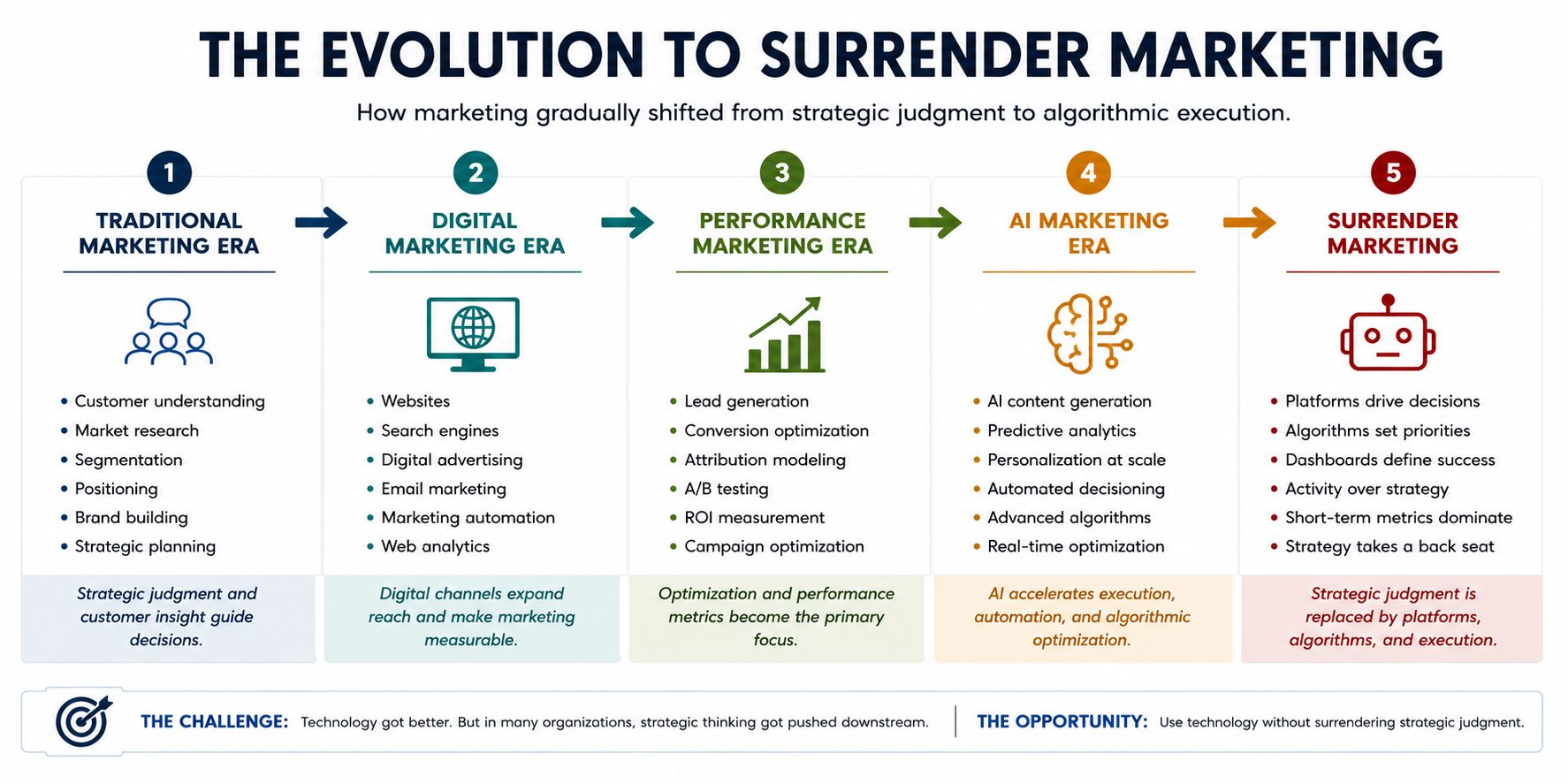
The evolution can be visualized through five distinct stages.
[Insert Evolution to Surrender Marketing Graphic Here]
Stage One: Traditional Marketing
Before the rise of digital technologies, marketing was generally viewed as a strategic discipline.
Marketing leaders were expected to understand customers, identify unmet needs, evaluate market opportunities, shape innovation priorities, guide positioning decisions, and help determine where future growth should come from. While advertising and promotion remained important, they represented only one part of a broader responsibility.
The tools available to marketers were relatively limited.
Data was scarce.
Measurement was slower.
Attribution was often imprecise.
Yet strategic judgment occupied a central role.
Marketing’s primary responsibility was not simply communicating value. It was helping organizations create value and determine how that value should be delivered to customers.
In many respects, marketing functioned as a growth discipline.
Stage Two: The Digital Marketing Revolution
The arrival of websites, search engines, CRM systems, digital advertising platforms, marketing automation tools, and web analytics fundamentally transformed the profession.
For the first time, organizations could observe customer behavior at scale.
Marketers gained visibility into search patterns, website interactions, campaign performance, engagement metrics, and buying journeys. Decisions that once relied heavily on intuition could increasingly be supported by data.
This represented a significant advancement.
Digital marketing made organizations more accountable, more measurable, and more responsive to customer behavior.
However, the digital revolution also introduced a subtle shift.
As measurement capabilities expanded, organizations naturally began focusing greater attention on the activities that could be measured most easily. Execution became increasingly visible. Strategic thinking became relatively less visible.
The seeds of Surrender Marketing had been planted, even if few organizations recognized it at the time.
Stage Three: The Rise of Performance Marketing
As digital capabilities matured, organizations became increasingly focused on performance optimization.
Marketing teams gained access to sophisticated tools for measuring leads, conversions, acquisition costs, attribution pathways, campaign effectiveness, and return on investment. Budget decisions became more data-driven. Marketing leaders gained stronger evidence for demonstrating business impact.
Performance marketing created tremendous value.
Organizations became more disciplined.
Resources were allocated more efficiently.
Campaigns became more accountable.
Yet performance marketing also introduced new incentives.
Questions such as:
- How can we improve conversion rates?
- How can we lower acquisition costs?
- Which channels generate the best return?
- How can we optimize campaign performance?
began receiving greater attention than questions involving differentiation, customer value, innovation priorities, category creation, and long-term growth.
The profession became increasingly focused on improving performance within existing systems rather than examining whether those systems were strategically aligned in the first place.
Stage Four: The AI Marketing Era
Artificial intelligence has accelerated many of these trends.
Organizations can now generate content, automate communications, personalize experiences, optimize campaigns, analyze data, and scale marketing activities at unprecedented speed.
The productivity gains are extraordinary.
Activities that once required days or weeks can often be completed in minutes.
The challenge is that AI primarily improves execution.
It does not automatically create differentiation.
It does not determine positioning.
It does not identify growth opportunities.
It does not define competitive advantage.
It does not decide which customers matter most.
Artificial intelligence can dramatically improve how organizations execute strategy.
It cannot replace the responsibility of creating strategy.
In many cases, AI simply amplifies whatever strategic foundation already exists. Strong strategies become stronger. Weak strategies become more efficiently executed.
As execution becomes easier, strategic judgment becomes even more important.
Stage Five: The Emergence of Surrender Marketing
Surrender Marketing emerges when organizations allow execution systems to displace strategic thinking.
The shift rarely occurs intentionally.
Instead, leadership teams devote increasing attention to optimization, automation, dashboards, performance metrics, content production systems, platform visibility, and AI-enabled execution while spending progressively less time discussing customer insight, differentiation, innovation, market definition, and growth strategy.
Marketing activity continues to increase.
Strategic influence declines.
Organizations become more efficient at executing.
They become less effective at shaping markets.
Over time, marketing becomes increasingly reactive. Teams respond to algorithm changes, platform dynamics, competitive actions, and short-term performance fluctuations rather than proactively defining the future direction of the business.
This is the point at which marketing ceases to function primarily as a strategic discipline and begins functioning primarily as an execution discipline.
This is Surrender Marketing.
Why Upstream Marketing Matters More Than Ever
The evolution from traditional marketing to digital marketing, performance marketing, and artificial intelligence represents extraordinary progress. Organizations today possess capabilities that previous generations of marketers could scarcely imagine.
Yet the evolution also reveals an important truth.
As execution becomes easier, strategy becomes more important.
The more efficiently organizations can create content, automate communications, optimize campaigns, and analyze performance, the more critical it becomes to answer the questions that technology cannot answer on its own.
Which customers matter most?
Where should we compete?
How should we differentiate?
What value do we uniquely create?
Which growth opportunities deserve investment?
These are upstream questions.
The organizations most likely to thrive in the coming decade will not necessarily be those with the most advanced marketing technologies. They will be the organizations that combine modern execution capabilities with stronger customer insight, clearer positioning, more meaningful differentiation, and greater strategic discipline.
That is the role of Upstream Marketing.
Upstream Marketing focuses on the strategic decisions that shape market success before campaigns are launched, content is created, media is purchased, or technologies are deployed.
If Surrender Marketing describes the gradual displacement of strategic judgment, Upstream Marketing represents the path back.
The Real Lesson
The lesson is not that organizations should reject digital marketing, performance marketing, analytics, automation, or artificial intelligence.
The lesson is that every technological advancement increases the value of strategic thinking.
The easier execution becomes, the more important differentiation becomes.
The more abundant content becomes, the more valuable customer understanding becomes.
The more sophisticated optimization becomes, the more essential strategic direction becomes.
Technology should strengthen strategy.
It should not replace it.
Organizations that thrive in the coming decade will not be those that resist technological change.
They will be the organizations that combine modern marketing capabilities with customer insight, meaningful differentiation, innovation discipline, and long-term strategic clarity.
Has Your Organization Fallen Into the Surrender Marketing Trap?
Most organizations do not recognize Surrender Marketing when it first begins to emerge.
The shift happens gradually. Teams become increasingly focused on execution, optimization, automation, and performance measurement while strategic clarity slowly erodes.
The result is often greater marketing activity but weaker differentiation, higher acquisition costs, increasing commoditization, and slower long-term growth.
Our Upstream Strategy Diagnostic helps leadership teams evaluate whether strategic decision-making is being displaced by tactical execution and identify opportunities to strengthen customer insight, positioning, growth strategy, innovation alignment, and competitive advantage.
Explore the Upstream Strategy Diagnostic →
About EquiBrand Consulting
EquiBrand Consulting helps organizations strengthen the upstream decisions that drive long-term growth.
Our work focuses on customer insight, growth strategy, innovation strategy, value proposition development, positioning, and brand architecture, the strategic disciplines that shape market success before downstream execution begins.
As marketing becomes increasingly influenced by platforms, algorithms, automation, and artificial intelligence, we help leadership teams maintain the strategic clarity necessary to create meaningful differentiation and sustainable competitive advantage.
Because sustainable growth is rarely created through execution alone.
It begins with better strategic decisions.
Learn More About EquiBrand Consulting →





Follow EquiBrand