
Philip Kotler's Warning: Most Companies Are Living in a Dream World
Why the companies that win the next decade decide where to play and how to win before the market decides for them
When Philip Kotler endorsed Upstream Marketing, he didn't begin by praising the book. He began with a warning:
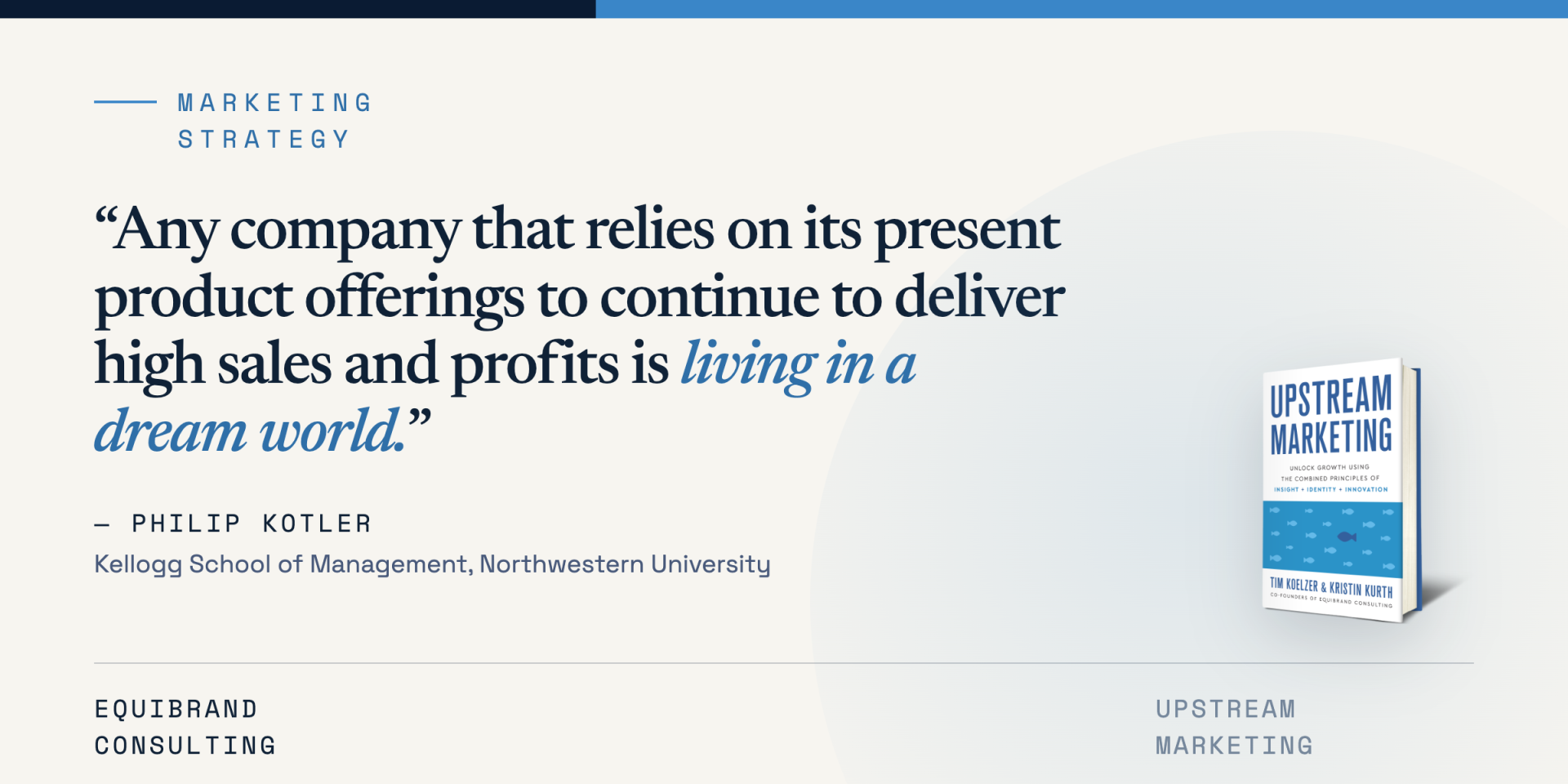
"Any company that relies on its present product offerings to continue to deliver high sales and profits is living in a dream world."
Coming from the father of modern marketing, that's an uncomfortable observation, because most leadership teams are doing exactly that.
They manage today's portfolio, defend today's share and fund today's campaigns. Next year's plan looks like this year's, with better execution.
Kotler's point is that this plan has an expiration date, whether anyone has written it down or not.
Two forces you can't negotiate with
The dream ends for two reasons, and neither is optional.
Success attracts competition. In Kotler's words, "every profitable company will attract new competitors who will bite off some business." New entrants, adjacent players and well-funded challengers all respond to the signal that there's money here. No single bite is fatal. Together, they hollow out the core.
Customers move on. Customers "develop new interests and see present offerings of some companies as 'old' or 'out of fashion.'" They rarely announce it. They simply drift toward whatever better meets their evolving needs.
Neither force cares how well you run your current business. Operational excellence makes the dream last longer, but it doesn't change how it ends.
And AI is accelerating both.
AI is lowering the cost and increasing the speed of competitive response. Competitors can identify opportunities, develop offerings, test ideas and communicate value faster than ever. Advantages that once lasted years may erode much more quickly.
That makes proprietary customer insight, and making upstream choices before competitors do, even more valuable.
The real problem: too much downstream
Kotler's most important line may be about timing:
"Companies need to act on these problems before they occur."
That's the hard part.
By the time competitive erosion or customer drift shows up in the numbers, many of the best options are already gone. The natural response is to push harder downstream: more advertising, more promotion, sharper pricing and greater sales pressure.
Those activities matter. But they mostly increase acceptance of a product or service that already exists. They can't determine what the next one should be.
In our experience, the root cause of moderate or stalled growth is often an overreliance on downstream marketing. Companies come to see their business as largely fixed and fight competitors for the last bit of revenue rather than redefining where future growth will come from.
Most companies practiced upstream marketing when they started, perhaps without calling it that. They made deliberate choices about whom to serve, what needs to meet and what to offer.
Over time, day-to-day firefighting takes over. Marketing shifts from strategic to tactical, and executives end up working in the business instead of on it.
What upstream marketing actually means
Upstream marketing is everything that happens before the hook is in the water: deciding which customers to serve, which needs to meet and what it will take to win, before deciding how to promote it.
Kotler summed up its aim in a single sentence:
"to constantly use insight to identify new opportunities, choose one or more of them consistent with the company's identity and strengths, and plan and execute a successful innovation path."
That sentence maps directly onto the principles at the heart of Upstream Marketing:
- Insight: Understand customers deeply enough to see opportunities others don't.
- Identity: Know what your company can credibly and distinctively own.
- Innovation: Continually turn unmet needs into new solutions.
- Integration: Bring insight, identity and innovation together and execute.
Most organizations we work with have pieces of upstream marketing, with glimmers of insight, identity and innovation. What they lack is the integrated whole. Leaders go from one meeting and one planning cycle to the next without ever bringing the pieces together.
A system, not a slogan: the 7 steps
Kotler noted that the book offers "a system of 7 steps." That system exists because upstream marketing doesn't just happen. It has to be engineered.
The approach runs in two phases of roughly ninety days each.
Phase one: Where to play
- Set strategic direction. Assemble the team, put competing initiatives on a "stop doing" list and build a fact base across company, customers and competitors. One question cuts to the heart of it: What do you know about your important customers that your competitors don't know?
- Create the customer demand framework. Build a proprietary view of to whom and for what: segments based on needs, attitudes and jobs to be done, not simply demographics or the same syndicated data your competitors use.
- Confirm strategic opportunity areas. Prioritize a small number of opportunities, each with a defined target, insight, need, benefits sought and size, and decide what not to pursue.
Phase two: How to win, a repeating cycle
- Do the deep dive. Go deeper with the chosen target customers and the marketplace forces surrounding each opportunity.
- Run focused ideation. Generate new business models, offerings and concepts aimed at specific opportunity areas, not blue-sky brainstorming.
- Perform concept optimization. Put concepts in front of target customers and iterate until they're appealing, distinctive and credible.
- Finalize, launch and learn. Replace the 100-page annual plan with a rolling four-page plan. Launch, learn and recalibrate based on what the market teaches you.
Throughout the process, one question keeps the work honest:
What would have to be true for this to succeed?
Two ideas make the system practical for busy leadership teams.
The first is to be roughly right rather than precisely wrong. Deliberately tight timelines force decisions with partial information, because most upstream decisions can be reversed.
The second is ready, fire, aim. Business moves too fast to wait for certainty. Calibrate, launch and recalibrate.
Want the full method, including sample interview guides and the four-page plan template? Download Chapter 8: the Upstream Marketing 7-step approach.
What this looks like in practice
The book walks through how this played out for one of our clients, which was launching a new luxury automotive brand under a difficult constraint: it had to be sold through the parent company's existing mainstream dealers.
Instead of relying on the same industry reports every automaker could buy, we built a proprietary view of why luxury buyers behave the way they do.
That surfaced distinct customer segments, including a sizable group of buyers who would rather skip the showroom entirely. The brand launched with award-winning product and positioning, and it continues to refine its approach based on what it learns in market.
The important point wasn't simply the segmentation solution. Proprietary customer insight changed the view of where to play and how to win before decisions about positioning, communications and execution were made.
That's upstream marketing.
An endorsement, and a challenge
Kristin Kurth and I wrote Upstream Marketing to make this discipline practical for leaders who are busy running today's business. We were honored that Professor Kotler endorsed it, noting the book's "interesting ideas, a system of 7 steps and many case examples."
Here is his endorsement in full:
"Any company that relies on its present product offerings to continue to deliver high sales and profits is living in a dream world. Every profitable company will attract new competitors who will bite off some business. Customers normally develop new interests and see present offerings of some companies as 'old' or 'out of fashion.' Companies need to act on these problems before they occur. The aim of upstream marketing is to constantly use insight to identify new opportunities, choose one or more of them consistent with the company's identity and strengths, and plan and execute a successful innovation path. Tim Koelzer and Kristin Kurth share interesting ideas, a system of 7 steps and many case examples to show how to achieve success with upstream marketing."
Philip Kotler, S.C. Johnson & Son Distinguished Professor of International Marketing (emeritus), Kellogg School of Management, Northwestern University
Three questions for your leadership team
- Does the C-suite see the playing field as largely fixed, or is it open to redefining it?
- Over the last twelve months, how much of your marketing time and budget protected today's offering, and how much went into finding tomorrow's?
- What do you know about your most important customers that your competitors don't?
If those answers are uncomfortable, you may be closer to Kotler's dream world than you'd like.
Get Upstream Marketing → | Take the Growth Assessment → | Talk with EquiBrand about your upstream agenda →
Don't Wait for Growth to Stall
As Philip Kotler reminds us, companies need to identify new opportunities before competitive pressures and changing customer needs erode their advantage.
The question is how to turn that thinking into action.
Download Chapter 8 of Upstream Marketing to explore our proven 7-step approach for identifying growth opportunities, deciding where to play, and building a strategy for how to win.









Follow EquiBrand