Surrender Marketing
When Strategic Marketing Surrenders to Execution
Marketing has never had more tools.
Organizations can track website traffic, monitor conversion rates, optimize campaigns in real time, automate customer communications, generate content with artificial intelligence, and access performance dashboards from virtually anywhere.
In many ways, marketing has never been more sophisticated.
Yet many leadership teams continue to struggle with some of the most important questions facing the business.
Where should future growth come from?
Which customers matter most?
How should the organization differentiate itself?
What unmet needs represent the greatest opportunity?
How should innovation, positioning, and value creation work together to create competitive advantage?
The paradox is striking.
As marketing has become increasingly capable of measuring execution, many organizations have become less focused on the strategic decisions that drive sustainable growth.
The result is a growing imbalance between strategy and execution.
We call this phenomenon Surrender Marketing.
What Is Surrender Marketing?
Surrender Marketing occurs when organizations gradually transfer strategic marketing judgment to platforms, algorithms, dashboards, and tactical execution.
It rarely happens intentionally.
Most organizations do not wake up one morning and decide to abandon strategic thinking. Instead, surrender occurs gradually as measurable activities receive increasing attention while strategic questions receive progressively less attention.
Over time, discussions about customer needs become discussions about traffic.
Conversations about growth opportunities become conversations about conversion rates.
Questions about competitive advantage become questions about campaign performance.
Strategic judgment is not eliminated.
It simply becomes subordinate to execution.
The result is a form of marketing that can be highly active, highly optimized, and highly efficient while becoming increasingly disconnected from the decisions that create meaningful long-term advantage.
For a deeper introduction to the concept, see What Is Surrender Marketing?
Why Surrender Marketing Matters
The consequences of Surrender Marketing are often difficult to recognize because they rarely appear as obvious marketing failures.
In fact, many organizations practicing Surrender Marketing appear successful on the surface. Campaigns perform. Leads are generated. Dashboards look healthy. Content calendars remain full. Performance metrics improve.
Yet beneath the surface, deeper problems begin to emerge.
Differentiation weakens.
Innovation slows.
Growth becomes harder to sustain.
Organizations find themselves working harder to achieve results that once came more naturally.
The reason is simple.
Optimization cannot permanently compensate for weak strategy.
A better dashboard cannot solve a Brand Positioning problem.
More content cannot substitute for Customer Insight.
More leads cannot overcome a weak Value Proposition.
More automation cannot replace strategic judgment.
Eventually organizations discover that they have become highly efficient at executing strategies they never fully defined.
That realization often comes after years of focusing on tactical improvement while neglecting the upstream decisions that determine long-term success.
How We Got Here
The rise of Surrender Marketing is not the result of bad marketing.
In many respects, it is the unintended consequence of marketing’s success.
The digital revolution transformed the profession. Marketers gained unprecedented visibility into customer behavior. Performance marketing improved accountability. Analytics increased precision. Artificial intelligence accelerated execution and dramatically reduced the cost of content creation, optimization, and personalization.
Each of these developments created substantial value.
Collectively, however, they also shifted attention toward execution.
Questions about customer needs, Customer Segmentation, Strategic Opportunity Areas, Brand Positioning, Innovation Strategy, and competitive differentiation gradually gave way to discussions about attribution models, campaign performance, conversion rates, algorithmic optimization, and AI-generated content.
The profession became increasingly capable of measuring performance.
At the same time, many organizations became less disciplined about examining the strategic assumptions driving that performance.
The result was not the disappearance of strategy.
Rather, strategy increasingly became subordinate to execution.

The challenge is not technology itself.
The challenge is allowing technology to replace strategic thinking rather than support it.
To explore this evolution in greater depth, see The Evolution to Surrender Marketing.
A Framework for Understanding Surrender Marketing
Surrender Marketing is more than a single observation.
It is a framework for understanding a broader shift occurring across many organizations.
Some companies experience surrender through an excessive focus on performance metrics. Others experience it through overreliance on technology platforms, AI-generated content, or optimization systems. Still others experience it through organizational structures that separate marketing execution from strategic decision making.
The symptoms vary.
The underlying pattern is remarkably consistent.
Organizations gradually become more focused on improving performance within existing systems and less focused on questioning whether those systems are pointed in the right direction.
Understanding the phenomenon requires examining five dimensions.
First, organizations must recognize the symptoms.
Second, leaders must understand the causes.
Third, they must appreciate the consequences.
Fourth, organizations need a diagnostic.
Finally, they need a solution.
The articles below explore each of these dimensions in greater depth.
Explore the Surrender Marketing Framework
What Is Surrender Marketing?
This foundational article introduces the concept, defines the phenomenon, and explains how organizations gradually transfer strategic marketing judgment to platforms, algorithms, dashboards, and tactical execution.
7 Warning Signs of Surrender Marketing
Surrender Marketing rarely happens overnight. More often, it emerges through a series of subtle shifts in priorities, processes, and decision-making. This article explores seven warning signs that strategic thinking may be losing influence within an organization.
7 Warning Signs of Surrender Marketing
The Evolution to Surrender Marketing
How did the profession arrive here? This article examines the progression from traditional marketing to digital marketing, performance marketing, AI marketing, and ultimately Surrender Marketing.
The Evolution to Surrender Marketing
Why Smart Companies Fall Into the Surrender Marketing Trap
The organizations most susceptible to Surrender Marketing are often the most sophisticated. This article explores why intelligent organizations can unintentionally drift toward platform-driven decision making.
Why Smart Companies Fall Into the Surrender Marketing Trap
The Hidden Cost of Surrender Marketing
Marketing activity may increase while strategic effectiveness declines. This article examines the long-term consequences for differentiation, innovation, and growth.
The Hidden Cost of Surrender Marketing
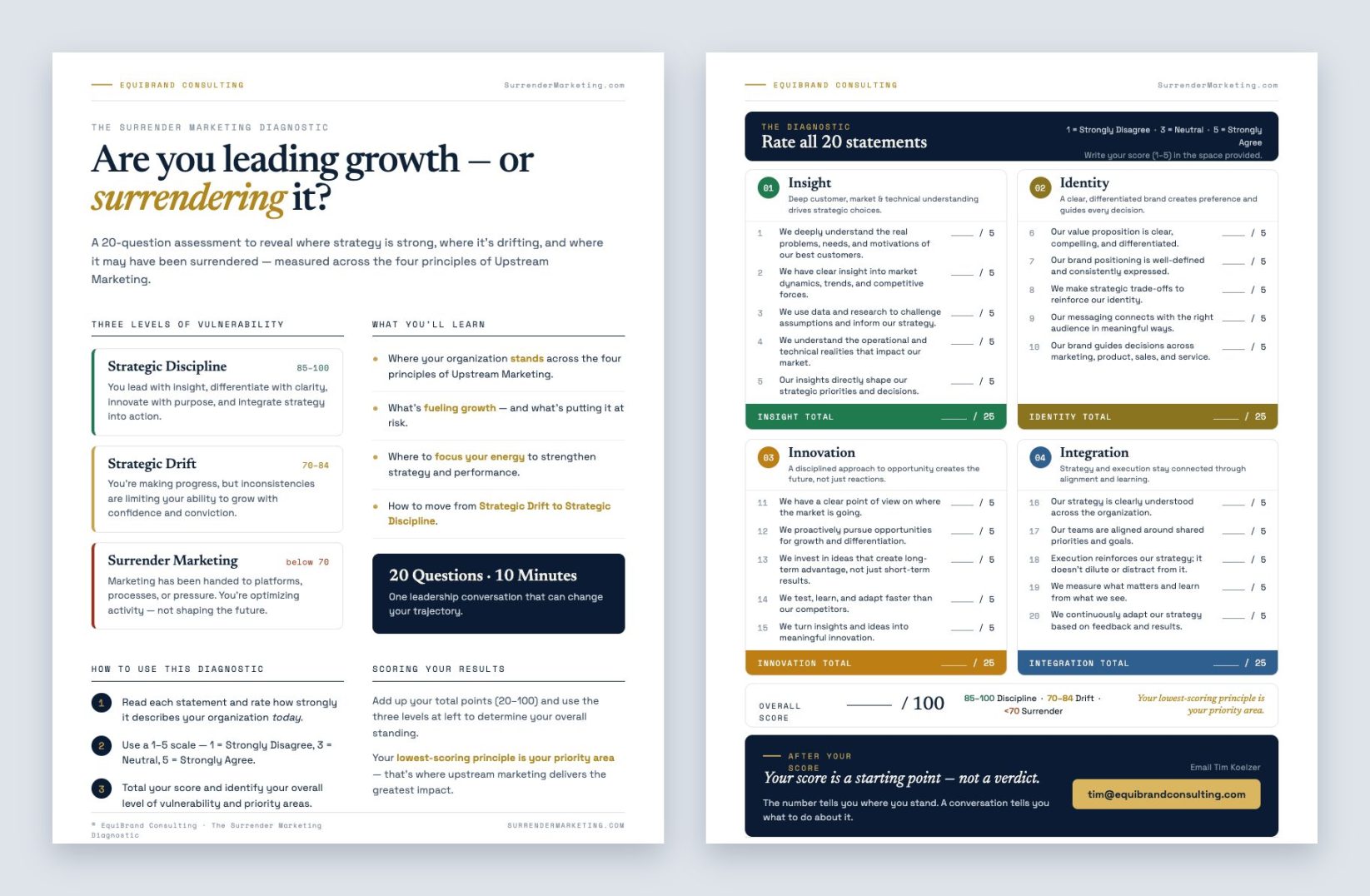
The Surrender Marketing Diagnostic
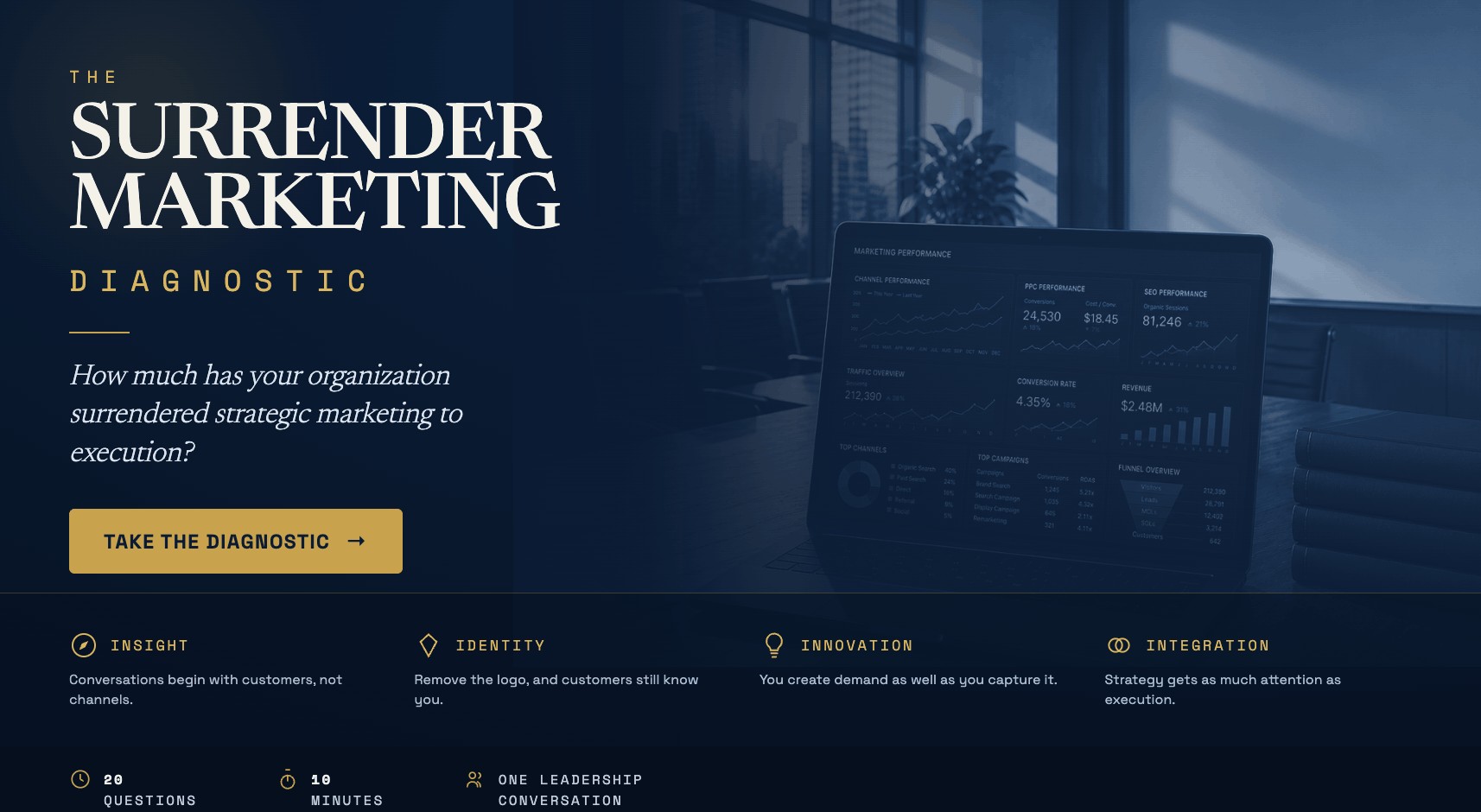
How much has your organization surrendered? This assessment helps leadership teams identify areas where strategic judgment may have been displaced by tactical execution.
Link: The Surrender Marketing Diagnostic (coming soon)
Upstream Marketing: The Antidote to Surrender Marketing
The solution is not abandoning technology. The solution is restoring balance. This article explains how Upstream Marketing helps organizations reconnect customer understanding, growth strategy, innovation, positioning, and value creation.
Upstream Marketing: The Antidote to Surrender Marketing
The Relationship Between Surrender Marketing and Upstream Marketing
Surrender Marketing identifies a problem.
Upstream Marketing provides a solution.
Organizations practicing Surrender Marketing tend to focus disproportionately on execution. Organizations practicing Upstream Marketing focus on the strategic decisions that occur before execution begins.
Before organizations determine which campaigns to launch, they must determine which customers matter most through effective Customer Segmentation.
Before they create content, they must develop meaningful Customer Insight.
Before they optimize conversion rates, they must establish clear Brand Positioning and a compelling Value Proposition.
Before they invest in channels, they must identify where future growth should come from through Strategic Growth, Innovation Strategy, and the identification of attractive Strategic Opportunity Areas.
This is why the rise of artificial intelligence, performance marketing, and marketing automation makes Upstream Marketing more relevant, not less.
As technology becomes increasingly capable of executing decisions, the quality of the decisions themselves becomes increasingly important.
The future belongs neither to organizations that reject technology nor to organizations that blindly surrender to it.
The future belongs to organizations that combine modern marketing capabilities with customer understanding, strategic clarity, meaningful differentiation, and disciplined growth choices.
In other words, organizations that use modern marketing tools without surrendering marketing itself.
The Future of Marketing Is Not More Technology. It Is Better Judgment.
The central argument behind Surrender Marketing is not that technology is bad.
Digital marketing, performance marketing, analytics, automation, and artificial intelligence have created tremendous value for organizations across virtually every industry.
The challenge is that every advance in execution increases the importance of strategic judgment.
As content becomes easier to create, differentiation becomes more important.
As optimization becomes more sophisticated, customer understanding becomes more valuable.
As artificial intelligence accelerates execution, strategic clarity becomes increasingly difficult to outsource.
Organizations that thrive in the coming decade will not be those that reject modern marketing technologies.
Nor will they be those that surrender entirely to them.
They will be the organizations that combine modern execution capabilities with deep customer understanding, meaningful differentiation, disciplined innovation, and a clear strategic direction.
That is ultimately the purpose of the Surrender Marketing framework.
Not to discourage execution.
But to ensure that execution remains connected to strategy.
How Vulnerable Is Your Organization to Surrender Marketing?
Most organizations do not recognize Surrender Marketing until strategic symptoms begin affecting differentiation, innovation, customer preference, pricing power, or growth.
Our Upstream Strategy Diagnostic helps leadership teams evaluate whether strategic judgment is being displaced by tactical execution and identify opportunities to strengthen customer insight, positioning, growth strategy, innovation alignment, and competitive advantage.
Explore the Upstream Strategy Diagnostic →
About EquiBrand Consulting
EquiBrand Consulting helps organizations strengthen customer insight, growth strategy, innovation strategy, positioning, value proposition development, and brand architecture through an upstream approach to marketing.
Because sustainable growth is created by strategic decisions before it is amplified through execution.
Learn More About EquiBrand Consulting →


Follow EquiBrand