
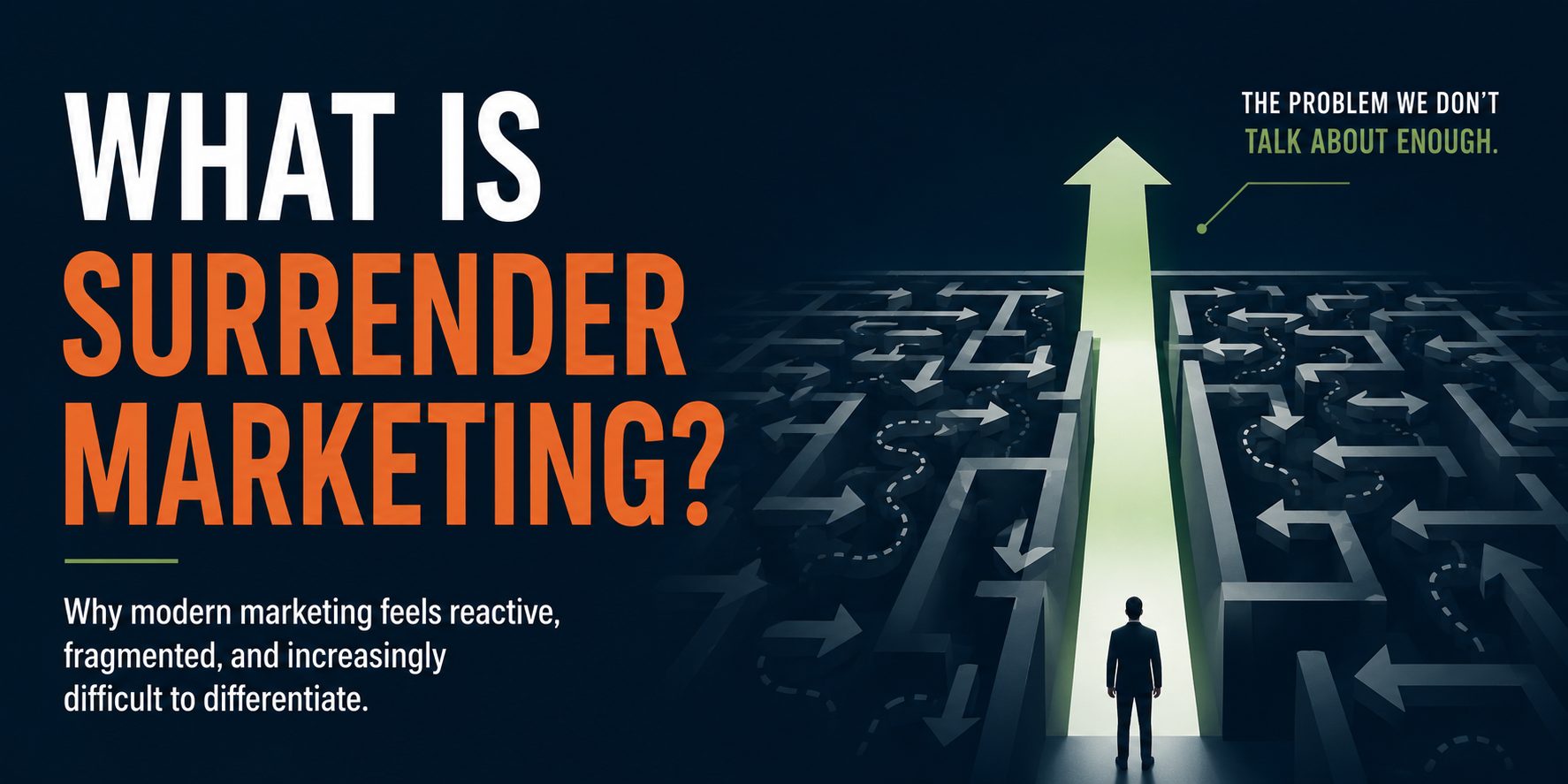
What Is Surrender Marketing?
Why Modern Marketing Feels Increasingly Reactive, Fragmented, and Difficult to Differentiate
Organizations today invest more in marketing technology, AI tools, automation, SEO, paid media, analytics, content production, and downstream execution than at any point in history.
Yet many leadership teams feel less strategically differentiated than ever.
Despite increasing marketing activity, organizations often struggle with rising acquisition costs, weaker differentiation, fragmented messaging, tactical overload, declining pricing power, reactive decision-making, AI-generated sameness, and increasing dependence on platforms and algorithms.
The issue is not necessarily a lack of marketing effort.
In many cases, the issue is that organizations have gradually surrendered strategic control to downstream marketing systems.
This is the rise of surrender marketing.
What Is Surrender Marketing?
Surrender marketing occurs when organizations become overly dependent on downstream execution while underinvesting in the upstream strategic decisions that create long-term differentiation and sustainable growth.
Rather than proactively shaping markets, organizations begin reacting continuously to algorithms, competitors, quarterly performance pressure, media platforms, tactical trends, channel demands, and short-term metrics.
Over time, marketing becomes increasingly reactive rather than strategic.
Organizations slowly surrender strategic clarity, differentiated positioning, pricing power, customer understanding, brand distinctiveness, category leadership, and long-term competitive advantage.
The result is often a cycle of tactical escalation without meaningful strategic separation.
The Rise of Surrender Marketing
Several forces are accelerating surrender marketing simultaneously.
Platform Dependency
Many organizations increasingly depend on Google, LinkedIn, Meta, Amazon, paid search ecosystems, and algorithm-driven discovery.
Over time, this changes how marketing decisions get made.
Organizations begin optimizing primarily for platform visibility instead of strategic differentiation. The focus shifts toward engagement metrics, content velocity, SEO production, media optimization, campaign efficiency, and short-term conversion, while larger strategic questions receive less attention.
Organizations have mistaken marketing acceleration for strategic progress.
AI and the Commoditization of Marketing
Artificial intelligence is dramatically accelerating marketing execution.
Organizations can now generate blogs, ad copy, emails, SEO content, landing pages, campaign variations, and social media content at unprecedented speed.
But AI also increases the risk of strategic sameness.
As execution becomes easier, differentiation becomes harder.
Without strong strategic clarity, organizations risk producing larger volumes of increasingly interchangeable marketing.
The danger is not AI itself. The danger is accelerating execution without strengthening strategy.
As execution becomes easier, differentiation becomes harder.
Tactical Acceleration Without Strategic Alignment
Many organizations have become increasingly sophisticated operationally while becoming less differentiated strategically.
Teams become increasingly focused on channels, workflows, campaign optimization, reporting dashboards, performance metrics, and automation systems while foundational strategic questions remain unresolved:
- What differentiated value do we create?
- Why should customers prefer us?
- Where should we compete?
- How should we position ourselves?
- What long-term advantage are we building?
Execution expands while strategic clarity weakens.
The Symptoms of Surrender Marketing
Most organizations experiencing surrender marketing do not recognize it immediately. Instead, they experience a series of recurring symptoms.
Endless Content Without Distinctiveness
Organizations publish constantly while sounding increasingly similar to competitors.
Content volume rises. Differentiation declines.
This is becoming especially common in industries flooded with AI-generated marketing. Many B2B categories now contain nearly identical messaging, interchangeable positioning, repetitive SEO content, and generic AI-enhanced thought leadership.
The result is increasing semantic sameness.
Fragmented Messaging
Different business units, agencies, sales teams, and marketing channels communicate inconsistent value narratives.
Customers receive fragmented signals instead of coherent positioning.
The organization becomes operationally active but strategically unclear.
Organizations experiencing this problem often need stronger Brand Positioning Strategy, Brand Architecture Consulting, and Value Proposition Development.
Weak Pricing Power
When organizations fail to communicate differentiated value, competition often shifts toward price, promotions, convenience, and tactical visibility rather than strategic preference.
This is frequently a symptom of weak positioning, customer value proposition clarity, brand differentiation, and market definition.
Reactive Decision-Making
Organizations trapped in surrender marketing often become highly reactive.
Competitor launches trigger messaging shifts. Platform changes trigger tactical pivots. Performance fluctuations trigger strategic overcorrections.
The organization continuously responds to external pressure rather than executing against a clear strategic direction.
Increasing Customer Acquisition Pressure
Without meaningful differentiation, organizations often become increasingly dependent on paid media, promotional activity, performance optimization, and continual campaign escalation.
Over time, customer acquisition becomes more expensive while long-term strategic advantage weakens.
The Difference Between Marketing Activity and Strategic Advantage
One of the most important distinctions in modern marketing is the difference between marketing activity and strategic advantage.
Many organizations are highly active. Far fewer are strategically differentiated.
Organizations often confuse visibility with preference, traffic with positioning, engagement with strategic relevance, and content production with market leadership.
Execution matters. But execution amplifies whatever strategy already exists.
When strategy lacks clarity, downstream marketing often amplifies confusion instead of differentiation.
Why More Optimization Is Often Not the Answer
Organizations trapped in surrender marketing often respond by increasing tactical optimization: more campaigns, more content, more automation, more analytics, more SEO production, and more media spending.
But optimization alone rarely solves strategic ambiguity.
In many cases, tactical acceleration actually increases fragmentation.
The organization becomes more efficient at communicating an unclear market position.
The Strategic Cost of Surrender Marketing
Surrender marketing creates long-term strategic consequences, including weaker brand equity, declining pricing power, increased acquisition costs, commoditization pressure, fragmented customer experiences, internal misalignment, reactive innovation, and slower long-term growth.
Perhaps most importantly, organizations lose the ability to proactively shape markets.
Instead, they continuously react to them.
Why This Matters More in the AI Era
The rise of AI makes upstream strategic clarity more important, not less.
AI dramatically improves execution efficiency.
But AI does not automatically create differentiation, strategic identity, customer insight, positioning clarity, brand meaning, or sustainable competitive advantage.
Organizations without strategic clarity may become increasingly interchangeable as AI-generated marketing proliferates.
Organizations with strong strategic definition will be better positioned to create preference, strengthen differentiation, align innovation, shape customer perception, and sustain long-term advantage.
The Alternative to Surrender Marketing
Escaping surrender marketing does not require abandoning downstream execution.
Organizations still need digital marketing, SEO, media, automation, analytics, content strategy, and campaign execution.
The issue is not downstream marketing itself.
The issue is strategic sequencing.
Organizations create stronger long-term growth when downstream execution is guided by upstream strategic clarity.
This includes clearly defining where to compete, which customers matter most, how to differentiate, what value the organization uniquely creates, how innovation supports positioning, and how the brand should be structured and communicated.
Organizations that strengthen Customer Insights & Analytics, Marketing Strategy Consulting, Growth Strategy Consulting, Value Proposition Consulting, and Brand Architecture Consulting are often better positioned to create sustainable growth.
Why Upstream Marketing Matters More Than Ever
As organizations face increasing tactical complexity, AI acceleration, and platform dependency, upstream marketing becomes increasingly important.
Upstream marketing focuses on the strategic decisions that shape market success before downstream execution begins.
Rather than reacting continuously to tactical pressure, upstream marketing helps organizations strengthen customer insight, positioning clarity, strategic identity, differentiated value, innovation alignment, and long-term market direction.
At EquiBrand Consulting, we apply the principles of upstream marketing to help organizations strengthen strategic clarity before major downstream investment occurs.
In an era increasingly dominated by tactical acceleration, organizations that strengthen upstream strategy will be better positioned to create sustainable competitive advantage.
That is why upstream marketing is increasingly becoming the antidote to surrender marketing.
Continue Reading
The Definitive Guide to Upstream Marketing
About the Author
Tim Koelzer is Founder & Managing Partner of EquiBrand Consulting and author of Upstream Marketing. His work focuses on marketing strategy, brand architecture, customer value proposition development, growth strategy, and the upstream strategic decisions that shape long-term competitive advantage.








Follow EquiBrand