
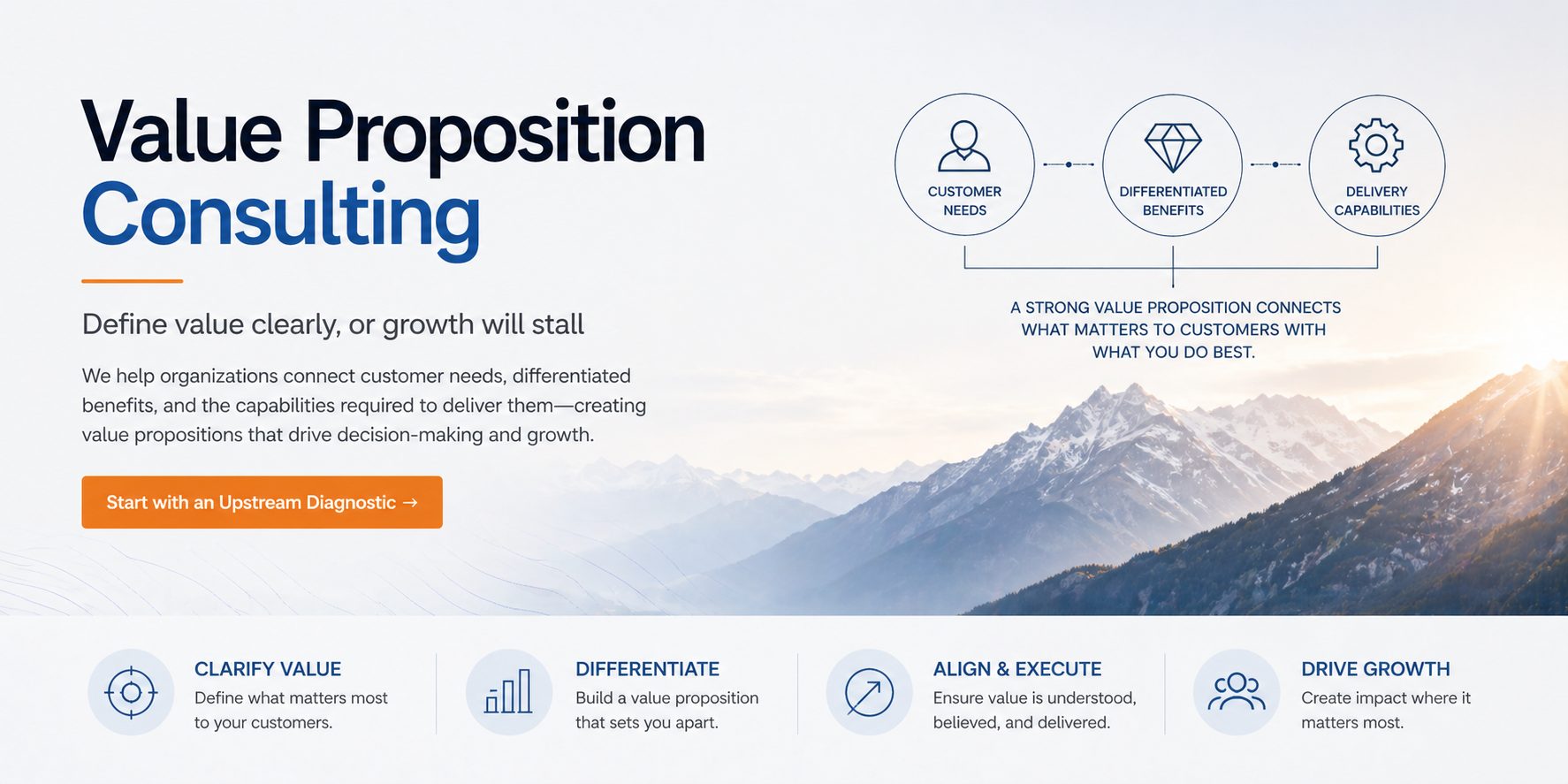
Value Proposition Consulting
Define Why Customers Choose You — and Make It Stick
Most companies have a version of their value proposition written down somewhere. A slide. A one-pager. A line on the website. But ask five people in leadership what it actually is, and you’ll get five different answers.
That’s not a communication problem. It’s a strategy problem.
When the value proposition is unclear or unconvincing, everything downstream gets harder. Sales conversations drift to price. Marketing messages feel generic. New products launch without traction. Competitors who are no better at delivering value start winning deals because they’re clearer about what they offer.
The companies that break out of this pattern don’t do it by refining their tagline. They do it by going upstream — defining, at the strategic level, why customers should choose them, why it matters, and why a competitor can’t simply copy it.
That’s the work EquiBrand does.
[Start with an Upstream Diagnostic | equibrandconsulting.com/upstream-diagnostic/]
What Is Value Proposition Consulting?
Value proposition consulting helps companies answer the single most important question in marketing: why should a customer choose you over every alternative available to them?
It’s a harder question than it sounds. Most organizations conflate it with messaging — they think the answer is a better headline or a sharper elevator pitch. But messaging communicates a value proposition. It doesn’t create one.
A true value proposition is not a statement. It is a structured set of benefit planks — typically four to six — that together describe the full scope of value a brand delivers to its target customers. Each plank is a specific, meaningful statement of customer benefit. The combination of all planks constitutes the complete value proposition.
This distinction matters because a single statement cannot capture the multidimensional nature of why customers actually choose one brand over another. Real purchase decisions are driven by a combination of benefits — functional, emotional, risk-reducing, credibility-building — that work together to create total perceived value. A one-sentence value proposition either oversimplifies that reality or compresses it into language so broad it becomes meaningless.
A true value proposition is built at the strategic level. It defines:
- What customers need and what they value most
- Which of those needs your brand is distinctively positioned to address through a differentiated set of benefit planks
- Why customers should believe you can deliver — and why competitors can’t easily replicate it
When those three elements are aligned, the value proposition becomes a strategic asset — something that guides product development, focuses sales conversations, anchors marketing investment, and gives leadership a shared definition of what the company stands for.
When they aren’t aligned, you get the most common failure mode in brand strategy: a company that is genuinely strong operationally but can’t articulate why customers should choose it, and slowly loses ground to competitors who can. This is what we call Surrender Marketing — ceding competitive ground not through failure but through strategic ambiguity. [Surrender Marketing | equibrandconsulting.com/surrender-marketing/]
A value proposition is also distinct from brand positioning, though the two are closely connected. The value proposition defines the benefit planks customers receive. Positioning defines how the brand is understood relative to competitive alternatives. One is the foundation; the other is the expression. Developing positioning before value proposition work is one of the most common mistakes in brand strategy. [Value Proposition and Brand Positioning | equibrandconsulting.com/value-proposition-positioning/]
[Explore the Value Proposition Framework | equibrandconsulting.com/value-proposition-framework/]
When Companies Need Value Proposition Consulting
The trigger is rarely a single event. It’s usually an accumulation of symptoms that point to the same underlying problem.
You may need value proposition consulting if:
- Sales conversations consistently drift toward price, even when your product or service is demonstrably stronger
- Marketing messages feel interchangeable with what competitors say
- New offerings fail to gain traction despite strong internal confidence
- Different leaders describe what you do and why it matters in different ways
- Customers choose you, but can’t clearly explain why — which means your sales team can’t replicate it
- Growth has slowed despite no obvious deterioration in product quality or service delivery
- You’re entering a new market, segment, or category and need to establish clear reasons to choose you
In each of these situations, improving execution alone won’t solve the problem. The constraint is strategic clarity — specifically, a clear definition of the value you create, for whom, and why it’s genuinely different from what competitors offer. Not sure whether value proposition consulting is the right starting point? [How to Choose a Value Proposition Consulting Firm | equibrandconsulting.com/how-to-choose-a-value-proposition-consulting-firm/]
The EquiBrand Approach: A Five-Phase Methodology
Most value proposition work is qualitative — a workshop, a framework exercise, a facilitated session that produces a set of benefit statements. That work has value. But it leaves the most important decisions — which benefit planks to lead with, how many to invest in, which combination maximizes reach — as intuition calls rather than data-driven conclusions.
EquiBrand’s approach moves through five phases, from internal situation assessment through organizational alignment, combining qualitative rigor with quantitative validation.
Phase 1 — Situation Assessment Structured internal interviews with leadership and key stakeholders to establish the strategic starting point — what the current value proposition is believed to be, where internal misalignment exists, and what the development work needs to accomplish.
Phase 2 — Qualitative Customer Discovery In-depth customer research to map the full universe of customer needs and benefit areas from the customer’s perspective — surfacing needs and language that internal teams rarely identify on their own.
Phase 3 — Iterative Proposition Development Benefit concepts are developed, tested qualitatively, refined in real time, and tested again. This iterative loop continues until each benefit plank is clearly articulated and the overall proposition holds together in customer conversations.
Phase 4 — Quantitative Validation: RDC Scoring and TURF Analysis Each benefit plank is scored quantitatively on Relevance, Differentiation, and Credibility. TURF analysis then identifies which combination of planks reaches the broadest possible customer audience — making benefit prioritization data-driven rather than intuitive. [How to Quantify a Value Proposition | equibrandconsulting.com/value-proposition-research/]
Phase 5 — Organizational Alignment Structured workshops map each benefit plank against current organizational capabilities, identify delivery gaps, and define the operational priorities required to close them. The value proposition leaves the process as an organizational commitment, not a document.
The Value Proposition Framework: Three Columns, One Strategic Foundation
The output of our process is a structured value proposition built around three interconnected elements — organized into a single template where each row is a benefit plank and the columns move from customer need to delivered benefit to operational proof.
Customer Needs The specific outcomes, goals, and concerns that drive customer decisions in your category. Not a generic description of your audience — a precise definition of what they are trying to accomplish, avoid, improve, or achieve.
Benefit Planks The differentiated benefits your brand delivers against those needs. A strong value proposition is built around four to six benefit planks — specific, meaningful reasons to choose you that together form a complete picture of the value you create.
Not all planks play the same role. Ante benefits are table stakes every credible competitor must deliver. Driver benefits are where being stronger than competitors creates measurable preference. Reassurance benefits reduce risk and close the gap between interest and commitment. Understanding which planks play which role is essential to how the value proposition is communicated and prioritized. See how leading companies structure their benefit planks in practice. [Value Proposition Examples | equibrandconsulting.com/value-proposition-examples/]
Value Elements The specific capabilities, assets, products, services, and experiences that enable each benefit plank. These are the proof points — the reasons a customer should believe you can deliver what you promise. Without credible value elements, a benefit plank is an aspiration, not a proposition.
[Explore the Full Value Proposition Framework | equibrandconsulting.com/value-proposition-framework/]
What Makes EquiBrand’s Approach Different
Most consulting firms approach value proposition work qualitatively. They facilitate workshops, apply established frameworks, and help leadership teams articulate what they believe they stand for. The output reflects the organization’s existing beliefs — shaped and clarified, but not validated against actual customer preference.
Two widely used frameworks illustrate the gap. The Value Proposition Canvas (Osterwalder) is entirely qualitative and has no competitive dimension — it maps what you offer against what customers want but doesn’t address why customers should choose you over alternatives. The HBR resonating focus framework (Anderson, Narus, van Rossum) correctly identifies that organizations should lead with the few benefits that matter most, but provides no quantitative method for determining which ones those are. [Beyond the Value Proposition Canvas | equibrandconsulting.com/value-proposition-canvas/] [Customer Value Propositions in Business Markets | equibrandconsulting.com/customer-value-propositions-in-business-markets/]
EquiBrand brings three specific capabilities that change the quality of the output:
Quantitative validation. RDC scoring and TURF analysis replace intuition with data on which benefit planks drive preference and which combinations maximize reach. The value proposition that emerges isn’t just strategically coherent — it’s empirically grounded.
Competitive grounding. Differentiation is one of the three explicit dimensions in RDC scoring. Every benefit plank is evaluated against what competitors offer, not just against what customers want. A benefit that matters but is matched by every competitor is identified as a table stakes plank — not a differentiator — before it anchors the proposition.
Organizational delivery. Phase 5 gap assessment ensures the organization can actually deliver the benefit planks it commits to. Most firms hand over a value proposition and walk away. EquiBrand’s process ends with alignment workshops that turn the proposition into an operational commitment.
We also bring the perspective of the Upstream Marketing framework — the principle that the most important marketing decisions are made before the product is built and before the campaign is launched. A value proposition developed upstream, grounded in genuine customer insight and competitive analysis, creates a foundation that downstream execution can actually leverage. [Upstream Marketing | equibrandconsulting.com/upstream-marketing/]
What Organizations Achieve
The outcomes of strong value proposition work show up across the business:
- Improved win rates and conversion — customers who understand your value choose you more often
- Stronger pricing power — a compelling, differentiated value proposition reduces price sensitivity
- More effective sales conversations — sales teams equipped with a clear, credible value story close more efficiently
- Sharper marketing investment — when you know which benefit planks drive preference, you know where to focus messaging and spend
- Faster new product traction — innovation grounded in a defined value proposition reaches the right customers with the right message from launch
- Greater organizational alignment — a shared plank structure aligns product, marketing, sales, and leadership around the same strategic foundation
- Stronger delivery on the brand promise — Phase 5 gap assessment ensures the organization can execute the benefit planks it commits to
Frequently Asked Questions
What is value proposition consulting? Value proposition consulting helps organizations define why customers choose them — and why they should continue to. The work involves qualitative customer research, competitive analysis, iterative benefit development, and quantitative validation to identify which benefit planks drive preference and how they combine to maximize customer reach.
What is a value proposition plank? A benefit plank is a single component of a complete value proposition — a specific, meaningful statement of the outcome a brand delivers against a particular customer need. A complete value proposition is built from four to six benefit planks that together describe the full scope of customer value. This is meaningfully different from the common definition of a value proposition as a single statement, which EquiBrand considers too narrow to be strategically useful.
How is a value proposition different from positioning? A value proposition defines the benefit planks customers receive from choosing you. Positioning defines how your brand is understood relative to the competitive alternatives available to customers. They are related but distinct — a strong value proposition is the foundation that positioning communicates. Developing them in the wrong order is one of the most common mistakes in brand strategy. [Value Proposition and Brand Positioning | equibrandconsulting.com/value-proposition-positioning/]
What is the Value Proposition Canvas and how does EquiBrand’s approach differ? The Value Proposition Canvas, developed by Alexander Osterwalder, is a widely used framework for qualitative thinking about customer value. EquiBrand’s approach differs in three important ways: it incorporates competitive context explicitly, it adds quantitative validation through RDC scoring and TURF analysis, and it operates at multiple organizational levels rather than at the level of a single product offering. [Beyond the Value Proposition Canvas | equibrandconsulting.com/value-proposition-canvas/]
What about the HBR framework on B2B value propositions? Anderson, Narus, and van Rossum’s 2006 HBR article “Customer Value Propositions in Business Markets” is one of the most cited pieces on the subject. EquiBrand’s approach builds on its core insight — that resonating focus outperforms all-benefits approaches — and adds the quantitative methodology the HBR framework advocates for but doesn’t provide. [Customer Value Propositions in Business Markets | equibrandconsulting.com/customer-value-propositions-in-business-markets/]
How long does a value proposition consulting engagement take? Most engagements run eight to sixteen weeks, depending on the scope of research required, the complexity of the organization’s portfolio, and the degree of stakeholder alignment work involved.
How do I choose a value proposition consulting firm? The most important question to ask is how they validate the value proposition they develop. If the answer is a workshop and a framework exercise, the output will reflect the organization’s existing beliefs more than actual customer preference. [How to Choose a Value Proposition Consulting Firm | equibrandconsulting.com/how-to-choose-a-value-proposition-consulting-firm/]
What are strong value proposition examples? Strong value propositions share three qualities: they address something customers genuinely care about, they differentiate the brand from available alternatives, and they are credible based on what the organization can demonstrably deliver.
- [Starbucks Value Proposition Example | equibrandconsulting.com/starbucks-value-proposition-example/]
- [Amazon Value Proposition Example | equibrandconsulting.com/amazon-value-proposition-example/]
- [Southwest Airlines Value Proposition Example | equibrandconsulting.com/southwest-airlines-value-proposition/]
[Browse Value Proposition Examples | equibrandconsulting.com/value-proposition-examples/]
Related Resources
Value Proposition Guides and Frameworks
- [Value Proposition Framework | equibrandconsulting.com/value-proposition-framework/]
- [How to Quantify a Value Proposition: RDC Scoring and TURF Analysis | equibrandconsulting.com/value-proposition-research/]
- [Value Proposition and Brand Positioning | equibrandconsulting.com/value-proposition-positioning/]
- [Beyond the Value Proposition Canvas | equibrandconsulting.com/value-proposition-canvas/]
- [Customer Value Propositions in Business Markets: Beyond the HBR Framework | equibrandconsulting.com/customer-value-propositions-in-business-markets/]
- [How to Choose a Value Proposition Consulting Firm | equibrandconsulting.com/how-to-choose-a-value-proposition-consulting-firm/]
- [Value Proposition Examples | equibrandconsulting.com/value-proposition-examples/]
Strategic Context
- [Surrender Marketing | equibrandconsulting.com/surrender-marketing/]
- [Upstream Marketing | equibrandconsulting.com/upstream-marketing/]
Related Services
Value proposition work rarely stands alone. It connects upstream to the customer insights and segmentation that define who you are serving, and downstream to the brand positioning, architecture, and messaging that communicate your value to the market.
- Customer Insights & Analytics — The research foundation that uncovers what customers need, how they decide, and where unmet opportunity exists. Strong value proposition work begins here. [Customer Insights | URL TBD]
- Segmentation — Defining which customer segments to serve and prioritize. A value proposition is only as strong as its understanding of who it is written for. [Segmentation | URL TBD]
- Brand Positioning — Translating your value proposition into a competitive position that defines how customers understand your brand relative to alternatives. [Brand Positioning | URL TBD]
- Brand Architecture — When organizations have multiple brands, business units, or products, value propositions must be structured to work together without overlap or contradiction. [Brand Architecture | equibrandconsulting.com/brand-architecture/]
- Growth Strategy & Innovation — A clearly defined value proposition defines the strategic boundaries for where and how an organization should grow. [Growth Strategy & Innovation | URL TBD]
- Messaging Strategy — The downstream expression of the value proposition — translating benefit planks into the language, stories, and content that reach customers across every channel. [Messaging Strategy | URL TBD]
Clarify Your Value Proposition
Most organizations underestimate how unclear their value proposition really is — not to their leadership team, but to the customers they’re trying to reach and the sales teams trying to convert them.
EquiBrand’s Upstream Diagnostic evaluates your current value proposition against your competitive landscape, identifies where clarity and differentiation are weakest, and defines a focused path forward.
The Upstream Diagnostic includes:
- Assessment of your current value proposition — plank by plank — against RDC criteria
- Competitive audit of how alternatives are positioned in the market
- Identification of the highest-impact opportunities for differentiation
- A prioritized roadmap for value proposition development
[Request an Upstream Diagnostic | equibrandconsulting.com/upstream-diagnostic/]
Typically completed in 4–6 weeks.





Follow EquiBrand